

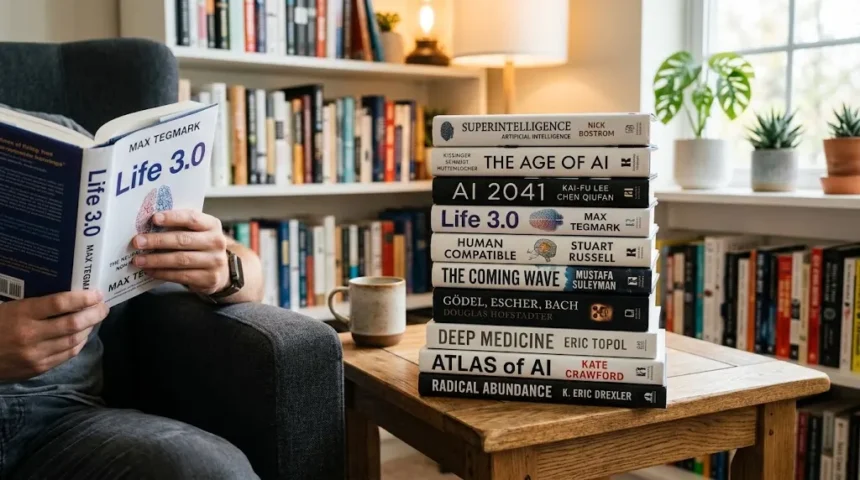
Artificial intelligence is changing how people work, communicate, create content, build businesses, analyze information, and solve complex problems. Whether you are a student, entrepreneur, developer, marketer, researcher, or simply curious about the future, reading the best books on artificial intelligence can help you understand what is happening beyond the headlines and popular AI tools.
The right AI books explain everything from machine learning and neural networks to automation, artificial general intelligence, AI ethics, business transformation, and human-machine collaboration. Some focus heavily on technical concepts, while others explore the economic, social, and philosophical consequences of increasingly intelligent systems. Choosing books that match your current knowledge level makes the learning process much easier.
This guide covers 10 of the best books on artificial intelligence to read for anyone who wants a deeper understanding of AI technology and its impact. The selection includes beginner-friendly explanations, technical textbooks, business-focused books, and thought-provoking works about AI safety and the future. Together, they provide a balanced foundation for understanding this rapidly developing field.
Why Reading Books About Artificial Intelligence Is Worth Your Time
Artificial intelligence develops quickly, but books provide something short online explanations often cannot: context. A well-written AI book connects machine learning concepts, history, business applications, ethical challenges, and future possibilities into a coherent picture. Instead of learning isolated definitions, readers begin understanding why particular technologies matter and how different areas of artificial intelligence relate to one another.
Books also encourage deeper thinking than short videos, social media posts, or tool tutorials. They allow experienced researchers, technology leaders, economists, and AI practitioners to explain complicated ideas in detail without reducing everything to simplified predictions. This makes reading particularly valuable for people who want to understand how artificial intelligence works rather than simply learn how to use individual AI platforms.
Building AI knowledge through books can also improve professional decision-making. Developers can strengthen their technical foundations, business owners can identify practical automation opportunities, and marketers can better understand generative AI capabilities and limitations. Even nontechnical readers benefit because artificial intelligence increasingly influences employment, education, healthcare, finance, software, communication, and everyday digital experiences.
How We Chose the Best Books on Artificial Intelligence
The best AI books should offer more than exciting predictions about robots or future technology. Strong selections explain meaningful concepts while giving readers useful frameworks for understanding machine intelligence, algorithms, data, automation, decision-making, and human-AI relationships. The books included here cover different levels of expertise so both complete beginners and experienced technology professionals can find something valuable.
Another important consideration is perspective. Artificial intelligence cannot be understood only through computer science because its development affects economics, psychology, management, security, ethics, education, and public policy. This list therefore includes books written by researchers, professors, entrepreneurs, economists, and technology thinkers who approach AI from different angles while still helping readers understand its practical importance.
Accessibility was considered alongside depth. Some readers want mathematical explanations of intelligent agents and machine learning, while others want understandable discussions of AI risks, business opportunities, or generative AI tools. Rather than recommending ten nearly identical books, this guide highlights complementary titles that can collectively provide a broader and more useful artificial intelligence education.
1. Artificial Intelligence: A Modern Approach by Stuart Russell and Peter Norvig
Artificial Intelligence: A Modern Approach is widely recognized as one of the most comprehensive books for studying artificial intelligence from a computer science perspective. It explores intelligent agents, search algorithms, reasoning, machine learning, natural language processing, robotics, perception, planning, and other foundational AI concepts. Readers who want academic depth will find significantly more detail here than in most general-interest AI books.
The book is particularly useful for computer science students, developers, researchers, and professionals who want to understand the mechanisms behind intelligent systems. Because many topics involve algorithms, mathematical reasoning, and technical terminology, complete beginners may initially find certain chapters challenging. However, readers willing to study gradually can use it as a long-term reference rather than attempting to absorb everything immediately.
One major advantage is its broad coverage of artificial intelligence rather than focusing only on whichever AI trend is currently receiving attention. Readers gain a framework for understanding how modern machine learning fits into the larger history and discipline of AI. If your goal is serious technical knowledge rather than surface-level familiarity, this is one of the strongest foundational artificial intelligence books available.
2. Life 3.0 by Max Tegmark
Life 3.0: Being Human in the Age of Artificial Intelligence explores how increasingly capable AI systems could affect civilization, employment, politics, economics, warfare, and human identity. Max Tegmark approaches artificial intelligence through both scientific and philosophical questions, making complex future scenarios understandable to readers without requiring programming knowledge. It is particularly engaging for people interested in where AI could eventually lead.
Rather than concentrating on how to build machine learning models, the book asks what humans should want from increasingly intelligent technology. It considers different possible futures involving advanced artificial intelligence and examines how decisions made today could influence long-term outcomes. This makes the book useful for readers interested in AI governance, safety, societal change, and the relationship between technological progress and human values.
The writing encourages readers to think beyond immediate applications such as chatbots, recommendation systems, or productivity automation. It raises larger questions about intelligence, consciousness, economic power, and humanity’s role in a world containing advanced machines. For anyone searching for an accessible AI book that combines science, philosophy, and future thinking, Life 3.0 remains a valuable choice.
3. Human Compatible by Stuart Russell
Human Compatible: Artificial Intelligence and the Problem of Control examines one of the most important questions in modern artificial intelligence: how can increasingly capable AI systems remain aligned with human interests? Stuart Russell explains why building machines that rigidly optimize specified objectives can create unexpected problems. His discussion makes AI alignment understandable without requiring readers to become machine learning engineers.
A central theme is that intelligent systems should account for uncertainty about what humans actually want instead of assuming that programmers can perfectly specify every objective beforehand. This perspective helps readers understand why AI safety involves more than preventing malicious software. Even systems following instructions accurately can create undesirable outcomes when objectives, incentives, context, or human preferences are misunderstood.
The book is especially valuable for readers interested in responsible AI development, artificial general intelligence, governance, and technology ethics. Russell combines technical expertise with accessible explanations, allowing a broad audience to explore difficult questions surrounding control and machine intelligence. Readers who enjoyed the technical authority behind Artificial Intelligence: A Modern Approach but want a more philosophical discussion may particularly appreciate this book.
4. The Alignment Problem by Brian Christian
The Alignment Problem: Machine Learning and Human Values examines what happens when artificial intelligence systems learn from human-generated data, decisions, preferences, and behavior. Brian Christian explains how machine learning models can reproduce biases, misunderstand objectives, or optimize measurements that imperfectly represent what people actually value. The book connects technical AI development with psychology, philosophy, ethics, and social consequences.
One of the book’s strengths is its ability to make complicated machine learning ideas understandable through stories about researchers and important developments within the field. Readers learn about reinforcement learning, reward systems, fairness, interpretability, and value alignment without being overwhelmed by technical equations. These concepts help explain why responsible AI requires careful consideration of both technological design and human behavior.
This book works particularly well for readers interested in AI ethics without wanting a purely philosophical discussion. It shows that problems involving fairness, objectives, and human values often emerge directly from how algorithms are trained and evaluated. For professionals working with AI-driven decisions, data science, automated systems, or generative models, these lessons can strengthen both technical awareness and ethical judgment.
5. AI 2041 by Kai-Fu Lee and Chen Qiufan
AI 2041: Ten Visions for Our Future combines fictional stories with analytical explanations to explore how artificial intelligence could influence everyday life over the coming decades. Kai-Fu Lee provides technological analysis, while science-fiction writer Chen Qiufan imagines realistic scenarios involving education, healthcare, transportation, employment, virtual experiences, and automated decision-making. The combination makes complicated AI trends engaging and easier to visualize.
Each scenario demonstrates how technologies such as deep learning, autonomous systems, natural language processing, computer vision, robotics, and digital environments might evolve. The accompanying explanations separate plausible technological progress from unrealistic science-fiction assumptions. Readers therefore receive both imaginative storytelling and practical context about the capabilities, limitations, opportunities, and potential consequences associated with future artificial intelligence.
The book is particularly suitable for readers who find traditional technology textbooks too dry or technical. Entrepreneurs, students, marketers, business leaders, and general readers can explore future AI applications without needing programming experience. By showing what artificial intelligence might look like in ordinary human situations, AI 2041 helps readers connect abstract technological developments with possible real-world changes.
6. Prediction Machines by Ajay Agrawal, Joshua Gans, and Avi Goldfarb
Prediction Machines: The Simple Economics of Artificial Intelligence approaches AI from a business and economic perspective rather than focusing primarily on coding. Its central idea is that many forms of artificial intelligence significantly reduce the cost of making predictions. This framework gives executives and entrepreneurs a practical way to evaluate how AI could change business processes, decisions, products, and competitive strategies.
The authors explain that prediction is only one component of decision-making. Organizations must also consider judgment, data, actions, outcomes, and the value associated with correct or incorrect decisions. This distinction helps businesses avoid treating artificial intelligence as a magical replacement for human thinking and instead identify specific processes where machine prediction can produce measurable operational or strategic benefits.
This is one of the more useful artificial intelligence books for business owners, managers, consultants, and professionals who want a structured approach to AI adoption. Readers do not need advanced technical expertise because the discussion focuses on economic reasoning and organizational decisions. It can help leaders move beyond vague statements about becoming “AI-powered” and identify where artificial intelligence actually creates value.
7. Competing in the Age of AI by Marco Iansiti and Karim R. Lakhani
Competing in the Age of AI examines how artificial intelligence, data, software, and digital operating models are reshaping modern organizations. The authors explore why companies built around scalable digital systems can operate differently from traditional businesses. Instead of treating AI as a separate tool, the book considers how algorithms can become embedded throughout operations, customer experiences, decision-making, and organizational strategy.
A major lesson is that successful AI transformation requires more than buying new software. Companies often need better data infrastructure, redesigned workflows, digital platforms, and management practices that allow automated systems to operate effectively. This makes the book particularly relevant for executives trying to understand why some organizations achieve substantial value from artificial intelligence while others struggle despite investing heavily.
Business strategists, founders, managers, and transformation leaders will find the organizational perspective especially useful. The book helps readers think about AI at company scale rather than limiting their attention to individual productivity tools. For anyone exploring digital transformation, platform strategy, automation, or AI-driven competitive advantage, it provides a practical framework for understanding how technology can reshape entire operating models.
8. Co-Intelligence by Ethan Mollick
Co-Intelligence: Living and Working with AI focuses on how people can collaborate effectively with generative artificial intelligence in work, education, and creative tasks. Ethan Mollick approaches AI as a technology people should actively experiment with rather than merely observe from a distance. The book is especially relevant for readers trying to understand how modern generative AI changes everyday professional workflows.
Instead of discussing only distant artificial general intelligence, Mollick examines practical questions surrounding current AI systems. Readers are encouraged to explore where AI can support brainstorming, writing, analysis, learning, experimentation, and problem-solving while remaining aware of hallucinations and other limitations. This balanced approach makes the book useful for professionals who want productivity benefits without assuming AI outputs are automatically reliable.
Teachers, marketers, entrepreneurs, writers, managers, consultants, and knowledge workers can find immediate applications in the ideas discussed. The broader lesson is that artificial intelligence may be most useful when humans learn how to work alongside it intelligently. For readers interested primarily in generative AI and human-AI collaboration, Co-Intelligence is one of the most approachable books on this list.
9. The Coming Wave by Mustafa Suleyman and Michael Bhaskar
The Coming Wave explores how rapidly advancing technologies, particularly artificial intelligence and synthetic biology, could create enormous opportunities while becoming increasingly difficult to control. Mustafa Suleyman draws on experience working within the technology industry to discuss how powerful innovations spread. The book examines both technological progress and the institutions responsible for managing its societal consequences.
One of its major themes is the challenge of containment. Technologies that provide strong economic, military, or competitive advantages are difficult to prevent from spreading, even when they introduce significant risks. The discussion therefore extends beyond artificial intelligence engineering into geopolitics, regulation, national security, corporate responsibility, and the ability of governments to respond to rapidly developing technologies.
Readers interested in AI policy, technological risk, governance, and global competition will find the book especially thought-provoking. It avoids presenting artificial intelligence solely as either an exciting opportunity or an inevitable disaster. Instead, it highlights the difficult balance between benefiting from innovation and establishing safeguards capable of reducing harmful consequences as increasingly powerful technologies become widely accessible.
10. You Look Like a Thing and I Love You by Janelle Shane
You Look Like a Thing and I Love You offers one of the most entertaining introductions to how artificial intelligence and machine learning actually behave. Janelle Shane uses humorous experiments and unusual AI-generated results to demonstrate how algorithms learn patterns, misunderstand instructions, and produce unexpected outputs. The approachable style makes technical ideas easier for readers with little previous AI knowledge.
Beneath the humor, the book teaches an important lesson: artificial intelligence does not necessarily understand tasks in the same way humans do. Machine learning systems can find shortcuts, exploit poorly designed objectives, and behave strangely when training data or instructions fail to represent the intended goal. These examples make abstract discussions about model limitations much easier to understand and remember.
The book is an excellent starting point for students, curious professionals, and readers intimidated by technical AI textbooks. It can help beginners develop realistic expectations before moving into deeper discussions of machine learning, generative AI, alignment, or AI safety. Anyone wanting an enjoyable introduction to artificial intelligence without sacrificing meaningful insights should consider adding it to their reading list.
Best Artificial Intelligence Books for Beginners
Beginners should generally start with books that explain concepts through examples rather than mathematical formulas. You Look Like a Thing and I Love You, AI 2041, and Co-Intelligence are particularly accessible because they connect AI concepts with recognizable situations. These books can build foundational understanding before readers move toward more technical discussions involving algorithms, probability, optimization, or machine learning architectures.
A beginner does not need to understand every technical term immediately. Learning concepts such as training data, models, prediction, neural networks, generative AI, reinforcement learning, and automation gradually provides enough foundation to understand more complicated material later. Reading broadly can also help newcomers discover whether they are most interested in programming, business applications, AI ethics, research, or future technology.
It is useful to combine books with practical learning resources rather than treating reading as the only way to understand artificial intelligence. Readers who want additional explanations, tutorials, or related learning material can also explore this AI resource: (add URL Here). Combining conceptual reading with hands-on experimentation makes unfamiliar terms easier to understand and helps transform theoretical knowledge into practical skills.
Best AI Books for Technical Readers and Developers
Technical readers should prioritize books that explain how intelligent systems actually make decisions and solve problems. Artificial Intelligence: A Modern Approach provides the deepest technical foundation among the recommendations in this guide. Developers can use it to explore search, planning, probabilistic reasoning, machine learning, natural language processing, robotics, and intelligent agents within a structured computer science framework.
Technical professionals may also benefit significantly from Human Compatible and The Alignment Problem. Although these books are accessible to general audiences, they explore issues directly connected to how AI objectives, reward functions, learning processes, and human preferences interact. Understanding these problems can help developers think beyond model performance metrics and consider the wider consequences of system design decisions.
Reading alone should still be combined with experimentation. Developers can strengthen their understanding by building small machine learning models, testing generative AI APIs, exploring open-source projects, or studying how different algorithms behave with changing data. Technical books become much more useful when readers connect theoretical ideas with actual programming, model evaluation, debugging, and artificial intelligence development workflows.
Best Artificial Intelligence Books for Business Leaders
Business leaders usually do not need to begin with mathematical descriptions of neural networks. Instead, they need frameworks for understanding where artificial intelligence creates economic value and how organizations must change to use it effectively. Prediction Machines provides a strong starting point because its prediction-cost framework helps managers identify practical opportunities for improving business decisions with AI.
Competing in the Age of AI expands this perspective from individual decisions to company-wide transformation. It helps executives understand the relationship between algorithms, data, digital platforms, workflows, operating models, and organizational scale. Leaders considering major AI initiatives can use these ideas to evaluate whether their existing processes and infrastructure are actually prepared to support technology-driven transformation.
Co-Intelligence is particularly valuable for understanding how generative AI affects individual employees and knowledge work. Together, these books cover strategic, organizational, and practical dimensions of AI adoption. Reading all three can help executives avoid both extremes: ignoring artificial intelligence entirely or investing aggressively without clearly understanding where the technology improves productivity, customer value, or competitive advantage.
Best Books About AI Ethics and the Future
Readers interested in artificial intelligence ethics should begin by understanding that ethical challenges are often connected to technical design decisions. The Alignment Problem demonstrates how training data, objectives, algorithms, and measurement systems can produce outcomes that conflict with human expectations. It provides valuable context for discussions involving bias, fairness, interpretability, automation, and responsible machine learning.
Human Compatible takes the discussion further by examining the challenge of controlling increasingly capable intelligent systems. Meanwhile, Life 3.0 explores much broader questions about civilization, employment, governance, and humanity’s long-term future. Reading these books together exposes readers to multiple levels of AI ethics, ranging from immediate algorithmic problems to potential consequences of highly advanced machine intelligence.
The Coming Wave adds another dimension by examining governance and technological containment. The book helps readers consider what happens when powerful AI capabilities become economically valuable and widely distributed. Anyone studying responsible AI, regulation, technological risk, public policy, or AI governance can benefit from comparing these different perspectives rather than relying on a single prediction about the future.
How to Choose the Right AI Book for Your Goals
Start by identifying why you want to learn about artificial intelligence. A programmer seeking technical foundations needs a different book from a marketing manager exploring generative AI or an executive evaluating automation opportunities. Clarifying your objective makes it easier to choose a book with the appropriate balance of technical detail, practical applications, strategic thinking, and broader discussion.
Your current knowledge level matters just as much as your goal. Starting with an advanced textbook before understanding basic AI terminology can make the subject unnecessarily intimidating. Beginners should first build conceptual familiarity through accessible books and practical experimentation, while readers with programming or mathematics experience can progress more quickly toward machine learning algorithms, intelligent agents, deep learning, and other technical areas.
You should also consider reading books with different viewpoints rather than searching for one definitive explanation of artificial intelligence. AI is simultaneously a computer science discipline, business technology, economic force, ethical challenge, and social phenomenon. Reading across these categories creates a more balanced perspective and reduces the risk of forming conclusions based on only technical enthusiasm or speculative fears.
How to Read AI Books Without Feeling Overwhelmed
Artificial intelligence contains terminology from computer science, mathematics, economics, philosophy, neuroscience, and several other disciplines, so encountering unfamiliar concepts is normal. Avoid stopping every few sentences to research every technical term. Instead, focus first on understanding the author’s main argument, highlighting repeated concepts, and identifying the ideas that appear essential to the chapter.
Taking short notes can improve retention substantially. After finishing a chapter, summarize its main argument in a few sentences and write down one or two concepts you want to investigate further. This simple habit forces active recall and helps distinguish important ideas from supporting details, making longer books about machine learning, AI safety, or digital transformation easier to remember.
Reading several books simultaneously is not necessary. Finishing one accessible book before moving to a more technical title often provides a smoother learning path. Readers can then revisit earlier concepts with greater understanding, especially because ideas such as prediction, optimization, training data, alignment, neural networks, and intelligent agents appear repeatedly across many artificial intelligence books.
How to Combine AI Books With Practical Learning
Reading provides the conceptual foundation, but practical experimentation shows how artificial intelligence behaves outside carefully written explanations. After learning about generative AI, try comparing prompts, analyzing model outputs, and identifying hallucinations or inconsistencies. After studying machine learning concepts, experimenting with simple datasets can demonstrate why training quality, features, evaluation methods, and objectives matter.
Business readers can apply the same approach without writing code. Identify repetitive tasks within your organization and evaluate whether AI can assist with research, customer support, documentation, forecasting, content production, or data analysis. Documenting where AI performs well and where human judgment remains necessary can make theoretical lessons from business-focused artificial intelligence books significantly more actionable.
Students and aspiring AI professionals should gradually connect reading with structured technical education. Programming fundamentals, Python, statistics, linear algebra, machine learning, and data analysis can provide the skills needed to understand more advanced materials. Books become far more valuable when readers can recognize the concepts inside real systems rather than treating artificial intelligence as purely theoretical knowledge.
Common Mistakes People Make When Learning About AI
One common mistake is assuming artificial intelligence is simply a collection of popular generative AI tools. Chatbots and image generators represent important applications, but the field also includes computer vision, reinforcement learning, robotics, recommendation systems, optimization, speech recognition, forecasting, and many other technologies. Understanding the broader field prevents readers from confusing temporary product trends with artificial intelligence itself.
Another mistake is treating every prediction about AI as certainty. Some authors emphasize transformational opportunities, while others focus heavily on catastrophic risks or technological limitations. Readers should compare arguments, examine assumptions, and recognize that future outcomes depend on technical progress, economics, policy, human behavior, and numerous unpredictable factors rather than following a predetermined path.
Finally, many beginners consume endless AI content without applying anything they learn. Reading ten books quickly is less valuable than deeply understanding several important concepts and testing them practically. A stronger approach combines focused reading, note-taking, experimentation, discussion, and gradual specialization into areas such as machine learning, generative AI, business automation, AI ethics, or artificial intelligence research.
Building a Complete Artificial Intelligence Reading List
A strong AI reading list should include technical foundations, practical applications, business strategy, ethics, and future implications. Reading only technical books can leave readers unaware of organizational and social consequences, while reading only futuristic books may produce opinions without understanding how the technology works. Combining different categories creates a more balanced and durable understanding of artificial intelligence.
Beginners might start with You Look Like a Thing and I Love You before progressing to AI 2041 and Co-Intelligence. Business professionals can then explore Prediction Machines and Competing in the Age of AI, while readers interested in responsible technology can continue with The Alignment Problem, Human Compatible, Life 3.0, and The Coming Wave.
Technical learners can eventually work through Artificial Intelligence: A Modern Approach alongside programming courses and machine learning projects. There is no requirement to read every recommendation in a fixed sequence, because your professional goals should determine the order. What matters is gradually moving from basic understanding toward deeper knowledge while maintaining exposure to multiple perspectives on intelligent technologies.
What You Can Learn From the Best Books on Artificial Intelligence
The biggest benefit of reading multiple AI books is discovering that artificial intelligence is not one technology with one predictable outcome. Different systems solve different problems, and their effectiveness depends on data, objectives, infrastructure, human decisions, and deployment environments. Understanding these distinctions makes conversations about AI more precise and helps readers evaluate new technologies more critically.
Good books also reveal how closely technical and human factors are connected. An algorithm may perform extremely well according to one measurement while still producing undesirable consequences when deployed in the real world. Learning about alignment, bias, incentives, prediction, decision-making, and organizational design helps readers understand why successful AI systems require more than powerful models.
Most importantly, reading builds the ability to ask better questions. Instead of simply asking whether AI will replace jobs or transform an industry, informed readers can examine which tasks are automatable, what data is required, where human judgment matters, and what new risks emerge. That deeper way of thinking remains useful even as individual AI products, models, and platforms continue changing.
Should You Read AI Books Even If You Are Not Technical?
You do not need programming experience to benefit from learning about artificial intelligence. AI increasingly influences workplace software, online search, advertising, education, recruitment, customer service, healthcare, entertainment, finance, and everyday productivity tools. Understanding basic principles can therefore help almost anyone make more informed decisions about technologies they already encounter regularly.
Many of the best books on artificial intelligence are specifically written for nontechnical audiences. Authors use business examples, stories, economic frameworks, and real-world scenarios instead of equations or programming exercises. Titles such as Co-Intelligence, Life 3.0, Prediction Machines, and AI 2041 allow readers to build meaningful AI knowledge without studying computer science beforehand.
Technical knowledge becomes more important only when your goals involve developing machine learning systems, conducting research, or working deeply with AI engineering. Everyone else can begin by understanding what AI can do, where it fails, how organizations use it, and which social questions it raises. That foundation is increasingly useful across both professional and personal life.
How AI Books Can Help Your Career
Artificial intelligence skills are becoming relevant across roles that previously required little direct interaction with machine learning. Marketing, sales, finance, operations, education, consulting, software development, product management, and customer experience teams increasingly use AI-assisted workflows. Reading can help professionals understand these tools strategically rather than simply following whatever new platform becomes popular.
Books can also help professionals communicate more effectively about artificial intelligence. Understanding terms such as models, training data, inference, prediction, automation, generative AI, reinforcement learning, and alignment makes conversations with technical teams easier. Managers who understand the basic principles can ask better questions when evaluating vendors, planning AI projects, or deciding which tasks should remain human-led.
However, reading should support rather than replace practical experience. Employers and clients generally benefit more from someone who can apply AI thoughtfully than from someone who simply knows terminology. Combining books with experimentation, projects, workflow improvements, technical learning, or measurable business applications can turn general artificial intelligence knowledge into genuinely valuable professional expertise.
Conclusion
The best books on artificial intelligence can help readers understand both the technology itself and the larger changes surrounding it. From technical foundations in Artificial Intelligence: A Modern Approach to human-AI collaboration in Co-Intelligence, each recommended title approaches AI from a different perspective. Reading across several categories creates a stronger foundation than concentrating on one narrow interpretation of artificial intelligence.
Beginners can start with accessible titles before gradually exploring more technical or philosophical material. Business leaders may find Prediction Machines and Competing in the Age of AI particularly useful, while readers interested in AI safety and ethics can explore Human Compatible, The Alignment Problem, Life 3.0, and The Coming Wave. Your ideal reading order ultimately depends on what you want to learn.
Artificial intelligence will continue evolving, but foundational understanding remains valuable even when individual tools change. The goal should not be to memorize every prediction or technical term but to develop a clear framework for evaluating intelligent systems. By combining thoughtful reading with practical experimentation, you can better understand AI’s capabilities, limitations, opportunities, and growing influence on everyday life.
What is the best artificial intelligence book for beginners?
You Look Like a Thing and I Love You is an excellent beginner-friendly choice because it explains AI concepts through simple, entertaining examples. AI 2041 and Co-Intelligence are also accessible options for nontechnical readers.
Which AI book is best for computer science students?
Artificial Intelligence: A Modern Approach by Stuart Russell and Peter Norvig is particularly suitable for computer science students. It covers intelligent agents, search, reasoning, machine learning, planning, natural language processing, and other essential AI topics.
What is the best AI book for business owners?
Prediction Machines is a strong option for business owners because it explains artificial intelligence through economics and decision-making. Competing in the Age of AI is better for leaders interested in broader digital and organizational transformation.
Are artificial intelligence books still useful when AI changes so quickly?
Yes. Tools and models change quickly, but foundational concepts such as machine learning, prediction, data, automation, alignment, and decision-making remain important. Books provide deeper frameworks that help readers understand new AI developments more effectively.
Do I need coding knowledge to read books about artificial intelligence?
No. Many AI books are written for general readers and business professionals without programming experience. Coding becomes necessary mainly when you want to develop machine learning models, pursue AI engineering, or study advanced technical concepts.