

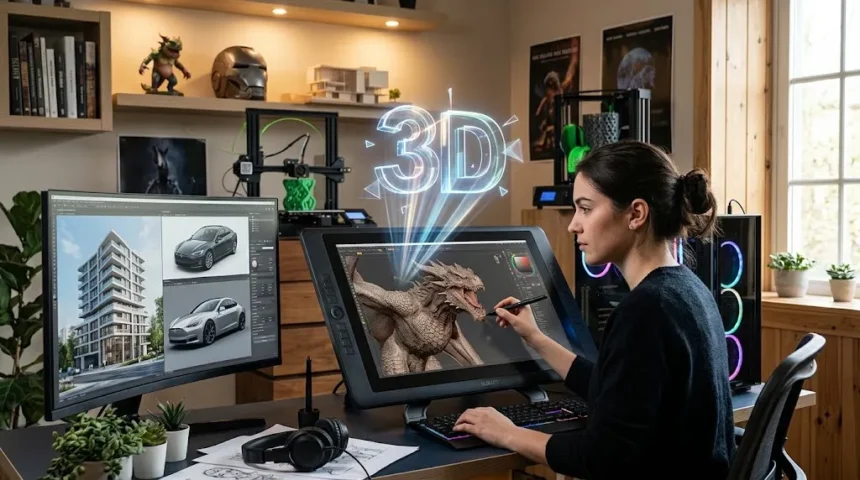
What Is 3D? Meaning, Examples & How It Works
3D stands for three-dimensional, meaning an object or environment has measurable height, width, and depth. Unlike a flat two-dimensional image that has only height and width, a three-dimensional object appears to occupy space and can be viewed from different angles. Everyday objects such as chairs, cars, buildings, phones, and people are naturally three-dimensional, while computers can also create digital 3D models that simulate real-world depth. Three-dimensional technology is now widely used in movies, video games, architecture, engineering, product design, healthcare, education, virtual reality, and 3D printing, making it an important concept across both physical and digital environments.
Understanding what 3D means is easier when you compare a drawing of a cube with an actual cube sitting on a table. The drawing may suggest depth through perspective and shading, but the physical cube actually extends into space. Digital 3D graphics work by representing objects mathematically so computers can calculate their shape, position, lighting, texture, and movement from different viewpoints. Specialized software then renders those models into images or animations that appear three-dimensional on a flat screen. This guide explains the meaning of 3D, how three-dimensional graphics work, common examples, 3D modeling and rendering, 3D printing, animation, and the ways modern industries use three-dimensional technology.
What Does 3D Mean?
3D means three-dimensional and describes anything that can be measured along three spatial dimensions: width, height, and depth. Width describes movement from side to side, height describes movement from bottom to top, and depth describes movement forward and backward. A square is commonly treated as a two-dimensional shape because it has width and height, while a cube is three-dimensional because it also extends in depth. This additional dimension allows objects to occupy volume rather than simply covering an area. In mathematics, design, graphics, and engineering, these three dimensions are usually represented using coordinates that describe where points exist within a three-dimensional space.
The idea of three dimensions is closely connected to how people experience the physical world. A coffee mug has height, width, and depth, and you can walk around it or rotate it to see different sides. A photograph of that mug does not physically contain depth, even though lighting, perspective, shadows, and focus can make the image appear realistic. This distinction explains why a flat screen can display convincing 3D imagery without becoming physically three-dimensional. The computer creates visual cues that the human brain interprets as depth, allowing objects on a monitor, television, or phone to appear as though they occupy a more complete spatial environment.
In computer graphics, 3D usually refers to objects created and stored using mathematical information rather than simple flat pixels alone. A digital 3D model may contain thousands or millions of points describing its shape, along with information about surfaces, materials, colors, and lighting. Because the computer understands the model as an object existing in virtual space, users can rotate it, move around it, zoom in, change the lighting, or view it from different camera angles. This flexibility is one reason three-dimensional modeling is widely used for architecture, engineering, product development, movies, and games. The same model can generate many different images without rebuilding the object from the beginning.
The term 3D can also describe physical technologies rather than digital graphics. Three-dimensional printing, for example, creates real objects by building material layer by layer from a digital design. 3D scanning captures the shape of physical objects so they can be represented digitally, while 3D imaging can be used in medicine to visualize internal anatomy. Virtual reality systems create interactive three-dimensional environments that users can look around and explore. These applications share the principle of representing or manipulating depth in addition to height and width, even though the technologies involved can be very different from one another.
People also use the term 3D informally to describe images, movies, and visual effects that create a stronger sense of depth. A 3D movie presents slightly different images to each eye so the brain interprets the scene as having depth beyond a normal flat image. Three-dimensional television experiments used similar principles, while modern virtual reality headsets use stereoscopic displays combined with head tracking to create a more immersive effect. The meaning of 3D therefore changes slightly depending on context, but the underlying concept remains consistent. It describes objects, images, or environments that represent depth as an important third dimension alongside height and width.
How Does 3D Work?
Digital 3D technology begins by creating a coordinate system that allows a computer to describe locations in virtual space. Most 3D software uses three axes commonly labeled X, Y, and Z, which correspond broadly to horizontal, vertical, and depth directions. A point can be positioned by assigning numerical values to these three coordinates, and many connected points can form the structure of a digital object. By changing these coordinates, software can move, rotate, enlarge, shrink, or deform an object mathematically. This coordinate-based environment allows designers and computers to understand relationships between objects even when the final result appears on a flat two-dimensional screen.
Most 3D objects are built from points called vertices, lines called edges, and surfaces commonly called faces or polygons. Several vertices connected together can create triangles or other polygonal shapes, and many polygons can form the visible surface of a detailed object. A simple cube needs relatively few polygons, while a realistic human character or automobile may use an extremely complex mesh containing many thousands or millions of surface elements. Artists can manipulate these structures to create curves, corners, folds, and other shapes. The resulting polygon mesh acts like the digital skeleton of the object’s outer form and provides a foundation for additional materials, textures, lighting, and animation.
After a model is created, surfaces are given materials that determine how they interact with light. A material can make an object appear metallic, transparent, rough, glossy, wet, plastic, fabric-like, or similar to many other real-world surfaces. Textures are often applied as image maps that add colors, patterns, scratches, labels, skin details, wood grain, or other visual information without requiring every feature to be physically modeled. Additional maps can influence surface roughness, reflections, transparency, or microscopic-looking depth. These techniques allow relatively efficient geometry to appear much more detailed, which is particularly important in video games and animation where computers need to process complex scenes quickly.
Lighting and cameras then determine how the three-dimensional scene will appear to the viewer. Virtual lights can simulate sunlight, lamps, studio lighting, neon signs, or almost any other illumination, while cameras define the viewpoint from which the scene is observed. The computer calculates how light interacts with objects, including shadows, reflections, transparency, and shading. Perspective causes nearby objects to appear larger than distant ones, creating another important depth cue. By moving the camera through a virtual environment, creators can produce the same kinds of cinematic shots that would be possible with a real camera, even when the entire environment exists only inside a computer.
The final process of converting a 3D scene into a visible two-dimensional image is known as rendering. Rendering software calculates which surfaces are visible from the camera, how they are illuminated, what colors and textures they contain, and how effects such as shadows or reflections should appear. Some rendering methods prioritize realism and may require significant computing time, while real-time rendering methods used in games and virtual reality must create many images every second. Modern graphics processors are designed specifically to accelerate these calculations. The viewer ultimately sees pixels on a flat display, but those pixels were generated from a complete three-dimensional scene containing virtual objects, lights, materials, and cameras.
3D vs 2D: What Is the Difference?
The clearest difference between 2D and 3D is the number of dimensions represented. Two-dimensional objects have width and height, while three-dimensional objects add depth. A circle, triangle, rectangle, or flat illustration can be described in two dimensions, whereas a sphere, pyramid, box, or physical sculpture occupies three-dimensional space. In digital design, a 2D image is typically represented on a flat coordinate plane, while a 3D model exists within a virtual space where objects can move forward, backward, up, down, and sideways. This difference changes how creators design, manipulate, and display visual content.
A 2D drawing can still create the illusion of depth through perspective, shadows, overlapping objects, and changes in size. Artists have used these techniques for centuries to make paintings appear three-dimensional even though the canvas itself remains flat. Digital photography works similarly because a camera captures a three-dimensional scene as a two-dimensional image. By contrast, a genuine digital 3D model contains geometric information describing the object’s structure in depth. The viewer may only see one rendered image at a time, but the underlying model can be rotated or viewed from another angle because the computer retains information about its full shape.
Production workflows are also different between two-dimensional and three-dimensional content. A 2D artist may draw characters, backgrounds, icons, or interface elements directly on a flat canvas, while a 3D artist usually creates models, materials, lighting, cameras, and sometimes animation rigs. Once a three-dimensional asset is complete, however, it can be reused from many viewpoints, which can make certain forms of production more flexible. A 3D product model, for example, can generate promotional images from multiple angles without photographing the physical product repeatedly. Two-dimensional artwork may be faster for simpler projects, while 3D workflows provide greater spatial control when depth and perspective matter.
Animation also demonstrates the difference clearly. Traditional 2D animation creates movement by changing drawings or digital shapes over time, while 3D animation moves models within three-dimensional space. A 3D character can turn around naturally because the model has a complete body structure, whereas a 2D animator may need to draw or construct different views. Three-dimensional animation also uses virtual cameras and lighting, allowing filmmakers to create complex movements through scenes. Neither technique is automatically better because each has distinctive visual qualities, production requirements, and artistic possibilities. Many modern productions even combine 2D and 3D techniques within the same project.
The choice between 2D and 3D depends on the goal rather than on which technology appears more advanced. Logos, diagrams, websites, illustrations, typography, and many mobile interfaces often work perfectly in two dimensions because additional depth would add unnecessary complexity. Architecture, engineering, product visualization, games, simulation, and virtual reality frequently benefit from 3D because spatial relationships are essential to the experience. Designers sometimes begin with simple 2D sketches and then develop selected ideas into three-dimensional models. Understanding both approaches helps creators choose the most efficient method instead of assuming every modern project needs to become three-dimensional.
What Is 3D Modeling?
3D modeling is the process of creating a mathematical representation of an object or environment within three-dimensional digital space. Artists, engineers, architects, product designers, and other professionals use specialized software to build shapes that can later be rendered, animated, simulated, or manufactured. A model might represent something simple such as a table or bottle, or something extremely complex such as a human body, vehicle, building, fantasy creature, or complete city. The modeling process determines the geometry and proportions of the object before materials and lighting are applied. Good 3D models balance visual detail with efficient structure according to how the asset will eventually be used.
Polygon modeling is one of the most common techniques and involves manipulating vertices, edges, and faces to construct a mesh. Artists may begin with a basic cube, sphere, cylinder, or plane and gradually reshape it into a more complex object. Extruding surfaces can create new forms, while moving vertices changes contours and proportions. Subdivision techniques can smooth rough polygonal structures into curved surfaces, making them useful for vehicles, characters, furniture, and other organic or manufactured objects. Because polygon meshes are widely supported by rendering engines, game engines, and animation software, this method remains an important foundation of modern three-dimensional content creation.
Digital sculpting provides another approach by allowing artists to manipulate virtual material in a way that resembles sculpting clay. Instead of moving individual polygons constantly, artists use brush-like tools to push, pull, smooth, carve, and add detail to surfaces. This technique is especially popular for creating characters, creatures, faces, fabric folds, skin texture, and other complex organic forms. Sculpted models can contain extremely high levels of geometric detail, so they are often optimized later before being used in real-time applications such as video games. Detail from the original sculpture can then be transferred to a simpler model through texture maps and other techniques.
Computer-aided design, commonly called CAD, provides a more precision-focused form of three-dimensional modeling used heavily in engineering, manufacturing, architecture, and industrial design. CAD software allows users to create objects with exact dimensions, constraints, curves, surfaces, and mechanical relationships. A designer creating an engine component needs accurate measurements and tolerances rather than only a visually convincing shape. Architectural models likewise need walls, doors, windows, structural components, and building systems to correspond with real specifications. CAD models can also be connected to simulation and manufacturing processes, making them valuable for testing ideas before expensive physical prototypes or construction begin.
Photogrammetry and 3D scanning can generate models from existing physical objects instead of creating every surface manually. Photogrammetry uses many photographs taken from different angles to reconstruct shape and texture, while 3D scanners measure physical surfaces using technologies such as structured light, lasers, or depth sensors. These methods can capture buildings, landscapes, sculptures, archaeological objects, human bodies, industrial parts, and other subjects with high levels of detail. The captured information often requires cleanup and optimization before use, but it can save considerable modeling time when accurate reproduction is important. Digital twins and virtual heritage projects increasingly use these techniques to connect real-world objects with three-dimensional digital representations.
What Is 3D Rendering?
3D rendering is the process that turns a three-dimensional digital scene into an image or sequence of images that people can see. Before rendering, the scene exists as mathematical geometry, materials, lights, cameras, and other digital information rather than as a finished picture. The rendering engine calculates how all these elements should appear from the selected camera position. It determines which surfaces are visible, how shadows fall, how light reflects, and how transparent or glossy materials behave. The result can range from a simple technical visualization to a highly realistic image that is difficult to distinguish from photography.
Realistic rendering depends heavily on how accurately the software simulates light. In the physical world, light can bounce from walls, reflect from polished surfaces, pass through glass, scatter inside skin, or create soft shadows depending on the environment. Advanced renderers approximate many of these interactions through techniques such as ray tracing and path tracing. These methods follow simulated rays of light through a scene to calculate reflections, refractions, shadows, and indirect illumination. The calculations can be computationally intensive, particularly when images contain complex geometry and high-resolution textures. Powerful graphics processors and specialized rendering systems help accelerate the process significantly.
Real-time rendering takes a different approach because images need to be produced almost instantly. Video games, virtual reality applications, interactive architectural walkthroughs, and simulations may need to display dozens or even hundreds of frames every second. Game engines therefore use efficient rendering techniques, optimized models, precomputed data, and modern graphics hardware to create convincing scenes quickly. Real-time ray tracing has also become increasingly practical as graphics processors have gained dedicated acceleration features. The distinction between offline cinematic rendering and interactive real-time graphics is becoming less dramatic as hardware and rendering algorithms improve, although extremely complex scenes can still require substantial processing.
Rendering also includes choices that are artistic rather than purely technical. Lighting color, camera position, lens settings, depth of field, exposure, atmosphere, and composition all influence how the final image feels. A perfectly modeled room can look unconvincing if the lighting is flat, while thoughtful illumination can make a relatively simple model appear polished and realistic. Product visualization artists often create studio-style lighting that highlights important shapes and materials, while filmmakers may use dramatic contrast to support storytelling. Rendering therefore sits between mathematics and visual design, requiring an understanding of both computer technology and traditional principles of photography, lighting, and composition.
After rendering, images may undergo additional post-production to refine color, contrast, atmospheric effects, or visual details. Film and advertising pipelines can combine multiple rendering passes so artists control shadows, reflections, lighting, and other elements independently. Compositing software can also combine three-dimensional renders with live-action footage, photographs, smoke, particles, or other effects. This workflow is common in visual effects because filmmakers rarely need to render every part of a final shot in one step. The ability to manipulate three-dimensional imagery during and after rendering makes the technology extremely flexible for movies, television, advertising, architecture, product design, and digital art.
Common 3D Examples in Everyday Life
Video games are one of the most familiar examples of three-dimensional technology because modern games often place players inside interactive 3D environments. Characters, vehicles, buildings, landscapes, weapons, furniture, and other elements are created as digital models and rendered from the player’s changing viewpoint. The game engine calculates lighting, animation, physics, sound positions, collisions, and many other systems while responding to player input in real time. Even games displayed on flat televisions or computer monitors can create strong depth because perspective, motion, shadows, and spatial relationships imitate real-world vision. Virtual reality games extend this effect further by allowing players to look around naturally through head movement.
Movies and television use 3D for animation, visual effects, virtual sets, creatures, vehicles, and environments that would be difficult or impossible to film physically. Fully animated films can create every character and location inside three-dimensional software, while live-action productions often blend computer-generated objects with real footage. Digital doubles can perform dangerous stunts, imaginary creatures can interact with actors, and entire cities can be recreated or modified virtually. Modern production methods also use real-time game engines for virtual production, allowing filmmakers to view digital environments while shooting. Three-dimensional graphics have therefore become deeply integrated into entertainment even when audiences do not realize a particular scene contains computer-generated imagery.
Architecture and interior design use 3D visualization to help clients understand spaces before construction begins. Floor plans provide useful two-dimensional measurements, but three-dimensional models make it easier to understand ceiling heights, furniture placement, natural light, exterior appearance, and how rooms connect. Designers can test different materials, paint colors, lighting options, and layouts quickly without physically rebuilding anything. Interactive walkthroughs allow clients to explore proposed spaces from a first-person viewpoint, while virtual reality can make those environments feel even more immersive. These tools help identify design problems earlier and can improve communication between architects, contractors, engineers, clients, and interior designers.
Online shopping increasingly uses three-dimensional product visualization as well. Furniture retailers can allow shoppers to rotate sofas or tables, while augmented reality tools can place virtual products inside a customer’s room through a smartphone camera. Automobile manufacturers can provide interactive vehicle configurators where users change paint colors, wheels, interiors, and trim while viewing the model from different angles. Fashion and eyewear platforms may use similar technology for virtual try-on experiences. These applications make digital shopping more informative because customers can understand shape and scale better than they could from one static photograph, although accurate measurements and realistic materials remain important for setting correct expectations.
Maps and geographic applications provide another everyday 3D example. Modern mapping software can display terrain, buildings, roads, and city skylines in three dimensions, allowing users to understand locations more intuitively than traditional flat maps sometimes permit. Satellite imagery and elevation data can be combined with 3D geometry to create virtual landscapes, while street-level photography provides complementary real-world views. Urban planners can use similar technologies to evaluate development proposals and infrastructure. Pilots and drivers may also use three-dimensional navigation displays that communicate terrain or road environments more clearly. These examples show how 3D technology can transform spatial information into formats that are easier to explore and understand.
What Is 3D Printing and How Does It Work?
3D printing is a manufacturing process that creates physical objects from digital three-dimensional models, usually by adding material layer by layer. This approach is known as additive manufacturing because objects are built by adding material rather than cutting it away from a larger block. The process begins with a 3D model created in CAD or another modeling program, after which specialized software divides the design into thin horizontal layers. The printer follows those instructions and deposits, cures, melts, or otherwise forms material according to each layer. When all layers are completed, the result is a physical version of the original digital design.
Fused deposition modeling is one of the most familiar consumer 3D printing methods. A printer heats plastic filament and pushes the softened material through a nozzle that moves across a build surface. The printer creates one thin layer, raises or adjusts the printing position, and then creates the next layer on top of it. Hundreds or thousands of these layers can eventually form a complete object. Common materials include different types of thermoplastics, although available options depend on the printer. This technology is popular for prototypes, educational projects, replacement parts, hobby models, enclosures, tools, and other relatively accessible applications.
Resin-based printing uses liquid photopolymer materials that harden when exposed to specific light. These printers can produce extremely fine details and smooth surfaces, making them useful for jewelry models, dental applications, miniatures, prototypes, and other objects requiring precise features. Industrial additive manufacturing systems can also work with metals, ceramics, composites, and specialized polymers. Metal 3D printing is used in industries such as aerospace, medicine, automotive manufacturing, and engineering because it can produce complex structures that would be difficult to create using conventional machining. The printing method and material are selected according to strength, accuracy, cost, surface finish, and intended use.
One important advantage of 3D printing is its ability to produce custom objects without creating expensive molds or manufacturing tools first. A designer can modify a digital model and print a new version relatively quickly, making the technology useful for rapid prototyping. Doctors and medical engineers can create patient-specific anatomical models, while manufacturers can produce specialized jigs, fixtures, or low-volume components. Designers can also create internal structures and complex geometries that are difficult to manufacture through traditional processes. However, printing can be slower than mass manufacturing for large production volumes, and printed parts may require finishing, support removal, heat treatment, or other post-processing before they are ready for use.
3D printing also changes how people think about the relationship between digital design and physical manufacturing. A digital file can potentially be sent across the world and manufactured close to where the object is needed rather than shipping the finished item from one central factory. Spare parts could sometimes be produced on demand instead of being stored for years, although material certification, intellectual property, quality control, and manufacturing standards remain important considerations. The technology does not replace conventional manufacturing in every situation, but it provides another powerful option. Its greatest value often appears where customization, complex geometry, rapid iteration, or relatively low production volumes are more important than maximum manufacturing speed.
3D Animation, Virtual Reality, and Augmented Reality
3D animation creates movement by changing the position, rotation, shape, or other properties of three-dimensional objects over time. A character might walk across a room, a vehicle may accelerate around a track, or a mechanical component can demonstrate how a machine operates. Animators typically create key poses at important moments while software calculates intermediate movement, although artists refine timing and motion extensively to achieve believable results. Physical simulations can also generate effects such as cloth, hair, smoke, fluids, destruction, and collisions. Because the model exists in virtual space, cameras can move around animated objects freely, giving directors considerable control over how a scene is presented.
Character animation frequently uses a digital skeleton known as a rig. Artists place bones and controls inside a model so animators can move arms, legs, facial features, and other body parts without manually reshaping the entire mesh for every frame. Skinning connects the surface of the model to that skeleton so the body deforms naturally as joints move. Facial rigs may include many additional controls for expressions, lip movement, and subtle emotion. Motion capture can record the movement of real performers and transfer it to digital characters, although animators often adjust the captured data afterward. These techniques support everything from animated films to realistic game characters.
Virtual reality, commonly called VR, places users inside an interactive three-dimensional digital environment. A headset displays slightly different images to each eye while tracking head movement so the virtual camera changes as the user looks around. Hand controllers or tracking systems can allow people to interact with objects, navigate spaces, or perform simulated tasks. VR is used for entertainment, training, education, architecture, medical simulation, industrial design, and other applications where immersion can improve understanding. High frame rates and low latency are particularly important because delays between physical movement and visual response can make the experience uncomfortable or reduce the sense of presence.
Augmented reality, commonly called AR, takes a different approach by placing digital objects or information over the user’s view of the physical world. A smartphone may show a virtual piece of furniture inside a real room, while industrial workers can receive visual instructions positioned over machinery. AR systems use cameras, motion sensors, depth information, and environmental understanding to determine where virtual objects should appear. If tracking works correctly, a digital object can remain attached to a specific physical surface even as the user moves around. This combination of real and virtual environments can make three-dimensional information useful without requiring users to leave the physical world entirely.
Mixed reality and spatial computing expand these ideas by allowing digital content to respond more deeply to the physical environment. Three-dimensional interfaces can appear anchored to walls, tables, rooms, or real objects, while users interact through hands, eyes, voice, or specialized controllers. These technologies require accurate tracking, mapping, rendering, and depth understanding so digital objects maintain believable positions. As hardware improves, 3D content may become increasingly integrated into workplace collaboration, training, design, shopping, entertainment, and communication. The underlying principle remains the same as other three-dimensional technologies: computers create and understand spatial relationships rather than treating every interaction as something happening only on a flat screen.
Why 3D Technology Matters
Three-dimensional technology matters because it allows people to communicate spatial ideas more clearly than flat descriptions sometimes can. An architect can show a client what a building may look like before construction, while an engineer can rotate a mechanical part and inspect how components fit together. Medical professionals can examine three-dimensional anatomical images, and students can explore digital models of planets, molecules, historical objects, or biological structures. These visual representations can make complicated relationships easier to understand because users can observe scale, depth, orientation, and movement directly. In many fields, a well-designed 3D model communicates information that would otherwise require numerous drawings or lengthy explanations.
3D also improves product development by helping teams test and refine ideas before creating final physical versions. Designers can adjust dimensions, materials, colors, and components inside software, while engineers can run simulations to evaluate stress, airflow, motion, or other performance characteristics. Virtual prototypes can expose design problems earlier when changes are generally less expensive to make. Once the design is mature, 3D printing or conventional manufacturing systems can use related digital information to create physical prototypes or production components. This connection between visualization, engineering, and manufacturing has made three-dimensional design fundamental to industries ranging from consumer electronics to aerospace.
Entertainment has been transformed by 3D because filmmakers and game developers can create environments and characters unrestricted by physical reality. Fantasy worlds, historical reconstructions, distant planets, giant creatures, and impossible camera movements can all be produced digitally. Realistic simulations also allow racing games, flight simulators, and virtual training environments to reproduce complex spatial experiences. Three-dimensional animation has become a major creative medium in its own right rather than simply imitating live-action filmmaking. As real-time graphics improve, audiences can also influence what happens inside 3D environments, turning passive visual experiences into interactive worlds.
Healthcare provides another important area where three-dimensional technology can create practical benefits. Medical imaging systems can generate volumetric information that allows clinicians to examine anatomical structures from multiple angles rather than relying entirely on individual flat slices. Surgeons can use patient-specific models for planning complicated procedures, while 3D printing can create anatomical teaching models, dental devices, and certain customized medical products. Researchers can visualize molecules and biological structures in three dimensions, making complex relationships easier to investigate. These applications require careful validation and professional expertise, but they demonstrate how 3D technology can support decisions far beyond entertainment or visual design.
Ultimately, 3D technology matters because the real world is spatial, and computers increasingly need ways to represent that spatial complexity. Advances in graphics processors, cameras, depth sensors, artificial intelligence, 3D scanning, additive manufacturing, and immersive displays continue making three-dimensional content easier to create and use. The boundaries between physical and digital objects are also becoming less distinct as scanned environments become digital models and digital models become physical objects through 3D printing. Whether someone is designing a building, playing a game, planning a product, learning anatomy, or exploring virtual reality, the core concept remains the same. Three-dimensional technology gives digital information height, width, and depth, allowing it to behave more like the world people naturally understand.
Frequently Asked Questions
What does 3D stand for?
3D stands for three-dimensional. It describes objects or environments that have width, height, and depth rather than only the width and height associated with two-dimensional shapes or images.
What is a simple example of 3D?
A cube is a simple 3D example because it has height, width, and depth. Everyday objects such as phones, tables, cars, buildings, and people are also three-dimensional because they occupy physical space.
How do computers create 3D images?
Computers create 3D images by building virtual models from mathematical coordinates, shapes, materials, lights, and camera positions. Rendering software then calculates how the three-dimensional scene should appear as pixels on a two-dimensional screen.
What is the difference between 2D and 3D?
2D has two dimensions, usually height and width, while 3D adds depth as a third dimension. A square is two-dimensional, whereas a cube is three-dimensional because it occupies volume and can be viewed from multiple spatial angles.
Where is 3D technology used?
3D technology is used in video games, movies, architecture, engineering, manufacturing, healthcare, education, virtual reality, augmented reality, product design, scientific visualization, and 3D printing. Its value is greatest when understanding shape, depth, movement, or spatial relationships is important.