

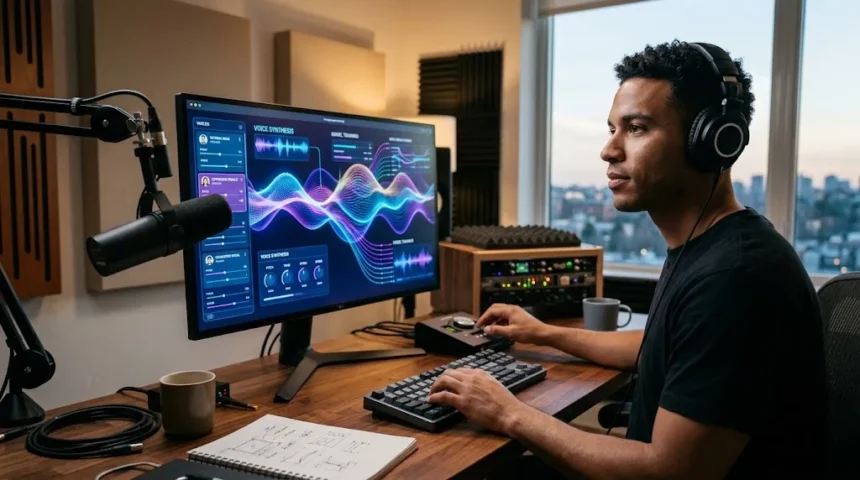
AI voice generators are software tools that convert written text into realistic-sounding speech using artificial intelligence. Instead of relying on basic robotic text-to-speech voices, modern platforms can produce natural pacing, expression, pronunciation, and different speaking styles. Creators use them for videos, podcasts, advertisements, training materials, audiobooks, presentations, and other projects that require professional voice narration.
Most AI voice platforms provide a library of voices representing different tones, languages, accents, ages, or delivery styles. Users enter a script, select a suitable voice, and generate an audio file without recording every sentence manually. This makes voice production significantly faster for individuals and businesses that regularly create spoken digital content.
The technology is particularly useful when hiring a voice actor or maintaining a recording studio for every small project is impractical. AI-generated voices can reduce production time while giving creators more flexibility during editing. However, responsible use remains important, especially when voice cloning, impersonation, consent, or commercial rights are involved.
ElevenLabs: Best Overall AI Voice Generator
ElevenLabs is a popular choice for creators looking for realistic AI-generated speech with strong control over voice delivery. It can produce narration that includes natural pauses, emotional variation, and expressive speech, making it suitable for videos, storytelling, audiobooks, and other projects where a robotic voice would weaken the listening experience.
Content creators can generate multiple versions of the same script and experiment with different voices before selecting the strongest result. This makes editing easier because individual sentences can be regenerated without recording an entire voiceover again. Multilingual capabilities can also help businesses produce spoken content for audiences in several regions without creating every version manually.
Voice cloning adds another layer of flexibility, but it should only be used when proper rights and consent are available. Creating or imitating someone’s recognizable voice without authorization can cause ethical and legal problems. Businesses should establish clear policies regarding voice ownership and approved usage before incorporating cloned voices into customer-facing campaigns.
Murf AI: Best for Professional Business Voiceovers
Murf AI is especially useful for businesses that need polished narration for presentations, training courses, product demonstrations, advertisements, or internal communications. Its workflow is designed to make professional voice production accessible without requiring advanced audio-editing experience. Users can enter scripts, choose voices, and adjust delivery according to the purpose of the content.
Training teams can use AI narration when creating onboarding videos or instructional materials that need to be updated regularly. If one policy changes, the affected section can be regenerated rather than requiring the original speaker to return for another recording session. This flexibility can reduce both production costs and the delays associated with traditional recording workflows.
Marketing teams may also use Murf for explainer videos and advertising concepts. The best results still require thoughtful scripts because even an excellent synthetic voice cannot rescue confusing or poorly structured messaging. Businesses should focus first on clarity, pacing, and audience needs, then select a voice that supports the intended tone.
Speechify: Best for Turning Text Into Spoken Content
Speechify is useful for people who want written content converted into spoken audio for easier listening. Students, professionals, creators, and readers can use text-to-speech features to hear documents, articles, notes, and other written material. This can make information more accessible when reading long documents on a screen is inconvenient.
Creators can also use AI-generated voices for certain narration workflows. Turning scripts into audio can accelerate content production and allow teams to experiment before committing to a final voiceover. Listening to written material is also a useful editing technique because awkward sentences and repetitive wording can become more obvious when heard aloud.
Accessibility is an important benefit of high-quality text-to-speech technology. Some people absorb information better through listening, while others may have difficulty reading lengthy documents comfortably. AI voices can provide another way to consume written information, although organizations should still consider broader accessibility standards instead of assuming speech generation solves every accessibility need.
LOVO AI: Best for Creative Voice Projects
LOVO AI is designed for creators who want a broad range of voice options for videos, marketing, entertainment, and other multimedia projects. Different voice styles can help match narration to the intended audience and emotional atmosphere. This flexibility is useful when a creator produces several types of content and does not want every project to sound identical.
A YouTube creator, for example, might need an energetic voice for short promotional videos and a calmer narrator for educational content. Marketing agencies may experiment with several deliveries before selecting the voice that fits a campaign. AI allows these variations to be produced quickly without organizing separate recording sessions for every concept.
Creators should avoid choosing voices based only on novelty. The voice needs to fit the script, pacing, brand, and audience expectations. A highly dramatic delivery can become distracting in a technical tutorial, while an overly neutral voice may weaken entertainment content, so creative judgment remains important even when generation itself is automated.
PlayHT: Best for Scalable Voice Content
PlayHT can be useful for teams producing larger volumes of voice content across different projects, languages, or formats. AI-generated speech allows businesses to turn written material into audio more efficiently than recording each version manually. This can support publishing, education, marketing, software experiences, and other workflows requiring repeatable voice generation.
Scalability becomes particularly valuable when companies need frequent updates. Product tutorials, knowledge content, training materials, or localized scripts may change over time, and AI-generated audio can be regenerated as information evolves. Teams can therefore maintain spoken content without depending entirely on the availability of recording studios or individual voice performers.
Businesses should still create review processes before publishing generated audio at scale. Pronunciation errors, awkward emphasis, or incorrect scripts can become much more damaging when automatically distributed across hundreds of recordings. Quality checks are essential so greater production capacity does not simply multiply mistakes faster than human teams can identify them.
Descript: Best for Voice and Audio Editing
Descript is particularly valuable for creators who want AI voice capabilities combined with audio and video editing. Instead of treating voice generation as an isolated task, users can work with transcripts and edit spoken content through a text-based workflow. This can simplify podcast, interview, tutorial, and video production for creators who prefer editing words rather than traditional audio timelines.
One practical advantage is correcting small mistakes without repeating an entire recording session. When appropriate features and permissions are available, creators can make targeted voice corrections or adjustments while maintaining continuity with the rest of the project. This can reduce editing time when only a few words or sentences need to change.
The platform is especially useful for teams that already produce spoken or video content regularly. Someone who only needs occasional text-to-speech may prefer a simpler voice generator. Podcasters, educators, marketers, and video creators, however, can benefit from combining transcription, editing, voice workflows, and production inside a more connected environment.
Canva AI Voice Tools: Best for Quick Social Content
Canva is useful for creators who want voice generation as part of a broader visual-content workflow. Social media managers and small businesses frequently need presentations, short videos, promotional graphics, and narrated content without switching between numerous specialized applications. Combining design and voice capabilities can make simple multimedia production much easier.
A creator might design a short social video, prepare the script, and add AI-generated narration without establishing a traditional recording setup. This is convenient for businesses that produce regular promotional content but do not have dedicated audio professionals. Templates can also shorten the time required to turn a basic idea into a finished visual presentation.
Canva is generally more attractive for convenience than highly specialized voice control. Creators producing sophisticated audiobooks, dramatic performances, or extensive narration may prefer dedicated AI voice platforms. For everyday marketing content, however, an integrated environment can be more productive than moving files repeatedly between separate design, editing, and voice applications.
AI Voice Generators for Business and IT Teams
AI-generated speech has practical applications beyond marketing and entertainment. Businesses can create employee training, software tutorials, onboarding videos, accessibility features, customer instructions, and internal presentations without repeatedly recording narration. IT teams may also use synthetic voices within applications, automated support experiences, or other systems where spoken interaction improves usability.
Voice technology increasingly sits within a larger ecosystem of artificial intelligence used across business operations. Companies exploring AI in IT may combine voice interfaces with automation, intelligent support, data analysis, and other AI-powered services. Spoken interaction can make complicated technical systems easier for employees or customers to use.
Security and consent remain particularly important for business deployments. Companies should know who owns generated voices, where audio data is processed, and whether sensitive information enters third-party platforms. Enterprise adoption should consider privacy, permissions, contractual rights, and appropriate human oversight alongside convenience and potential productivity improvements.
How AI Voice Generation Works
AI voice generators generally use deep learning models trained on large collections of speech recordings. During training, the system learns relationships between written language, pronunciation, rhythm, pauses, pitch, and other characteristics of human speech. It can then transform new text into audio that follows patterns learned from those training examples.
Modern speech synthesis can model more than basic pronunciation. Advanced systems may reproduce differences in pacing, emphasis, emotion, and conversational style, making generated voices sound considerably more natural than older text-to-speech technology. Some platforms also allow users to adjust settings that influence stability, expression, speed, or the overall character of a generated voice.
Voice cloning uses similar technology but focuses on recreating characteristics associated with a specific speaker. A short recording may be analyzed so an AI model can generate new speech resembling that voice. Because this creates obvious impersonation risks, legitimate cloning should always involve appropriate consent and clear authorization from the person whose voice is being reproduced.
How to Choose the Best AI Voice Generator
Start by identifying what type of audio you need to create most often. An audiobook narrator has different requirements from a marketer producing thirty-second advertisements or a company developing internal training videos. Define whether realism, language support, emotional delivery, editing, voice cloning, or workflow integration matters most before comparing individual platforms.
Listen carefully to generated samples instead of judging a tool solely by its feature list. Pay attention to pronunciation, pauses, emphasis, sentence transitions, and whether longer passages remain natural. A voice that sounds impressive during one short demonstration may become repetitive or artificial when used for several minutes of continuous narration.
Pricing and usage rights should also influence the decision. Check how plans measure generation limits and whether your intended commercial use is permitted. Frequent creators should calculate the approximate volume of audio they expect to produce so an attractive introductory price does not become unexpectedly expensive once regular production begins.
Tips for Creating Better AI Voiceovers
Start with a script written for listening rather than reading. Spoken sentences generally work better when they are shorter, conversational, and easy to understand on the first listen. Complicated paragraphs filled with long clauses may look professional on a page but sound difficult to follow when converted directly into speech.
Punctuation can influence how some systems interpret pacing. Strategic commas, periods, and paragraph breaks can create more natural pauses and prevent the voice from rushing through important ideas. If a sentence still sounds unnatural, rewrite the text before endlessly adjusting technical controls, because clearer writing usually produces clearer narration.
Finally, generate short sections and review them before processing an entire project. Check difficult names, technical terms, acronyms, numbers, and unusual pronunciations first. This saves time by identifying problems early and allows you to establish a consistent voice style before producing dozens of minutes of audio that later requires extensive correction.
Risks and Ethical Issues With AI Voices
Voice cloning creates one of the most serious concerns surrounding AI-generated speech. The technology can potentially imitate recognizable people and produce statements they never actually made. This creates risks involving fraud, misinformation, harassment, scams, and unauthorized commercial use, making consent essential whenever a generated voice resembles a real individual.
Creators should also be transparent when context makes disclosure important. An audience may reasonably expect to know when a synthetic voice represents a fictional narrator rather than a real spokesperson. Businesses should avoid designs that intentionally mislead customers about whether a person genuinely recorded or endorsed the content they are hearing.
Copyright, contracts, and platform usage rules can also affect commercial voice projects. Read licensing terms carefully before building a business workflow around any generated voice. Responsible users should protect personal voice data, obtain appropriate permission, and avoid imitating people without authorization, even when the technology makes that imitation technically easy.
Conclusion
The best AI voice generators can dramatically reduce the time required to create professional narration. ElevenLabs offers strong overall voice generation, Murf suits business content, Speechify supports text-to-speech workflows, LOVO provides creative variety, PlayHT supports scalable production, and Descript combines AI voice capabilities with broader audio and video editing.
The right platform depends on what you actually produce. Content creators may prioritize realism and emotional delivery, while businesses may care more about consistent training narration, languages, integrations, and commercial rights. Testing several voices with your own script is one of the easiest ways to determine which platform fits your workflow.
AI voices make audio creation faster, but human judgment remains essential. Write scripts for listening, review pronunciation, understand licensing, and obtain proper consent for voice cloning. When used responsibly, AI voice technology can help creators and businesses produce more spoken content without sacrificing the quality and trust audiences expect.
FAQs
What is the best AI voice generator?
ElevenLabs is a strong general-purpose choice for realistic AI speech, while Murf, LOVO, PlayHT, Speechify, and Descript suit different business and creative workflows. The best option depends on your specific requirements.
Can AI voice generators create realistic voices?
Yes. Modern AI voice generators can produce highly natural speech with realistic pacing, pauses, pronunciation, and expression. Quality varies by voice, platform, language, script, and the settings used during generation.
Can I use AI voices for YouTube videos?
AI voices can be used for many video-production workflows when the platform’s licensing terms permit your intended use. Creators should prioritize original content and avoid unauthorized impersonation or misleading voice cloning.
Is AI voice cloning safe?
Voice cloning can be useful when the speaker has clearly authorized it, but unauthorized cloning can enable impersonation, scams, and misinformation. Always obtain appropriate consent before reproducing a recognizable person’s voice.
Are free AI voice generators worth using?
Free plans can be useful for testing voices and producing small projects, although they may limit generation time, downloads, commercial rights, or advanced features. Frequent creators may eventually benefit from a paid plan.