

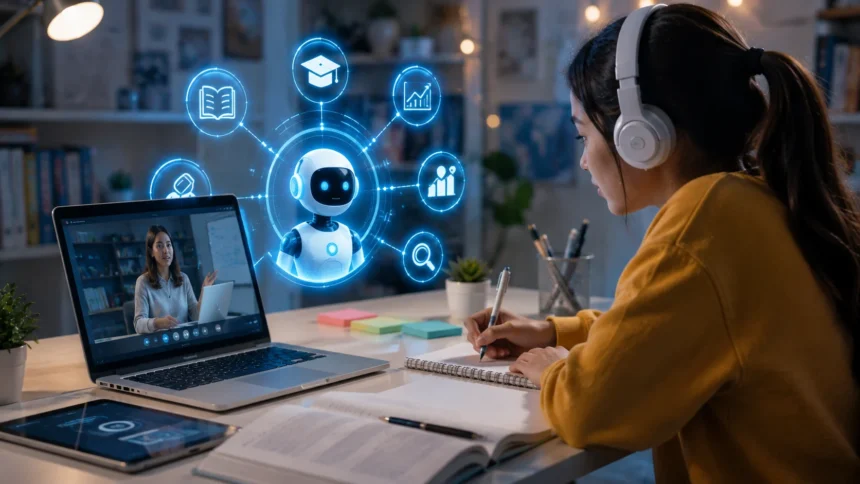
How AI Is Changing Education and Online Learning
Artificial intelligence is changing education by influencing how students learn, how teachers prepare lessons, how institutions evaluate progress, and how online courses are delivered. Students can now use AI-powered tutors to explore difficult concepts, receive explanations in different ways, practice skills, and obtain feedback much faster than traditional digital tools allowed. At the same time, educators can use AI to organize materials, create learning activities, analyze student performance, and reduce some of the repetitive administrative work that takes time away from teaching.
The impact of AI in education goes far beyond generating essays or answering homework questions. Modern artificial intelligence can support personalized learning paths, adaptive assessments, accessibility tools, language translation, virtual tutoring, course development, research, career guidance, and student support. These capabilities are particularly important for online learning, where students may not always have immediate access to an instructor when they become confused or need additional explanation.
However, artificial intelligence does not automatically improve learning simply because it makes tasks faster. A student who asks AI to complete every assignment may produce more work without developing deeper understanding. Effective educational use requires learners to question outputs, explain reasoning, practice independently, verify information, and use AI as a learning partner rather than a shortcut around the learning process.
Teachers remain equally important in this changing environment. They provide motivation, context, feedback, emotional support, classroom management, mentorship, and professional judgment that an automated system cannot fully reproduce. The future of artificial intelligence in education is therefore likely to depend on collaboration between teachers, learners, and technology, with AI providing additional capabilities while people remain responsible for the purpose and quality of education.
What Does AI in Education Actually Mean?
AI in education refers to the use of artificial intelligence technologies to support teaching, learning, assessment, administration, research, and student services. These technologies may include machine learning, natural language processing, generative AI, speech recognition, computer vision, adaptive learning systems, and intelligent tutoring tools that respond to student behavior or questions.
Generative AI is one of the most visible forms because students and teachers can communicate with it using ordinary language. A learner can ask for an explanation of a mathematical concept, request practice questions, compare two historical events, or receive feedback on a draft. Teachers can use similar systems to brainstorm activities, simplify complicated information, generate examples, or prepare lesson materials.
Other educational AI systems work more quietly behind the scenes. Adaptive learning platforms may change question difficulty according to student performance, while analytics systems identify patterns suggesting that a learner needs additional support. Universities may use AI to organize administrative requests, help students navigate services, or analyze large collections of educational data.
The important point is that AI is not one single educational technology. It includes many different systems with different purposes, capabilities, and risks. A tool that helps a student practice vocabulary creates very different concerns from an AI system making high-impact decisions about admissions or academic performance, so each application needs to be evaluated according to its specific role.
Why AI Is Changing Education So Quickly
One reason AI is spreading quickly through education is accessibility. Many generative AI systems allow students and teachers to interact with sophisticated technology through natural-language conversations rather than learning complicated software. Someone can simply describe what they need and receive an explanation, outline, example, or learning activity within seconds.
Another factor is the amount of information involved in modern education. Teachers work with lesson materials, assessments, student records, administrative tasks, communications, and curriculum requirements. Learners work with textbooks, videos, articles, lecture notes, exercises, and online resources. AI can help organize and summarize some of this information more efficiently.
Online learning has also created strong demand for flexible educational support. Students may study at different times, in different locations, and at different speeds. Traditional courses cannot always provide immediate one-to-one assistance to every learner, whereas AI systems can potentially provide explanations and practice around the clock.
At the same time, widespread availability creates new challenges. Students can now generate polished text or solve certain academic tasks with very little effort, forcing educators to reconsider what meaningful assignments should look like. Education is therefore changing not only because AI provides new tools but also because schools and universities must rethink how learning itself is demonstrated.
AI Makes Learning More Personalized
Traditional classrooms often require one teacher to support many students with different abilities, interests, backgrounds, and learning speeds. Some learners understand a topic immediately, while others need additional examples or more time. AI can help provide more individualized support without requiring the teacher to create a completely separate lesson for every student.
An AI tutor can explain the same concept in several ways. A student who does not understand a textbook definition might ask for a simpler explanation, a practical example, an analogy, or a step-by-step walkthrough. This flexibility can reduce frustration and help learners discover explanations that connect more naturally with how they think.
Personalized systems can also adjust difficulty according to performance. If a student repeatedly answers introductory questions correctly, the system may present more advanced exercises. If the learner struggles, it can provide additional practice or return to foundational concepts before moving forward.
Personalization should not become complete isolation. Students still benefit from shared discussion, collaborative learning, teacher guidance, and exposure to ideas they would not necessarily choose themselves. Personalized learning with AI works best when customization supports a broader educational experience rather than turning every learner into a completely separate curriculum.
AI Tutors Can Provide On-Demand Help
One of the most promising uses of AI is intelligent tutoring. Students often become stuck outside normal classroom hours, especially when completing homework or studying online. An AI tutor can provide immediate assistance without requiring the learner to wait until the next lesson.
A strong AI tutor should guide rather than simply provide the final answer. For a mathematics problem, it might ask the student what step they would try first, identify where their reasoning went wrong, and provide a hint before revealing more information. This approach supports learning much more effectively than simply completing the exercise.
AI tutors can also encourage active recall by generating practice questions and asking learners to explain concepts in their own words. If the student provides an incomplete response, the tutor can highlight what is missing and provide another opportunity to try.
However, students should understand that AI tutors can make mistakes. Important explanations should be compared with course materials or verified with teachers when uncertainty remains. AI tutoring becomes most valuable when learners treat the system as an interactive study aid rather than an unquestionable source of truth.
AI Is Transforming Online Learning
Online education has traditionally relied heavily on prerecorded videos, reading materials, quizzes, and discussion forums. These formats provide flexibility, but learners can feel isolated when they need clarification. AI can make digital courses more interactive by adding conversational support and personalized explanations.
A learner taking an online programming course might ask an AI assistant why their code failed rather than repeatedly rewatching the same lecture. Someone studying economics could request another example of a difficult concept. This immediate interaction can make asynchronous learning feel more responsive.
AI can also help online platforms recommend relevant materials. If a student struggles with one topic, the system may suggest a specific lesson, exercise, video, or supplementary resource. This can help learners spend more time addressing genuine weaknesses instead of moving through every resource in exactly the same sequence.
The challenge is maintaining educational quality. Convenience should not encourage platforms to replace carefully designed instruction with automatically generated material. Strong AI online learning still requires clear learning objectives, reliable content, meaningful practice, good assessment, and opportunities for human interaction.
AI Helps Teachers Plan Lessons Faster
Lesson planning requires teachers to consider learning objectives, activities, examples, assessments, student needs, and curriculum expectations. AI can help generate initial ideas, allowing educators to spend less time starting from a blank page.
A teacher might provide a topic and age group and ask for several ways to introduce the concept. AI can suggest classroom discussions, demonstrations, group activities, practice questions, or real-world examples. The teacher can then select and adapt the ideas according to the class.
AI can also help differentiate materials. A teacher may create one core activity and ask for easier or more challenging versions for students with different levels of understanding. This can make differentiated instruction more manageable, particularly in classrooms with diverse learning needs.
Professional judgment remains essential. AI does not know the students personally or fully understand the curriculum, classroom dynamics, cultural context, or institutional expectations. Teachers should therefore treat generated lesson plans as editable suggestions rather than ready-to-use instructions.
AI Can Reduce Teacher Administrative Work
Teachers often spend substantial time on work that happens outside direct instruction. Emails, lesson materials, reports, documentation, schedules, and administrative communication can consume hours that could otherwise support students.
AI can help draft routine communication, organize notes, summarize meetings, create templates, and transform rough information into structured documents. These capabilities can reduce repetitive writing while allowing educators to review and personalize the final result.
Administrative AI can also help schools analyze schedules, organize resources, and route common student questions toward appropriate departments. Universities may use conversational systems to answer routine questions about enrollment, campus services, or course procedures.
The objective should be freeing educators for higher-value work rather than simply increasing expectations because technology makes certain tasks faster. If AI saves a teacher several hours each week, that time can support feedback, planning, mentoring, collaboration, or professional development.
AI Is Changing Assessment and Feedback
Traditional assessment often requires teachers to grade many assignments manually, which can delay feedback. AI can help analyze certain types of work and provide initial comments or identify patterns that deserve attention.
Students benefit when feedback arrives while the learning activity is still fresh. An AI-supported writing tool might identify unclear structure, weak evidence, grammar problems, or areas where an argument requires further explanation. The learner can then revise before submitting the final version.
AI can also generate practice assessments. Teachers can create question banks at different difficulty levels or ask for alternative versions of an exercise so students receive additional practice without simply memorizing one answer set.
High-stakes grading deserves much stronger human oversight. AI may misunderstand creativity, context, reasoning, cultural language, or unconventional but valid approaches. Automated assessment should support educators where appropriate rather than quietly becoming the sole authority over important academic decisions.
AI Changes What Good Assignments Look Like
Traditional take-home essays and worksheets can become less meaningful when AI can complete much of the task almost instantly. This does not mean written assignments are no longer useful, but educators may need to design them differently.
Assignments can emphasize process rather than only final output. Students might submit research notes, explain why they chose particular evidence, compare AI-generated answers with trusted sources, or describe how their thinking changed during the project.
Teachers can also use more context-specific tasks. Asking students to connect material with a classroom discussion, local issue, personal experiment, or original dataset makes generic AI completion less useful and encourages genuine engagement.
Oral presentations, collaborative work, practical demonstrations, project-based learning, and reflective activities can also provide additional evidence of understanding. AI is pushing education toward assessments that evaluate thinking and application rather than only the ability to produce polished text.
AI Can Support Students With Different Learning Needs
Artificial intelligence can provide useful accessibility support for learners with disabilities or different educational needs. Speech recognition, text-to-speech systems, caption generation, language simplification, and adaptive interfaces can make learning materials easier to access.
A student with reading difficulties might request a simpler explanation or listen to written content aloud. Someone with hearing impairment may benefit from automatic captions, while learners with visual limitations can use tools that describe certain types of visual content.
AI can also help teachers adjust materials while maintaining the same learning objective. Instructions may be rewritten more clearly, examples may be broken into smaller steps, or additional practice may be created for students who need it.
Accessibility tools still need careful evaluation because inaccurate captions, descriptions, or simplified explanations can create new barriers. Learners should also have the ability to choose the support that works for them rather than having automated systems make assumptions about their needs.
AI Helps Break Language Barriers
Education increasingly brings together students who speak different languages. AI-powered translation and language tools can help learners understand course materials and participate more confidently when the language of instruction is not their first language.
Students may translate explanations, clarify unfamiliar vocabulary, or ask AI to explain a concept using simpler language. Teachers can also create preliminary versions of instructions or learning materials in several languages before checking them for accuracy.
Language learners can practice conversations with AI without worrying about embarrassment. They may simulate everyday situations, ask for corrections, practice vocabulary, or request explanations of grammar patterns whenever they have time.
Automatic translation still has limitations. Technical terms, idioms, cultural references, and nuanced academic language can be misunderstood. AI should reduce communication barriers while educators remain aware that translated information sometimes requires human verification.
Generative AI Can Support Writing Skills
Students can use generative AI as a writing coach when the technology is incorporated thoughtfully. Instead of asking the system to write an entire essay, learners can use it to brainstorm ideas, evaluate structure, clarify difficult sentences, or identify questions a reader might still have.
AI can also help students understand revision. A learner might compare two versions of a paragraph and ask why one is clearer. This allows them to study writing decisions rather than simply receiving corrections.
Teachers can create activities where students critique AI-generated text. They might identify unsupported claims, weak arguments, poor evidence, or repetitive language. Such exercises can improve both writing skills and AI literacy.
The danger appears when students outsource the thinking entirely. Writing helps people organize ideas, evaluate evidence, and develop reasoning. If AI performs every stage, the learner may submit impressive text while missing the educational process that made the assignment valuable.
AI Is Changing Research Skills
Students traditionally learn research by searching for information, evaluating sources, taking notes, comparing viewpoints, and synthesizing findings. Generative AI can accelerate some of this work, but it also changes which skills become most important.
AI can help learners brainstorm research questions, identify terminology, organize notes, and understand complicated concepts before they investigate deeper. These capabilities can reduce the initial difficulty of entering an unfamiliar subject.
However, AI-generated answers may contain incorrect claims, invented citations, or oversimplified interpretations. Students need to trace important information back to reliable sources instead of treating a generated response as evidence.
Research education therefore increasingly needs to include source verification, information literacy, and understanding how AI systems produce answers. Knowing how to question information may become even more important when incorrect statements can be generated in highly convincing language.
AI Makes Feedback More Immediate
Feedback is one of the most important parts of learning because students improve when they understand what they did well and where they need additional work. Traditional classroom constraints sometimes mean learners wait days before receiving detailed comments.
AI can provide immediate formative feedback while a student is practicing. A language learner can receive corrections during a conversation, while a programming student may receive explanations of errors as soon as code fails.
This instant response supports iteration. Students can try again immediately instead of repeating the same misunderstanding until the next class. Frequent low-stakes practice can make learning more active.
AI feedback should still be viewed critically. A model may incorrectly label a valid answer or recommend a weaker approach. Teachers remain important for deeper feedback involving reasoning, creativity, disciplinary standards, and individual development.
AI Can Help Identify Students Who Need Support
Educational institutions collect data about attendance, assessment performance, course participation, assignment completion, and other learning activities. Analytical systems can identify patterns suggesting that a student may be struggling.
For example, a learner who stops participating in an online course, misses several assignments, and performs poorly on recent quizzes may benefit from early outreach. AI can help bring these combined signals to an educator’s attention.
Early intervention can be particularly valuable in online education, where struggling learners may disappear quietly without an instructor noticing immediately. Timely encouragement or academic support may help students re-engage before dropping out.
Predictive systems should not label students permanently. Performance can change, data may be incomplete, and an algorithm cannot fully understand personal circumstances. Risk indicators should trigger supportive human attention rather than automatic negative consequences.
AI Is Changing Course Creation
Creating an online course requires instructors to plan objectives, organize lessons, develop examples, prepare assessments, and produce supporting materials. Generative AI can accelerate several stages of this process.
An educator may use AI to brainstorm lesson structures, generate examples, create practice questions, or turn long notes into preliminary summaries. This allows subject experts to focus more time on improving explanations and checking accuracy.
AI can also help adapt one course into different formats. A lecture transcript might become study notes, flashcards, quiz questions, or a shorter revision guide. Repurposing can make courses more useful to students with different learning preferences.
Course creators still need instructional design skills. Automatically generating hundreds of lessons does not guarantee that students will understand or remember them. Effective courses require sequencing, practice, feedback, engagement, and clear learning objectives that technology alone cannot determine.
AI Can Create More Interactive Online Courses
Online learners often struggle when courses feel like collections of videos rather than interactive learning environments. AI can provide conversational experiences that make digital education more responsive.
Course-specific assistants can answer questions using approved materials, explain difficult lessons, and guide students toward relevant resources. Learners gain an additional place to seek clarification when an instructor is unavailable.
AI can also create scenario-based learning. Business students might practice negotiations, language learners can simulate conversations, and customer-service trainees can respond to virtual customer situations.
Interactive simulations should reflect real educational goals rather than adding technology for novelty. Students need opportunities to apply knowledge, receive feedback, and understand mistakes. AI works best when interaction reinforces the skills the course was designed to teach.
AI Supports Lifelong Learning
Education increasingly continues beyond school and university because workers need to update skills throughout their careers. AI can make self-directed learning easier by helping adults navigate unfamiliar topics and create personalized study plans.
A professional learning data analysis, for example, can ask AI to explain concepts according to their existing knowledge and recommend practice activities. Someone preparing for a new role may use AI to identify skill gaps and organize a learning roadmap.
Microlearning can become more personalized as well. Instead of completing an entire broad course, workers might focus on specific competencies they need for a current project or career transition.
Learners still need reliable curricula and credible evidence of competence where qualifications matter. AI can support learning, but employers and educational institutions will continue to need trustworthy ways to determine whether someone has genuinely mastered a skill.
AI Literacy Is Becoming an Essential Skill
As AI becomes part of everyday work and learning, students increasingly need to understand more than how to enter prompts. AI literacy includes understanding what artificial intelligence can do, where it can fail, how to evaluate outputs, and how to use it responsibly.
Students should learn that AI responses are generated based on patterns rather than human understanding in the ordinary sense. This helps explain why systems can provide confident but inaccurate answers.
Ethical issues also belong within AI literacy. Learners should understand privacy, bias, copyright, attribution, misinformation, and the consequences of using AI in different academic or professional situations.
Most importantly, students should develop the confidence to challenge AI. The ability to recognize when an automated answer seems questionable may become one of the most valuable digital skills as artificial intelligence becomes integrated into more parts of society and work.
AI Is Changing the Role of Teachers
Teachers are becoming guides not only to subject knowledge but also to responsible technology use. Students need help understanding when AI can support learning and when using it may prevent them from developing essential skills.
Educators can model effective AI use by showing students how to ask better questions, verify information, compare sources, critique generated responses, and document AI assistance appropriately.
Teachers may also spend less time delivering basic information and more time facilitating discussion, coaching, problem solving, project work, and critical thinking. AI can provide information quickly, increasing the value of educators who help students understand what that information means.
The role remains deeply human. Students need encouragement, relationships, expectations, feedback, inspiration, and a sense that someone understands their development. Technology can assist teaching, but education involves social and emotional experiences as well as information transfer.
AI Is Changing Higher Education
Universities are dealing with AI across teaching, research, assessment, administration, and student services. Students increasingly use generative AI during research, writing, programming, and revision, forcing institutions to establish clearer expectations.
Some universities allow AI for brainstorming or editing while requiring students to disclose its use. Other assignments may prohibit AI because the purpose is evaluating the student’s independent ability. Clear policies help reduce confusion.
Higher education is also exploring AI tutors, research assistants, administrative chatbots, and tools that help instructors prepare educational materials. These applications can improve efficiency but require governance.
Universities must also reconsider what graduates need to know. Employers may increasingly expect workers to collaborate with AI systems, making the ability to use technology critically and responsibly part of professional preparation.
AI Is Influencing Vocational and Professional Training
Vocational education focuses on practical skills that connect closely with employment. AI can help training providers update curricula as industries change and create realistic simulations for technical and professional learning.
Learners can practice customer conversations, troubleshooting, decision-making, or other scenarios through interactive systems before entering real workplaces. These simulations create opportunities to make mistakes safely.
AI can also help identify emerging workplace skills by analyzing labor-market information and industry changes. Training providers can use these insights when reviewing qualifications and course content.
Hands-on experience remains essential. A digital simulation cannot fully replace physically operating equipment, working with real customers, or responding to unpredictable workplace situations. AI should strengthen practical education rather than separate learners from real-world experience.
AI Can Improve Student Career Guidance
Career decisions involve interests, abilities, qualifications, labor-market conditions, and personal priorities. AI can help students explore possibilities by organizing information about occupations, skills, educational pathways, and potential career transitions.
A student might describe their interests and existing skills and receive suggestions about roles worth investigating. AI can also explain what qualifications are commonly associated with particular careers.
Career services can use AI to help students prepare interview questions, review resumes, practice conversations, or understand job descriptions. These tools can make basic preparation more accessible.
Career guidance should not become deterministic. An algorithm cannot fully understand a person’s ambitions, family circumstances, personality, values, or future opportunities. AI recommendations should expand possibilities rather than tell students what they are capable of becoming.
AI Can Improve Educational Accessibility
AI has the potential to make learning resources more accessible across different physical, linguistic, and educational needs. Automatic captions, speech interfaces, translation, text simplification, and personalized pacing can remove barriers for some learners.
Online education can particularly benefit because digital materials are easier to transform into multiple formats. A lecture can become a transcript, summary, audio explanation, or set of study questions.
Accessibility also means designing for different levels of connectivity and technology access. Highly sophisticated AI tools provide little benefit to learners who lack reliable internet, appropriate devices, or affordable access.
Educational institutions should therefore consider accessibility broadly. AI can reduce certain inequalities while creating new ones if only well-resourced learners can use the strongest tools. Responsible adoption requires attention to both technological and social barriers.
AI Creates New Academic Integrity Challenges
Generative AI makes it possible to produce essays, code, answers, and other academic work quickly, creating legitimate concerns about whether submitted work reflects student understanding.
Simply banning every AI tool may become difficult as these capabilities become integrated into common software. Institutions increasingly need clearer definitions of acceptable and unacceptable assistance.
Assignments can require students to disclose AI use, explain how outputs were verified, or demonstrate their reasoning through oral discussion and process evidence. These approaches focus on whether genuine learning occurred.
Academic integrity should remain connected to educational purpose. The goal is not catching students using technology but ensuring they develop the knowledge and skills that qualifications are supposed to represent.
AI Detection Tools Have Important Limits
Some schools have explored tools designed to determine whether text was generated by AI. These systems can create problems because AI-generated and human-written text can sometimes look similar.
False accusations can have serious consequences for students. Writers using simple structures, second-language learners, or people with particular writing styles may be incorrectly flagged.
Instead of relying exclusively on detection systems, educators can design assignments where learning is visible through drafts, classroom discussion, presentations, source notes, and personalized application.
Building trust and clear policies may prove more sustainable than creating an escalating technical competition between generation tools and detection tools. Assessment should focus on demonstrating understanding rather than only identifying how text was produced.
AI Can Produce Incorrect Information
One of the biggest educational risks is that generative AI can provide answers that sound convincing while containing inaccurate facts, invented sources, weak reasoning, or oversimplified explanations.
Students who lack background knowledge may find these errors particularly difficult to recognize. A confident response can appear more trustworthy than it deserves.
Teachers should encourage verification. Important claims should be checked against textbooks, academic publications, trusted websites, primary sources, or qualified experts depending on the topic.
This limitation can also become a learning opportunity. Asking students to fact-check AI responses or identify weaknesses can strengthen critical thinking and information literacy—skills that are increasingly important in a world filled with automatically generated information.
AI May Reduce Critical Thinking If Used Poorly
Learning often requires mental effort. Struggling with a problem, organizing an argument, remembering information, and correcting mistakes all contribute to deeper understanding.
If students immediately ask AI for every answer, they may bypass some of this productive difficulty. Tasks become easier, but learning may become shallower.
Educators can reduce this risk by designing AI use around questions rather than answers. Students might ask AI for feedback after attempting a problem themselves or compare their explanation against an AI-generated alternative.
The principle is simple: AI should increase thinking rather than replace it. Educational technology is most valuable when it helps learners reason more deeply, explore alternatives, and understand mistakes instead of merely completing assignments faster.
Privacy Is a Major Concern in AI Education
Educational data can include student identities, grades, behavioral information, learning difficulties, assignments, conversations, and other sensitive details. Connecting AI systems to this information requires careful privacy protection.
Schools and universities should understand what information external AI providers collect, how it is stored, how long it is retained, and whether it can be used for other purposes.
Students should also learn not to paste confidential information into unapproved AI tools. Personal records, private student information, research data, and institutional documents may require additional protection.
Privacy policies should be understandable rather than buried inside technical documents. Learners, parents, and educators need clear information about how AI systems interact with educational data so they can make informed decisions.
Bias Can Affect AI-Powered Learning
AI models learn from data created within societies that contain cultural, linguistic, economic, and historical inequalities. As a result, systems can reproduce bias even when developers do not intentionally design them that way.
A tutoring system may explain concepts more effectively for some language groups than others, while an automated evaluation system could misunderstand culturally different forms of expression.
Bias becomes particularly serious when AI influences admissions, grading, disciplinary decisions, or other high-impact outcomes. Such systems require strong validation, transparency, and opportunities for human review.
Education should expose students to diverse viewpoints rather than allowing one automated system to define what counts as normal or correct. Teachers and institutions remain responsible for ensuring technology supports inclusive learning.
AI Could Widen the Digital Divide
Artificial intelligence can expand educational opportunities, but its benefits may not be distributed equally. Some students have access to powerful devices, paid AI subscriptions, fast internet, and teachers trained in AI use, while others have much more limited technology.
If education increasingly assumes that every learner has equal access to advanced AI tools, existing inequalities may become more significant.
Schools and governments need to consider infrastructure, affordability, accessibility, teacher training, and language support when designing AI education policies.
Equity should be treated as a core implementation issue rather than an afterthought. The value of educational technology should be measured partly by whether it helps more learners succeed rather than only whether it makes learning more advanced for those already well supported.
Human Interaction Still Matters in Learning
Education is social. Students learn through discussion, collaboration, observation, encouragement, disagreement, mentorship, and shared experiences with other people.
An AI tutor can answer questions at midnight, but it cannot fully replace the relationship a student develops with a teacher who understands their personality, history, strengths, and struggles.
Peer interaction also develops communication, teamwork, empathy, negotiation, and social confidence. Individualized digital learning should not remove these opportunities.
The strongest educational models are therefore likely to combine intelligent technology with meaningful human relationships. AI can provide additional support while teachers and classmates contribute the social experiences through which much learning takes place.
How Students Should Use AI Responsibly
Students should begin by understanding the rules established by their school, university, or instructor. AI may be allowed for certain activities and prohibited for others, depending on what the assignment is designed to assess.
Use AI to support learning rather than hide gaps in understanding. Ask for explanations, practice questions, feedback, examples, or alternative approaches after making your own attempt.
Verify important information and do not automatically trust generated citations, statistics, or factual claims. AI should not become a replacement for reliable academic sources.
Finally, maintain ownership of your work. The ideas you submit should reflect your understanding, and you should be able to explain and defend what you have written or created. If you cannot explain the work without the AI system, you may not have learned enough from the process.
How Teachers Can Use AI Responsibly
Teachers should connect AI use with specific educational objectives. Before using a tool, ask what teaching problem it solves and whether it improves learning rather than simply making a task easier.
Review generated materials before giving them to students. Questions, explanations, examples, and assessments may contain factual or pedagogical weaknesses that require editing.
Establish clear expectations for student AI use. Explain which activities permit AI, when disclosure is required, and why certain tasks need independent work.
Teachers should also protect student information and use institutionally approved tools where appropriate. Responsible AI adoption combines experimentation with professional judgment, privacy awareness, and continuous evaluation.
Schools Need Clear AI Policies
Confusion increases when students receive completely different AI rules from every teacher without broader institutional guidance. Schools and universities benefit from developing clear principles that educators can adapt to different subjects.
Policies should distinguish between low-risk learning support and high-impact uses. Asking AI to generate practice questions is different from using an algorithm to make disciplinary or admissions decisions.
Rules also need to evolve. AI technology changes quickly, so policies written around one specific product may become outdated. Principles around transparency, learning, privacy, fairness, accountability, and human oversight are more durable.
Institutions should involve teachers and students in policy discussions where possible. The people using these systems every day often identify practical issues that administrators or technology vendors may overlook.
The Future of AI in Education
Future learning platforms are likely to become increasingly conversational and adaptive. Students may interact with AI assistants embedded directly inside textbooks, courses, learning-management systems, and educational applications.
Multimodal AI may allow learners to ask questions using text, speech, images, diagrams, or video. A student could potentially photograph a science experiment, describe what happened, and receive guidance about what to investigate next.
AI agents may also support more complicated educational workflows, such as organizing study schedules, gathering approved resources, tracking progress, or helping students prepare revision plans.
The greatest challenge will be ensuring that increased automation produces genuine learning. Education should use powerful technology to expand human ability rather than allowing convenience to gradually remove the thinking, creativity, relationships, and curiosity that make learning meaningful.
Final Thoughts
AI is changing education and online learning by making educational support more personalized, interactive, accessible, and available whenever students need it. AI tutors, adaptive learning, automated feedback, language support, accessibility tools, course assistants, and teacher productivity tools are already reshaping how learning experiences can be designed.
The technology also creates important opportunities for educators. Teachers can spend less time on repetitive planning and administrative tasks while using AI to develop differentiated materials, generate practice activities, and identify students who may need additional support.
At the same time, artificial intelligence creates serious questions about academic integrity, critical thinking, privacy, bias, accuracy, unequal access, and the changing meaning of assessment. Education systems need to address these issues deliberately rather than assuming technology will solve them automatically.
The most promising future is not one where AI replaces teachers or completes learning for students. It is one where artificial intelligence removes unnecessary barriers, provides additional support, and gives people more opportunities to teach, learn, question, create, and think deeply. Human judgment and curiosity must remain at the center of education even as the tools surrounding them become more intelligent.
Frequently Asked Questions
How is AI changing education?
AI is changing education through personalized learning, virtual tutoring, automated feedback, accessibility tools, teacher assistance, adaptive assessments, and more interactive online learning experiences.
Can AI replace teachers?
No. AI can support instruction and automate repetitive tasks, but teachers remain essential for mentorship, motivation, classroom judgment, social learning, feedback, and emotional support.
How does AI improve online learning?
AI can provide immediate explanations, personalized recommendations, adaptive practice, course-specific tutoring, multilingual assistance, and 24/7 support for students learning remotely.
What are the risks of AI in education?
Major risks include inaccurate information, academic misuse, reduced critical thinking, privacy problems, algorithmic bias, overreliance on technology, and unequal access to advanced AI tools.
Should students use AI for homework?
Students can use AI for explanations, feedback, brainstorming, and practice when their instructor permits it. They should avoid using AI to replace their own thinking or submit generated work as independent learning.