

Real-Time Monitoring: Benefits, Uses & Examples
Real-time monitoring is the continuous process of collecting, processing, and reviewing data as events happen so that people or automated systems can respond quickly. Businesses use it to track everything from website performance and cybersecurity threats to manufacturing equipment, financial transactions, delivery fleets, and customer activity. Instead of waiting hours or days for a report, teams can see important changes almost immediately through live dashboards, alerts, logs, metrics, and other monitoring tools. This faster visibility can reduce downtime, improve operational efficiency, and help organizations identify problems before they become costly. Real-time data monitoring has therefore become an important part of modern IT operations, business intelligence, security, and connected-device management. Its value grows as companies depend increasingly on digital systems that customers expect to remain available around the clock.
However, real-time monitoring does not simply mean displaying constantly changing numbers on a screen. A useful monitoring system must collect relevant information, organize it correctly, distinguish normal behavior from unusual activity, and notify the right people when action is needed. Many organizations combine telemetry, event streaming, application performance monitoring, network monitoring, infrastructure monitoring, and automated alerts to create this visibility. The goal is usually not to watch every event manually but to surface the information that matters most. Effective monitoring therefore combines technology with clear thresholds, business priorities, and response procedures. This guide explains how real-time monitoring works, its major benefits, common applications, practical examples, implementation steps, and the challenges businesses should consider.
What Is Real-Time Monitoring?
Real-time monitoring is the practice of observing systems, processes, devices, applications, or business activities continuously or with extremely low delay. Data is collected as events occur and then made available for analysis, visualization, alerting, or automated action. Depending on the use case, the information may come from servers, software applications, security tools, databases, sensors, payment systems, vehicles, or customer interactions. Organizations usually display important indicators through monitoring dashboards that help teams understand current conditions quickly. Alerts can be generated when a value crosses a predefined threshold or when unusual activity appears. This continuous visibility allows teams to respond to changing conditions faster than they could using periodic reports alone.
The word real-time can mean slightly different things depending on the environment being monitored. In some systems, an event may need to be detected within milliseconds, while in others a delay of several seconds or even a minute may still be considered operationally real-time. A financial fraud system, for example, may need to evaluate a transaction before payment is approved. A warehouse monitoring dashboard may only need to refresh inventory or equipment data every few seconds. What matters is that the information arrives quickly enough to support the required decision or response. Organizations should therefore define acceptable monitoring latency according to the business problem rather than treating real-time as one universal technical standard.
Real-time monitoring commonly relies on several types of data, including metrics, logs, events, traces, and sensor readings. Metrics provide numerical measurements such as CPU utilization, response time, temperature, transaction volume, or error rate. Logs contain detailed records describing what happened within an application, device, or system at a particular time. Traces can show how a request moves across several services, which is useful in distributed software environments. Events record meaningful changes such as a login, payment, shipment update, machine failure, or security action. Combining these different data sources gives teams a more complete understanding of current system behavior and makes troubleshooting significantly faster.
Monitoring is often closely associated with observability, although the two concepts are not completely identical. Monitoring generally focuses on collecting known signals and checking whether systems are behaving within expected conditions. Observability takes a broader approach by helping teams investigate unfamiliar problems using information generated by the system itself. A monitoring dashboard might reveal that application response time has increased, while observability tools can help engineers investigate which service or database query is responsible. Modern platforms increasingly combine both capabilities because complex cloud environments can produce problems that predefined alerts do not always explain. Together, monitoring and observability help organizations detect issues, investigate causes, and understand system health more effectively.
Real-time monitoring also differs from traditional reporting because it emphasizes immediate operational awareness rather than historical analysis alone. A weekly report may show that a website experienced several hours of poor performance, but a real-time alert can warn the team while customers are actually being affected. Historical data remains important because it reveals trends, seasonal patterns, capacity requirements, and long-term performance changes. The strongest monitoring environments usually combine current data with historical context so that teams can tell whether a situation is normal or unusual. This approach enables both immediate response and better future planning. Real-time monitoring is therefore most valuable when it complements broader analytics instead of replacing them entirely.
How Real-Time Monitoring Works
A real-time monitoring system begins by collecting data from the environment that needs to be observed. Software applications may generate logs, performance metrics, traces, and user events, while physical equipment may send temperature, vibration, pressure, location, or energy readings through connected sensors. Networks can produce information about bandwidth, device availability, packet loss, and connection activity. Business platforms may generate events related to orders, payments, customer activity, inventory, or workflows. Monitoring agents, APIs, integrations, collectors, and message streams are commonly used to capture these signals. The quality of the monitoring system depends heavily on collecting information that accurately represents the conditions teams actually need to understand.
After data is collected, it must usually be transmitted to a processing or monitoring platform with minimal delay. Modern systems may use event streams, message queues, telemetry pipelines, APIs, or specialized data collectors to move information between sources and analysis tools. High-volume environments can generate enormous numbers of events, so monitoring infrastructure must be capable of processing information efficiently without becoming a bottleneck itself. Data may also need to be normalized because different applications and devices often produce information in different formats. Standardized timestamps, identifiers, categories, and labels make analysis easier across many sources. Reliable data pipelines are particularly important because missing or delayed information can create misleading dashboards and prevent alerts from triggering at the right time.
The monitoring platform then evaluates incoming information according to predefined rules, thresholds, statistical patterns, or machine learning models. A simple rule might create an alert when server CPU usage remains above a certain percentage for several minutes. More advanced anomaly detection can compare current activity with historical behavior and identify unusual patterns that do not fit a fixed threshold. Security systems may correlate activity across multiple sources before deciding that an event deserves investigation. Manufacturing platforms might compare sensor readings with acceptable operating ranges to detect equipment problems. The objective is to transform large volumes of raw data into signals that people or automated systems can understand and act upon quickly.
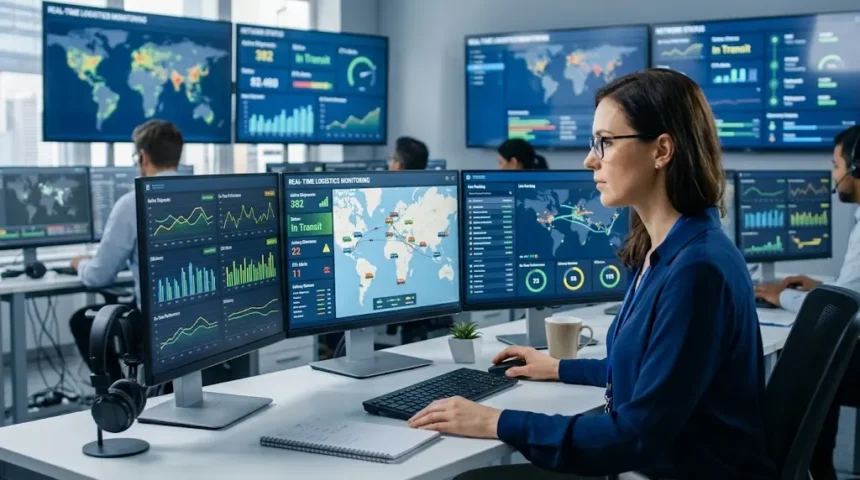
Dashboards provide visual representations of the monitored environment and allow teams to assess current status without reading thousands of individual data points. Common dashboard elements include charts, counters, maps, status indicators, timelines, error summaries, service health information, and key performance indicators. Different teams may require different views because an executive wants business-level information while an engineer needs detailed technical metrics. Well-designed dashboards prioritize the most important signals rather than displaying every available measurement. Too much information can make important changes difficult to notice and encourage teams to ignore the dashboard. Effective visualization therefore depends on understanding what decisions users need to make and presenting the minimum information required to support those decisions.
Alerts complete the real-time monitoring cycle by notifying people or systems when attention is required. Notifications may be sent through email, messaging platforms, incident management tools, mobile applications, automated workflows, or other communication channels. Critical issues may trigger immediate escalation, while lower-priority events can be grouped for later review. Some monitoring environments automatically respond by restarting services, adjusting cloud capacity, blocking suspicious activity, or switching to backup systems. Automation can reduce response time, but it must be carefully designed to avoid making problems worse through inappropriate actions. The strongest monitoring programs connect detection with clearly defined response procedures so that teams know what should happen after an alert appears.
Key Benefits of Real-Time Monitoring
One of the biggest benefits of real-time monitoring is faster problem detection. Without live monitoring, an organization may first learn about a failure when customers complain, employees cannot complete their work, or a scheduled report reveals a problem long after it occurred. Real-time alerts allow technical teams to discover abnormal conditions much earlier and begin investigating immediately. Earlier detection can reduce the duration of outages, prevent smaller problems from spreading, and improve overall service reliability. This is particularly valuable for customer-facing systems where even short periods of downtime can affect revenue and reputation. Faster awareness does not guarantee faster resolution, but it gives teams a crucial head start when incidents occur.
Real-time monitoring can also improve operational efficiency by showing teams exactly where resources or processes are underperforming. Manufacturing managers can identify slow equipment, logistics teams can see delivery delays, and IT teams can detect infrastructure capacity problems before they affect users. Instead of relying entirely on manual inspection, employees can focus their attention on situations that monitoring systems identify as unusual or urgent. Historical monitoring data can also reveal recurring bottlenecks that deserve long-term improvement. When organizations connect monitoring information with operational workflows, they can make decisions based on measurable conditions rather than assumptions. This creates opportunities to reduce wasted time, unnecessary resource consumption, and preventable interruptions.
Better customer experience is another important benefit because many customer problems originate from issues that can be detected through system monitoring. Slow page loading, failed payments, broken login processes, application errors, inventory problems, and unavailable services can all damage user satisfaction. Application performance monitoring can reveal these issues before support teams receive large numbers of complaints. Businesses can also track customer journeys and transaction success rates to understand whether important digital processes are working properly. Faster troubleshooting means customers may experience shorter disruptions and fewer repeated failures. In competitive markets where users expect digital services to work instantly, operational visibility can become an important part of maintaining trust and customer retention.
Security teams depend heavily on real-time monitoring because cyber threats often require immediate investigation. Security monitoring platforms can observe authentication attempts, network traffic, endpoint activity, privilege changes, file access, cloud events, and other signals associated with suspicious behavior. Alerts can help analysts identify unusual login locations, repeated failed access attempts, malware activity, unauthorized changes, or unexpected data movement. Faster detection may reduce the amount of time an attacker has to remain inside an environment without being noticed. Automated responses can sometimes block suspicious sessions or isolate compromised devices while security teams investigate further. Real-time security monitoring is not a complete cybersecurity strategy, but it is a critical component of modern threat detection and incident response.
Real-time monitoring also supports better business decision-making by giving leaders current information about important operations. Retailers can monitor sales activity, inventory availability, and checkout performance, while financial organizations can observe transaction volumes and risk indicators. Logistics companies can track vehicle locations and delivery progress, and digital businesses can watch traffic, conversions, and customer activity. Decision-makers can respond more confidently when they understand what is happening now rather than relying entirely on yesterday’s numbers. Live information is especially useful during product launches, promotional campaigns, major events, or periods of unusual demand. When combined with historical analytics, real-time data gives organizations both immediate awareness and deeper context for planning future actions.
Common Uses of Real-Time Monitoring
IT infrastructure monitoring is one of the most established uses of real-time monitoring. Organizations track servers, cloud resources, databases, storage systems, virtual machines, containers, and other infrastructure components to understand whether they are operating normally. Important metrics may include CPU utilization, memory usage, disk capacity, latency, availability, and system errors. Alerts can warn engineers when resources are approaching limits or when an important service becomes unavailable. Cloud environments can also use monitoring information to support automatic scaling when traffic rises or falls. By maintaining constant visibility into infrastructure health, IT teams can reduce unexpected outages and use computing resources more efficiently.
Application performance monitoring focuses on how software behaves from both technical and user perspectives. Teams may track page load time, API response speed, error rates, database queries, transaction completion, crash frequency, and individual service performance. Distributed applications can be difficult to troubleshoot because a single user request may pass through many services before producing a result. Tracing tools help developers follow these requests and identify where delays or failures occur. Real-time application monitoring is especially valuable after software deployments because teams can immediately see whether a new release creates unexpected problems. Rapid feedback allows developers to fix issues or roll back changes before a large portion of users is affected.
Network monitoring helps organizations maintain reliable communication between devices, applications, offices, cloud services, and the wider internet. Network teams may observe bandwidth usage, packet loss, latency, device availability, connection errors, and unusual traffic patterns. When a router, switch, wireless access point, or network link fails, monitoring can identify the affected component and alert administrators quickly. Traffic analysis can also help teams understand whether performance problems are caused by congestion, misconfiguration, hardware failure, or unexpected demand. In large organizations, manual network inspection would be too slow and difficult to manage consistently. Live network visibility therefore plays an important role in maintaining connectivity and identifying infrastructure problems before they spread.
Security monitoring is another major use case because organizations must continuously observe digital environments for suspicious behavior. Security information and event management platforms can collect information from firewalls, identity systems, endpoints, cloud services, applications, and other security tools. Analysts can correlate these events to identify patterns that would be difficult to detect by examining one system independently. Real-time alerts help teams investigate potentially compromised accounts, unusual network connections, malware detections, policy violations, or unauthorized administrative changes. Monitoring can also support compliance by creating records of important security activity. Effective security operations combine automated detection with trained analysts who can determine whether an alert represents a genuine threat or normal business behavior.
Internet of Things monitoring extends real-time visibility to physical devices, equipment, buildings, vehicles, and industrial systems. IoT sensors can continuously measure temperature, humidity, vibration, location, pressure, energy consumption, or other physical conditions. Manufacturing companies may use these readings to detect machine deterioration, while logistics businesses can monitor vehicles and sensitive shipments. Smart buildings can adjust heating, cooling, and lighting according to occupancy and environmental conditions. Agricultural systems can track soil moisture and weather information to support more efficient irrigation decisions. The ability to connect physical processes with digital monitoring platforms allows organizations to identify problems that previously required frequent manual inspection.
Real-Time Monitoring Examples Across Industries
In ecommerce, real-time monitoring can help businesses understand whether customers can successfully browse products, add items to carts, and complete purchases. An online store may track website response time, checkout error rates, payment failures, inventory availability, traffic spikes, and order volume. If a payment provider begins returning unusual errors, monitoring can alert the operations team before thousands of transactions are affected. During major promotional events, infrastructure dashboards can show whether servers are handling increased demand effectively. Retailers can also watch stock levels and trigger replenishment workflows when inventory falls below defined thresholds. These capabilities help ecommerce companies protect revenue while delivering a smoother shopping experience during both normal and high-demand periods.
Financial organizations use real-time monitoring to evaluate transactions, system performance, fraud risk, and market activity. A payment platform may analyze transactions as they occur and flag unusual amounts, locations, devices, or behavior for additional verification. Banks can monitor digital banking systems for service interruptions and detect abnormal login patterns that may indicate account takeover attempts. Trading platforms require extremely low-latency monitoring because delays can affect financial decisions and regulatory obligations. Real-time transaction monitoring can also help organizations identify operational problems that might otherwise produce duplicate payments or failed transfers. Because financial systems handle valuable and sensitive information, monitoring is closely connected with security, reliability, and risk management.
Manufacturing companies use live monitoring to understand equipment condition, production output, quality, and workplace processes. Sensors attached to machines can measure vibration, temperature, pressure, speed, and other operating characteristics that indicate whether equipment is functioning correctly. If readings move outside an expected range, maintenance teams can investigate before a complete failure occurs. This approach supports predictive maintenance by identifying patterns associated with deterioration rather than waiting for equipment to break unexpectedly. Production dashboards can also show whether individual lines are meeting output targets or experiencing unusual delays. Better visibility can reduce downtime, improve maintenance planning, and help manufacturers use equipment more efficiently throughout its operating life.
Healthcare organizations can use real-time monitoring in both clinical and operational environments, although systems handling patient information require strong privacy and security controls. Medical devices may continuously monitor measurements that clinicians need to evaluate, while hospital operations teams can track equipment availability, system performance, and facility conditions. Digital health applications may monitor technical performance so that patients can reliably access appointments, records, or remote-care services. Temperature monitoring is also important for certain medications, laboratory materials, and storage environments that must remain within controlled ranges. Alerts can notify responsible staff when conditions change unexpectedly. In healthcare, monitoring systems must be designed carefully because inaccurate or missed information can have consequences beyond ordinary business inconvenience.
Transportation and logistics organizations use real-time tracking to monitor vehicles, shipments, routes, delivery progress, and operating conditions. GPS data can show fleet locations and help dispatch teams respond when traffic, weather, or mechanical problems disrupt planned routes. Sensors may monitor temperature-sensitive products such as food or pharmaceuticals while they travel through the supply chain. Delivery platforms can provide customers with live order status and estimated arrival information, improving transparency without requiring constant support calls. Fuel consumption and vehicle performance data can also help fleet managers identify inefficient behavior or maintenance requirements. By connecting location, condition, and scheduling information, real-time monitoring helps logistics teams operate more predictably in environments where circumstances can change quickly.
How to Implement Real-Time Monitoring Effectively
The first step in implementing real-time monitoring is defining what the organization actually needs to observe. Collecting every possible metric creates large amounts of data but does not necessarily produce useful operational insight. Teams should begin with important business services, user journeys, infrastructure components, security risks, or physical processes that would create significant consequences if they failed. From there, they can identify indicators that reveal whether those areas are healthy. An ecommerce business might prioritize checkout success and payment latency, while a manufacturing company may focus on machine temperature and production output. Starting with clear objectives makes tool selection, dashboard design, and alert configuration much easier.
Organizations must then choose monitoring tools that fit their technical environment and operational requirements. Some platforms specialize in infrastructure or application performance monitoring, while others focus on logs, security events, network visibility, IoT devices, or business analytics. Larger organizations may combine several specialized tools and connect their data through common observability or incident management systems. Important considerations include scalability, integrations, data retention, query capabilities, alerting features, automation options, security, and total cost. The platform should also be usable by the teams responsible for responding to its information. A technically powerful monitoring tool provides little value if employees cannot configure it, interpret its dashboards, or investigate alerts efficiently.
Defining meaningful thresholds and alerts is one of the most important parts of implementation. If thresholds are too sensitive, employees may receive hundreds of unnecessary notifications and gradually start ignoring them, a problem commonly known as alert fatigue. If thresholds are too relaxed, significant failures may continue for too long before anyone is notified. Teams should prioritize alerts according to severity, customer impact, security risk, and required response time. Dynamic thresholds or anomaly detection may be helpful in environments where normal activity changes considerably throughout the day. Alert rules should also be reviewed regularly because infrastructure, traffic patterns, and business priorities evolve over time.
Monitoring dashboards should be designed around specific users and decisions rather than technical data alone. An operations engineer may require detailed system metrics, while customer support teams need simple information about whether a service is currently experiencing problems. Business leaders may care more about transaction volume, conversion, order processing, or revenue-related indicators. Creating role-specific dashboards prevents users from searching through irrelevant information whenever a problem occurs. Visual hierarchy should highlight critical conditions and make trends easy to interpret quickly. Dashboards should also provide enough context for teams to investigate further instead of simply showing that something is wrong without indicating where they should begin.
Finally, organizations need response procedures that connect monitoring alerts with real operational action. Teams should know who owns each critical system, how incidents are escalated, what information needs to be recorded, and when customers or stakeholders should be informed. Incident response playbooks can provide structured steps for common situations such as service outages, database failures, security events, or equipment problems. After significant incidents, teams should review what happened and determine whether monitoring could be improved. Perhaps an alert arrived too late, generated unnecessary noise, or failed to include important diagnostic information. Continuous refinement transforms monitoring from a collection of dashboards into a dependable operational capability.
Challenges and Best Practices for Real-Time Monitoring
Data volume is one of the biggest challenges because modern applications and connected environments can produce millions or billions of monitoring events. Storing and processing every log, metric, trace, and sensor reading indefinitely can become expensive and technically difficult. Organizations need policies determining which information requires immediate analysis, which should be sampled, and how long different categories should be retained. Data aggregation can reduce storage requirements while preserving useful long-term trends. Teams should also avoid collecting information simply because a tool makes it technically possible. A focused monitoring strategy captures enough detail to troubleshoot problems while controlling unnecessary infrastructure and licensing costs.
Alert fatigue is another common problem and can undermine an otherwise sophisticated monitoring program. When employees receive repeated notifications for minor or expected events, they naturally begin treating alerts as background noise. This increases the risk that a serious problem will be overlooked when it eventually appears. Alerts should represent situations that require meaningful attention rather than every temporary metric fluctuation. Related events can sometimes be grouped into a single incident instead of generating dozens of separate notifications. Organizations should measure alert quality by asking whether each notification leads to a useful investigation or action, then continuously remove rules that create noise without improving outcomes.
Monitoring systems also need strong security because they often contain sensitive operational information about an organization’s infrastructure, users, applications, and business activity. Access should be restricted according to employee roles, and monitoring accounts should follow appropriate authentication practices. Logs may contain usernames, network addresses, transaction details, or application information that should not be exposed unnecessarily. Organizations should therefore consider data minimization and masking when collecting sensitive fields. Monitoring tools themselves must also receive security updates and be included in broader access reviews. A platform designed to improve security or reliability should not become an additional source of risk because permissions were configured carelessly.
Context is another challenge because an alert can accurately report a technical problem without explaining whether it matters to customers or the business. A server reaching high CPU usage may be completely normal during a scheduled workload, while a smaller increase in checkout errors could represent a serious revenue problem. Effective monitoring therefore connects technical signals with service dependencies, customer journeys, and business outcomes. Teams should understand which applications depend on particular infrastructure components and which processes are most critical. Service maps and distributed tracing can provide useful context in complex environments. The more closely monitoring reflects actual user impact, the easier it becomes to prioritize incidents correctly.
The best real-time monitoring programs evolve continuously rather than remaining unchanged after their initial implementation. New software releases, cloud migrations, business growth, security threats, and customer expectations can all change which signals deserve attention. Teams should regularly review dashboards, alert thresholds, data retention policies, monitoring coverage, and incident response procedures. Monitoring gaps discovered during outages should become opportunities to improve future detection and diagnosis. Organizations should also track whether monitoring investments are reducing downtime, response times, security risk, or operational inefficiency. When treated as an ongoing operational discipline, real-time monitoring becomes more accurate, less noisy, and increasingly valuable as the business changes.
Frequently Asked Questions About Real-Time Monitoring
What is real-time monitoring in simple terms?
Real-time monitoring means continuously watching systems, devices, processes, or data so that important changes can be detected almost immediately. It helps organizations see what is happening now rather than waiting for a later report.
What is an example of real-time monitoring?
A simple example is a website monitoring system that checks application availability and immediately alerts an IT team when the site stops responding. Other examples include fraud detection, GPS fleet tracking, machine sensor monitoring, and live cybersecurity alerts.
What is the main benefit of real-time monitoring?
The main benefit is faster visibility into problems and changing conditions. Earlier detection can reduce downtime, improve security, speed up troubleshooting, and help teams make more informed operational decisions.
What data is used in real-time monitoring?
Real-time monitoring systems may use metrics, logs, traces, events, network data, transaction information, location data, and IoT sensor readings. The appropriate data depends on the system or business process being monitored.
Is real-time monitoring the same as observability?
Not exactly. Monitoring generally tracks known indicators and conditions, while observability provides broader information that helps teams investigate both known and unexpected problems in complex systems.