
Telemetry Meaning: How Remote Data Collection Works
Telemetry is the process of automatically collecting measurements from devices, machines, software, vehicles, sensors, or other systems and transmitting that information to another location for monitoring and analysis. The word is commonly associated with satellites, spacecraft, medical equipment, industrial machinery, automobiles, computer networks, and Internet of Things devices. Instead of requiring a person to physically inspect every system, telemetry allows information such as temperature, pressure, speed, location, battery level, error rates, or equipment status to be collected remotely. The data can then be displayed on dashboards, stored for historical analysis, or used to trigger automated actions. Modern telemetry systems can transmit information continuously or only when certain events occur. This ability to observe systems from a distance has become essential to many digital and physical operations.
The concept is not new, but modern cloud computing, wireless networks, inexpensive sensors, and IoT platforms have dramatically expanded where telemetry can be used. A fleet manager can monitor thousands of vehicles, a factory can identify unusual machine vibration, and a software company can detect application errors without visiting the user’s computer. Healthcare devices can send measurements to monitoring platforms, while weather stations can report environmental conditions from remote locations. In each case, telemetry turns physical or digital activity into data that can be understood somewhere else. The value comes not simply from collecting large amounts of information but from using that information to improve decisions, reliability, safety, and performance. Understanding the meaning of telemetry makes many modern technologies easier to understand.
What Does Telemetry Mean?
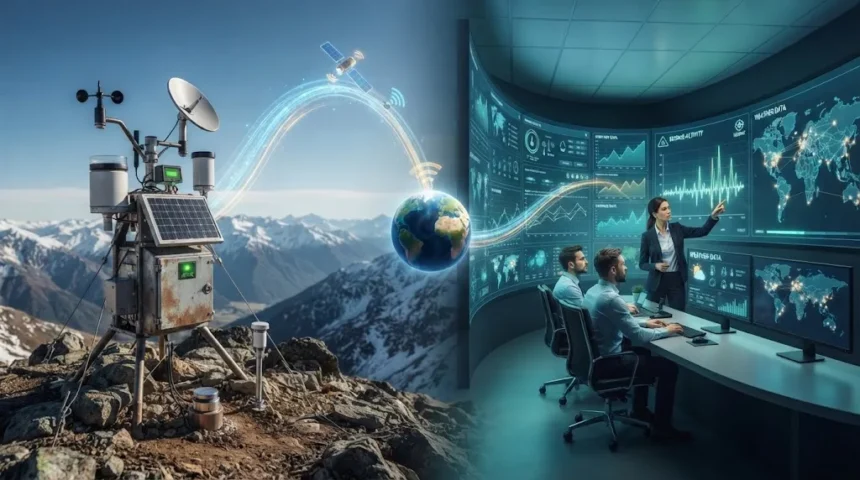
The simplest telemetry meaning is remote measurement and data transmission. A telemetry-enabled system measures something at one location and sends the resulting data to another system where it can be monitored, stored, or analyzed. The source could be a physical sensor measuring temperature or a software application recording response times and errors. The destination might be a nearby control room, a centralized server, a cloud platform, or a mobile application. Communication can occur through cellular networks, Wi-Fi, satellite links, radio, wired networks, or internet protocols. What makes the process telemetry is the automatic movement of measured information from the monitored system to another location.
Telemetry typically begins with a measurable condition or event. A sensor may detect pressure inside a pipeline, a vehicle computer may record engine temperature, or a web server may track how long an application request takes to complete. These measurements are converted into data that a computer system can process. The information may be transmitted immediately, collected into batches, or sent only when a threshold is exceeded. Once received, software can organize the readings and present them through dashboards, alerts, reports, or analytical models. The entire process allows people to understand what is happening remotely without needing direct physical access to the original system.
The word telemetry is sometimes used interchangeably with monitoring, but the two concepts are not exactly identical. Monitoring describes the broader activity of observing the condition or performance of a system, while telemetry describes one of the main ways information is gathered for that observation. A monitoring dashboard may depend on telemetry coming from dozens of servers, sensors, or devices. Similarly, telemetry can be collected even when nobody is watching a dashboard at that exact moment. The information might simply be stored for later analysis or used by automated software. In practice, telemetry and monitoring work closely together because accurate remote monitoring requires dependable data from the systems being observed.
Telemetry should also be distinguished from ordinary data logging. A device can log information locally without sending it anywhere, such as a machine storing temperature measurements inside its own memory. Telemetry adds the transmission component by moving that information to another location. Logging and telemetry are often used together because a system may record detailed events locally while transmitting selected metrics to a central platform. This distinction matters when network connectivity is unreliable because a device can continue logging data even when it cannot transmit immediately. Once the connection returns, stored information may be uploaded. Well-designed systems therefore combine local resilience with remote visibility.
The purpose of telemetry is ultimately to reduce uncertainty about systems that cannot or should not be inspected continuously by people. Organizations use it to identify problems early, optimize resources, understand behavior, improve safety, and support automated decision-making. A utility provider can monitor electrical infrastructure across a wide region, while a software company can detect rising error rates within seconds. Space agencies rely on telemetry because spacecraft can be millions of kilometers away from engineers. The same principle now applies to everyday connected devices. Wherever a system produces measurable information and remote visibility creates value, telemetry can become an important part of the technology architecture.
How Does Telemetry Work?
A telemetry system usually starts with data collection at the source. Physical systems use sensors to measure conditions such as temperature, humidity, pressure, vibration, voltage, movement, location, or fluid flow. Digital systems can collect metrics directly from software, operating systems, networks, databases, or applications. These raw measurements are often converted into standardized values that software can understand. The system may also add information such as timestamps, device identifiers, location, or status codes so the measurement has useful context. Without this context, a temperature reading of 80 degrees would be difficult to interpret because nobody would know when, where, or from which device the value came.
After collection, telemetry data may be processed before transmission. Edge devices can remove duplicate readings, compress information, calculate averages, detect abnormal conditions, or convert measurements into standardized formats. This processing helps reduce bandwidth and prevents central systems from receiving unnecessary data. For example, a vibration sensor in a factory might generate thousands of readings per second, but the edge device may transmit only summarized patterns or unusual changes. In other environments, every raw measurement may be needed for detailed analysis. The amount of processing performed locally depends on network capacity, device power, latency requirements, and the importance of the information being collected.
The next stage is transmission. Telemetry data can travel through wired Ethernet, Wi-Fi, Bluetooth, cellular networks, low-power wide-area networks, radio systems, or satellite communication depending on where the source is located. A wearable device might send information to a smartphone using Bluetooth before the phone forwards it to the cloud. An agricultural sensor in a remote field may use a low-power wireless network designed to operate across long distances. A ship or remote scientific station may depend on satellite connectivity because terrestrial networks are unavailable. Choosing the transmission method requires balancing coverage, speed, cost, power consumption, reliability, and the amount of data being sent.
Once telemetry reaches its destination, the receiving system has to ingest and organize the information. Cloud platforms and centralized servers often use message brokers, databases, data pipelines, and streaming technologies to handle large volumes of incoming measurements. The system may validate whether data came from an authorized device and check whether values appear structurally correct. Information can then be stored as time-series data because telemetry is frequently analyzed according to how measurements change over time. The storage architecture must also accommodate the scale of the system. A few devices sending one measurement every hour creates very different requirements from millions of devices transmitting multiple events every second.
Finally, telemetry becomes useful through analysis and action. Dashboards can show current conditions, while alerting systems can notify people when readings cross predefined thresholds. Historical analysis can reveal trends such as steadily rising machine temperature or increasing software latency over several weeks. Machine learning models may identify unusual patterns that simple thresholds would miss. Some telemetry systems also trigger automatic responses, such as shutting down equipment when dangerous conditions are detected. This closes the loop between measurement and operational control. The real value of telemetry therefore comes not from moving data alone but from turning remote measurements into information that supports faster and better decisions.
Key Components of a Telemetry System
Sensors are fundamental components of physical telemetry systems because they convert real-world conditions into measurable signals. Different sensors are designed for different environments and may measure temperature, acceleration, sound, pressure, light, humidity, chemical concentration, position, or many other variables. The accuracy and reliability of telemetry depend heavily on sensor quality and correct installation. A poorly calibrated sensor can produce misleading data even when the communication system works perfectly. Sensors may also operate in harsh environments involving heat, vibration, water, dust, radiation, or extreme cold. Selecting the right sensor therefore requires understanding both what must be measured and where the device will operate.
A telemetry device or data acquisition unit usually sits between the sensor and communication network. This hardware collects signals, converts them into digital information, and may process measurements before transmission. It can also manage multiple sensors simultaneously and attach metadata such as device identification or timestamps. Some devices contain processors powerful enough to run advanced analytics directly at the edge. Others are intentionally simple because they need to operate for years on small batteries. The design depends on how quickly data must be processed and how difficult the device is to maintain. Remote systems often prioritize low power consumption and reliability because replacing batteries or hardware can be expensive.
Communication modules connect telemetry sources with receiving systems. These modules may support cellular technologies, Wi-Fi, Bluetooth, radio, satellite communication, Ethernet, or specialized IoT networking protocols. Devices that move, such as vehicles, need communication that remains available across changing locations. Fixed industrial equipment may rely on wired networking because it provides high reliability and does not require battery power. Remote environmental sensors may use networks optimized for transmitting very small amounts of information over long distances. Communication systems also need methods for handling temporary failures. Devices may store data locally until connectivity returns, preventing information from being permanently lost when the network becomes unavailable.
Central telemetry platforms receive, store, and manage data coming from devices or software systems. These platforms may run inside company data centers or use cloud infrastructure that can scale as the number of devices grows. They often include device registries, data ingestion services, authentication systems, storage databases, alerting tools, and dashboards. Large deployments may process millions of events and need systems capable of handling sudden spikes without dropping information. The platform must also maintain relationships between measurements and their original sources. Without strong device management, organizations can struggle to determine which sensor or application produced a particular reading when problems occur.
Visualization and analytics tools form the user-facing layer of the telemetry architecture. Dashboards may show current temperatures, maps of moving vehicles, CPU usage, patient readings, network traffic, or machine health depending on the use case. Historical graphs allow users to compare current performance with previous periods and identify unusual behavior. Alerting systems can notify technicians through email, messaging applications, or incident-management tools when important metrics change. Advanced platforms may use predictive analytics to estimate when equipment will fail or when software demand will exceed available capacity. These tools transform raw telemetry into operational understanding. Without useful visualization and analysis, organizations can collect enormous quantities of data without receiving meaningful value.
Types of Telemetry and Data Transmission
Wireless telemetry is widely used when sensors or devices are mobile, geographically dispersed, or difficult to connect with physical cables. Cellular networks allow vehicles, industrial equipment, and remote devices to transmit data anywhere suitable mobile coverage exists. Wi-Fi is useful within buildings and campuses where local network infrastructure is already available. Bluetooth supports short-range communication and is common in wearables, healthcare devices, and consumer electronics. Specialized IoT networks can transmit small packets over longer distances while using very little battery power. Wireless systems make deployment flexible, but engineers must consider interference, signal strength, network availability, security, and ongoing connectivity costs.
Wired telemetry remains valuable because physical network connections can provide excellent reliability, high bandwidth, and predictable latency. Industrial facilities may connect machines using Ethernet, serial communication, fieldbus technologies, or other wired protocols. Data centers also rely heavily on wired connections because servers generate large amounts of operational telemetry. Wired systems avoid many battery and radio-coverage concerns, although installation can become expensive across large or physically difficult environments. Cables can also be damaged or become impractical for moving equipment. The choice between wired and wireless telemetry therefore depends on the physical environment and performance requirements rather than one method always being superior.
Satellite telemetry becomes important when systems operate beyond ordinary terrestrial communication networks. Ships, aircraft, scientific equipment, weather stations, pipelines, and remote infrastructure may use satellites to transmit critical information. Spacecraft rely heavily on telemetry because engineers on Earth need continuous information about onboard systems, position, power, temperature, and scientific instruments. Satellite communication provides enormous geographic reach but can have higher costs, greater latency, and limited bandwidth compared with terrestrial networks. Engineers therefore prioritize which measurements genuinely need transmission. Data compression and scheduled communication windows can help use available bandwidth efficiently. Satellite telemetry demonstrates how remote data collection can operate across extremely large distances.
Software telemetry uses internet and network protocols rather than physical sensors to describe what digital systems are doing. Applications can automatically transmit usage metrics, crashes, errors, latency, feature interactions, and performance measurements to centralized monitoring platforms. Cloud infrastructure generates telemetry about processor utilization, memory consumption, database activity, storage capacity, and network traffic. This information helps engineers identify problems and understand how software behaves under real customer workloads. Software telemetry can be transmitted continuously through APIs, agents, message queues, or observability platforms. Because digital systems can generate enormous event volumes, organizations often sample, aggregate, or filter telemetry to prevent storage costs from growing unnecessarily.
Telemetry can also be categorized according to timing. Real-time telemetry sends information quickly enough that users can respond to conditions as they happen, which is important for safety systems, medical monitoring, industrial control, and network operations. Near-real-time systems may tolerate delays of several seconds or minutes while still supporting useful operational decisions. Batch telemetry collects data over a period and uploads it later, reducing communication costs and power consumption. Event-driven telemetry transmits information mainly when something meaningful occurs, such as a fault or threshold violation. Choosing the right timing model prevents organizations from treating every measurement as equally urgent and helps balance responsiveness against bandwidth, power, storage, and cost.
Where Is Telemetry Used?
Industrial companies use telemetry to monitor machinery, production lines, pipelines, utilities, and remote facilities. Sensors can track temperature, vibration, pressure, flow rates, energy consumption, and other conditions that reveal whether equipment is operating normally. When unusual patterns appear, maintenance teams can investigate before a complete failure interrupts production. This approach supports predictive maintenance, where data helps estimate when components are likely to require repair or replacement. Telemetry can also improve worker safety by detecting dangerous environmental conditions or equipment behavior. Industrial systems often combine telemetry with automation so certain actions occur automatically when predefined conditions are detected.
Vehicles increasingly generate telemetry about location, speed, fuel consumption, engine performance, battery condition, tire pressure, and driver behavior. Fleet operators use this information to plan routes, reduce fuel costs, schedule maintenance, and understand how vehicles are being used. Electric vehicles can report charging state, battery temperature, energy consumption, and other performance data. Modern connected cars also use telemetry to help manufacturers understand technical problems and improve future software updates. Motorsport teams depend heavily on real-time telemetry during races because engineers need immediate information about engine condition, tires, brakes, and vehicle dynamics. Transportation telemetry therefore supports both everyday operational efficiency and highly advanced performance analysis.
Healthcare telemetry makes it possible to monitor certain patient measurements without requiring continuous bedside observation. Devices may collect heart rhythm, oxygen saturation, blood pressure, glucose readings, or other physiological information depending on the clinical situation. Hospital telemetry systems can transmit readings to centralized monitoring stations where trained staff watch for important changes. Remote patient monitoring may allow some information to be transmitted from a person’s home to healthcare systems. These technologies can improve visibility, but clinical decisions still require appropriate professional interpretation. Medical telemetry systems also need strong privacy, accuracy, reliability, and security because errors or unauthorized access can have more serious consequences than ordinary consumer-device failures.
Software and cloud platforms rely on telemetry to maintain reliable digital services. Developers collect application logs, performance metrics, request traces, error rates, database statistics, and infrastructure measurements to understand what is happening inside complex systems. When a website becomes slow, telemetry can reveal whether the cause involves database queries, network latency, processor limits, or a particular software service. DevOps and site reliability engineering teams use this information to maintain availability and respond quickly to incidents. Telemetry also helps software companies understand which features are used most often, although user-data collection should be handled transparently and responsibly. Modern digital services would be extremely difficult to operate at scale without this continuous visibility.
Scientific and environmental applications also depend on telemetry. Weather stations automatically transmit temperature, rainfall, wind speed, atmospheric pressure, and humidity readings from locations that would be difficult to inspect manually. Ocean buoys can report wave conditions and water temperature, while wildlife researchers may use tracking devices to study animal movement. Earthquake and volcano monitoring systems collect measurements that help scientists understand changing geological conditions. Spacecraft transmit engineering and scientific telemetry from environments humans cannot directly access. Agriculture increasingly uses remote sensors for soil moisture, equipment condition, and environmental measurements. Across these fields, telemetry expands the amount of information people can gather while reducing the need for constant physical presence.
Benefits of Telemetry
One of the biggest benefits of telemetry is remote visibility. Organizations can understand what is happening across large numbers of devices, locations, or software systems without sending people to inspect everything manually. A utility company can monitor equipment spread across hundreds of kilometers, while an IT team can observe servers operating in several data centers. This reduces travel, labor, and response time. Problems can often be identified within minutes rather than waiting until a customer complains or equipment stops working completely. Remote visibility becomes especially valuable when assets operate in dangerous, inaccessible, or distant environments. Telemetry effectively gives organizations a continuously updated window into systems they cannot physically watch.
Telemetry can also improve reliability by identifying warning signs before serious failures occur. A machine bearing may begin producing unusual vibration days before it fails, while a server may show gradually rising memory usage before an outage. Historical telemetry makes these trends easier to recognize. Maintenance teams can then schedule repairs during planned downtime instead of responding after an emergency. Predictive analytics can make this process even more sophisticated by comparing current behavior with large amounts of previous performance data. Preventing even a few major failures can produce significant financial savings in industries where downtime is expensive. Better reliability can also improve customer satisfaction because services become more consistent.
Efficiency is another major advantage. Telemetry reveals how resources are actually being used rather than forcing organizations to rely on assumptions. Fleet managers can identify routes that waste fuel, building managers can understand energy consumption, and cloud teams can see whether servers are underused or overloaded. This information supports better scheduling, capacity planning, and resource allocation. Small improvements become meaningful when applied across thousands of machines or millions of digital transactions. Organizations can also compare sites, devices, or teams to identify unusually high consumption or poor performance. Data-driven optimization becomes much easier when telemetry provides accurate measurements rather than occasional manual estimates.
Safety can improve when telemetry detects conditions that would otherwise remain unnoticed. Industrial sensors can identify gas leaks, overheating, pressure changes, or electrical problems before workers enter dangerous areas. Vehicle telemetry can reveal mechanical problems or risky operating conditions. Healthcare telemetry can provide timely information when certain patient measurements move outside expected ranges. Environmental monitoring can alert authorities to changing weather or infrastructure conditions. Automated alerts reduce dependence on someone being physically present at the exact moment a problem begins. However, safety-critical telemetry needs reliable sensors, networks, alerts, and human procedures because inaccurate readings or ignored warnings can create false confidence.
Telemetry also supports better long-term decision-making. Historical datasets reveal how systems behave across seasons, workloads, locations, and changing operating conditions. Organizations can use these patterns when designing future products, planning infrastructure, forecasting demand, or improving maintenance schedules. Product teams can understand which device capabilities create the most value, while engineering teams can identify recurring technical weaknesses. Machine learning models can use telemetry as training data for predictions and anomaly detection. The benefit therefore extends far beyond real-time monitoring. A well-designed telemetry program creates a growing knowledge base that helps organizations understand both current performance and how their systems evolve over time.
Telemetry Challenges, Security, and Privacy
Collecting telemetry at large scale can create enormous volumes of data. A single sensor transmitting once every minute generates more than half a million readings in a year, and industrial sites may contain thousands of sensors. Software platforms can create even larger event streams because every user request can generate several metrics, logs, and traces. Storing all of this information indefinitely can become expensive and difficult to manage. Organizations therefore need retention policies, aggregation, compression, and sampling strategies. High-resolution data may be stored briefly while summarized measurements remain available for longer periods. Good telemetry design focuses on useful information rather than collecting every possible measurement simply because technology makes it easy.
Network reliability is another challenge because remote devices cannot always maintain continuous connectivity. A cellular sensor may move outside coverage, while storms can interrupt satellite or radio communication. Industrial networks may experience outages or maintenance windows. Telemetry systems need to tolerate these failures without losing important information. Devices can buffer measurements locally and transmit them when connectivity returns. Critical alerts may use redundant communication methods when delays would create unacceptable risk. Receiving platforms should also recognize when a device unexpectedly stops reporting because missing telemetry can itself indicate a problem. Reliability requires planning for communication failure rather than assuming every connection will remain available permanently.
Security is essential because attackers may target telemetry devices, communication channels, or central platforms. Unauthorized access could expose operational information, manipulate sensor readings, or potentially provide a route into larger networks. Devices should authenticate securely before transmitting data, and communications should use appropriate encryption whenever supported. Default passwords and outdated firmware can create avoidable vulnerabilities, particularly in IoT deployments containing thousands of devices. Organizations also need processes for updating devices after installation. Network segmentation can reduce the impact of a compromised sensor by preventing it from accessing unrelated systems. Secure telemetry therefore requires attention throughout the entire lifecycle, from device manufacturing and provisioning to eventual retirement.
Privacy becomes important when telemetry describes people rather than only machines. Smartphones, vehicles, wearable devices, websites, and applications can generate information about location, behavior, health, usage patterns, or personal preferences. Organizations should collect only information that serves a legitimate purpose and explain how that information is used. Data minimization can reduce both privacy risk and storage costs. Access controls should prevent employees from viewing detailed user telemetry unless their role requires it. Retention periods also matter because historical location or behavioral information can remain sensitive long after it was collected. Responsible telemetry design considers user expectations instead of assuming that technically collectible data should automatically be stored.
Accuracy is another important challenge because decisions are only as reliable as the measurements supporting them. Sensors drift over time, clocks become unsynchronized, software agents malfunction, and transmission errors can produce incomplete datasets. Engineers need calibration schedules, validation checks, quality monitoring, and clear handling of missing values. Sudden impossible measurements should be identified before they trigger inappropriate automated actions. Metadata can also become inaccurate when devices are moved but inventory systems are not updated. A temperature reading from “Sensor 42” provides little value when nobody knows where Sensor 42 is actually installed. High-quality telemetry therefore depends on disciplined data management as much as on sensors and communication technology.
Telemetry Best Practices
Start by defining exactly why telemetry is being collected. A vague goal such as “monitor everything” usually leads to unnecessary data volume and confusing dashboards. Instead, identify questions the system needs to answer, such as whether equipment is overheating, whether an application meets response-time targets, or whether a fleet is consuming fuel efficiently. These questions determine which measurements genuinely matter. Each metric should have a clear definition, source, frequency, unit, and intended use. This approach makes telemetry easier to maintain because engineers understand why every important measurement exists. New metrics can always be added when new questions emerge rather than collecting unlimited data from the beginning.
Choose collection intervals according to how quickly the underlying condition changes. A safety-critical pressure measurement may need to be transmitted many times per second, while a remote battery level might require only one update every hour. Sampling too slowly can hide important events, but sampling too quickly creates unnecessary bandwidth and storage costs. Event-driven reporting can provide an effective compromise by transmitting routine summaries while immediately sending alerts when conditions change significantly. Edge processing can also calculate averages or detect anomalies before data leaves the device. Matching telemetry frequency to the decision being supported creates a more efficient system without sacrificing useful visibility.
Standardize naming, units, and metadata across devices and systems. One sensor reporting temperature in Celsius while another uses Fahrenheit can create serious analytical mistakes if units are not recorded clearly. Software teams face similar problems when separate services use different names for equivalent metrics. Establishing consistent schemas makes dashboards, alerts, and analytics easier to build. Every reading should ideally include enough context to identify the source, timestamp, unit, and relevant operational information. Device inventories should also stay synchronized with physical installations. Standardization can feel administrative during early deployment, but it becomes extremely valuable once the system grows to thousands or millions of telemetry sources.
Design alerts carefully so users receive information that genuinely requires attention. If every small fluctuation generates a notification, operators can become overwhelmed and start ignoring alerts entirely. Thresholds should reflect meaningful operational conditions rather than arbitrary numbers. More advanced systems can combine several measurements or use anomaly detection to identify unusual patterns. Alerts should also include enough context for the recipient to understand what happened and what action may be required. Severity levels can distinguish minor warnings from critical failures. Regularly review alert performance because systems change over time, and a threshold that worked last year may no longer reflect current operating conditions.
Finally, treat telemetry as a complete lifecycle rather than a one-time engineering project. Devices need maintenance, software agents require updates, schemas evolve, dashboards change, and business questions shift. Periodically review whether collected data is still useful and remove measurements that no longer support decisions. Test failure scenarios so teams know what happens when devices disconnect or central platforms become unavailable. Monitor the telemetry pipeline itself because a broken monitoring system can make healthy infrastructure appear silent. Security and privacy controls should also be reassessed as risks change. A mature telemetry program continuously improves both the quality of the data and the organization’s ability to use it responsibly.
The Future of Telemetry and Remote Monitoring
The future of telemetry is increasingly connected with the growth of the Internet of Things. More physical objects are gaining sensors, processors, and network connections, allowing businesses to monitor equipment that previously operated without digital visibility. Smart buildings can measure energy use, occupancy, air quality, and equipment performance. Agriculture can use connected sensors to understand soil and environmental conditions across large areas. Logistics systems can monitor shipments, temperature-sensitive goods, and transportation assets. As sensor costs continue falling, telemetry will become practical for more everyday objects. The challenge will shift from obtaining measurements toward deciding which information is useful enough to collect and how organizations should manage it responsibly.
Edge computing will play a larger role because transmitting every raw measurement to the cloud is not always efficient. Devices and nearby gateways can analyze information locally and send only meaningful results. A camera system, for example, may process video at the edge and transmit detected events rather than uploading every frame. Industrial equipment can identify vibration anomalies locally and immediately trigger protective actions even when internet connectivity is unavailable. This reduces bandwidth and latency while improving resilience. Cloud platforms will still provide centralized analytics and long-term storage, but intelligence will increasingly be distributed between devices, edge systems, and central infrastructure. Telemetry architectures are therefore becoming more decentralized.
Artificial intelligence will make telemetry analysis more predictive. Traditional systems often rely on fixed thresholds, such as generating an alert when temperature exceeds a predefined limit. Machine learning can analyze combinations of signals and identify unusual patterns before individual measurements reach obvious danger levels. Predictive maintenance systems may estimate the remaining useful life of machine components based on vibration, temperature, workload, and historical failure data. Software observability platforms can identify relationships between application changes and performance degradation. AI does not remove the need for accurate telemetry because models still depend on high-quality data. Instead, better analytics increases the value organizations can extract from measurements they already collect.
Connectivity improvements will also expand where telemetry can operate. Modern cellular networks, low-power IoT technologies, satellite services, and specialized industrial networking can connect devices across environments that were previously difficult or expensive to monitor. Remote infrastructure, agricultural equipment, ships, wildlife tracking devices, and distributed energy systems can increasingly send information without relying on conventional broadband. However, connectivity diversity means telemetry platforms need to support devices with very different bandwidth and power limitations. A high-capacity factory connection can send detailed information continuously, while a battery-powered remote sensor may transmit only a few bytes periodically. Flexible architectures will be essential as connected systems become more varied.
Despite technological advances, the core purpose of telemetry will remain the same: make distant systems understandable through reliable measurements. Future platforms may use more automation, artificial intelligence, edge processing, and advanced wireless networks, but they still depend on accurate data reaching the right place at the right time. Organizations that collect information without clear goals can become overwhelmed regardless of how advanced their technology becomes. The strongest systems will combine thoughtful measurement design with secure communication, useful analysis, and clear operational actions. Telemetry will continue to become more invisible as it is built into everyday infrastructure and software. Its impact, however, will become more significant as decisions increasingly depend on real-time data.
Frequently Asked Questions About Telemetry
What does telemetry mean in simple terms?
Telemetry means automatically measuring information in one location and sending that data somewhere else for monitoring or analysis. It allows people and software to understand what remote devices, machines, or systems are doing without physically inspecting them.
What is an example of telemetry?
A vehicle sending its location, speed, fuel level, and engine temperature to a fleet management platform is an example of telemetry. Another example is a server transmitting CPU usage and error rates to a cloud monitoring dashboard.
What is telemetry used for?
Telemetry is used for remote monitoring, predictive maintenance, safety alerts, performance optimization, scientific research, healthcare monitoring, vehicle tracking, software observability, and many other applications. Its purpose is generally to provide timely information about systems that cannot be watched manually all the time.
What is the difference between telemetry and monitoring?
Telemetry is the process of collecting and transmitting remote measurements, while monitoring is the broader activity of observing a system’s condition or performance. Monitoring platforms often depend on telemetry as one of their primary data sources.
Is telemetry the same as IoT?
No. IoT describes networks of connected physical devices, while telemetry describes the collection and transmission of measurements from systems. Many IoT devices use telemetry, but telemetry also exists in software, spacecraft, vehicles, healthcare, and other environments that may not be described as IoT.
What is software telemetry?
Software telemetry is automatically collected information about applications, servers, operating systems, or digital services. Common examples include response times, crashes, errors, feature usage, CPU utilization, database activity, and network performance.
What is real-time telemetry?
Real-time telemetry sends measurements quickly enough that users or automated systems can respond to changing conditions almost immediately. It is particularly valuable in industrial control, healthcare monitoring, transportation, network operations, and other time-sensitive applications.
Is telemetry data secure?
Telemetry can be secure when organizations use appropriate authentication, encryption, access controls, device management, and network security. Poorly protected IoT devices or telemetry platforms can create security and privacy risks.
Can telemetry work without the internet?
Yes. Telemetry can use radio, satellite, dedicated wired networks, Bluetooth, cellular connections, and other communication methods that do not necessarily depend on the public internet. Devices can also store data locally and transmit it later when connectivity becomes available.
Why is telemetry important?
Telemetry gives organizations visibility into remote systems so they can identify problems, improve efficiency, reduce downtime, increase safety, and make better decisions. It becomes especially valuable when physical inspection would be slow, expensive, dangerous, or impossible.