

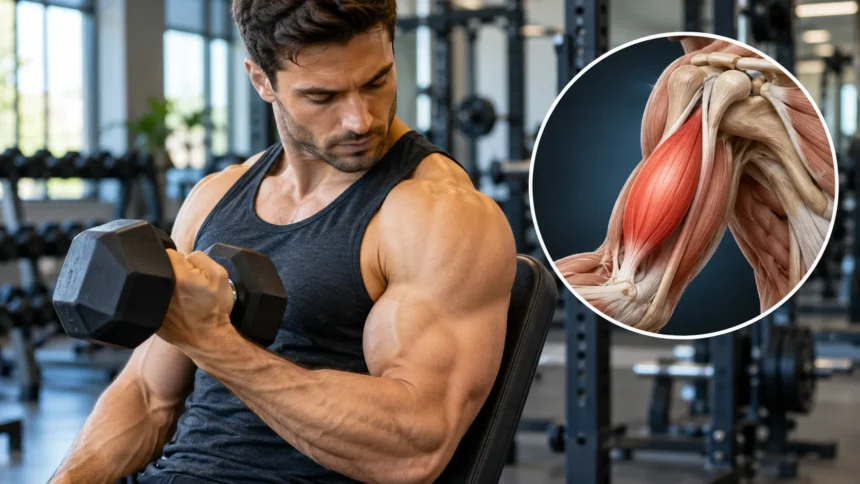
The biceps are among the most recognizable muscles in the human body. Located at the front of the upper arm, they play an important role in bending the elbow, rotating the forearm, and supporting everyday movements. From lifting everyday objects to carrying shopping bags, the biceps help perform many essential physical activities. Understanding how these muscles work can provide useful insights into human anatomy and muscular function.
Although people often associate biceps with arm strength and exercise, their role extends beyond appearance. These muscles coordinate with surrounding structures to support smooth movement at the elbow and shoulder. They also contribute to activities requiring controlled forearm rotation, such as turning a doorknob or using a screwdriver. Their complex anatomy allows them to perform several functions.
This guide explains what biceps are, their anatomical structure, main functions, and relationship with other arm muscles. You will also learn about common biceps injuries, basic strengthening movements, and important facts about muscle health. Whether you are studying anatomy or simply want to understand how your arms work, this article covers the essential information.
What Are Biceps?
The biceps are muscles with two distinct heads or points of origin. When people refer to the biceps, they usually mean the biceps brachii, a prominent muscle located on the front of the upper arm. The term comes from Latin words meaning two-headed muscle of the arm. Its structure allows it to contribute to multiple upper-limb movements.
The biceps brachii is a skeletal muscle, meaning it works under voluntary control. It contracts when activated by signals from the nervous system and works alongside other muscles to produce movement. Its most familiar action is bending the elbow. However, the muscle is also important for rotating the forearm and contributing to certain shoulder movements.
The biceps are part of a larger network of muscles, tendons, bones, and nerves. Their effectiveness depends on coordination with neighboring structures rather than independent action. Understanding this relationship helps explain why arm movement involves several muscles working together. The biceps are essential, but they are not responsible for every movement of the upper arm.
Biceps Anatomy: Structure and Location
The biceps brachii is located in the anterior compartment of the upper arm, between the shoulder and elbow. It has two heads called the long head and short head. Both originate from different locations on the scapula, commonly known as the shoulder blade. They join together to form a shared muscle belly.
The long head originates from the supraglenoid tubercle of the scapula, while the short head originates from the coracoid process. The muscle continues down the front of the upper arm before forming a tendon near the elbow. This tendon attaches primarily to the radial tuberosity of the radius. Another structure, the bicipital aponeurosis, extends into the forearm fascia.
Because the biceps crosses both the shoulder and elbow joints, it can influence movement at more than one location. Its arrangement also gives it a strong mechanical role in forearm rotation. The surrounding muscles contribute to stability and movement control. These anatomical features make the biceps an important component of upper-limb function.
The Long Head of the Biceps: Anatomy and Role
The long head of the biceps begins at the supraglenoid tubercle near the upper portion of the shoulder socket. Its tendon travels through the shoulder joint region and along a groove in the upper arm bone. This pathway places it close to important structures involved in shoulder stability. It continues downward to join the short head.
The long head contributes to elbow flexion and forearm supination alongside the rest of the biceps muscle. It also participates in certain shoulder movements, although its exact mechanical contribution varies with arm position. The long-head tendon can experience irritation or injury. Problems in this region may produce discomfort near the front of the shoulder.
Long-head biceps tendon disorders are often considered when evaluating persistent shoulder pain. However, similar symptoms can arise from rotator cuff conditions or other shoulder problems. A healthcare professional may assess tenderness, movement, and strength to identify the source. Accurate diagnosis is important because not every painful shoulder involves the biceps tendon.
The Short Head of the Biceps: Structure and Function
The short head of the biceps originates from the coracoid process of the scapula. Unlike the long head, its tendon does not pass through the same shoulder groove. It joins the long head to form the main biceps muscle belly. Together, both heads contribute to elbow bending and rotation of the forearm.
The short head also contributes to selected shoulder movements, particularly when the arm moves forward or toward the body. Its role varies depending on joint position and the activity being performed. The muscle works with other structures rather than acting alone. This coordination helps support controlled upper-limb movement.
Injury involving the short head is less commonly discussed than certain long-head tendon problems. However, muscle strains and other soft-tissue injuries can affect different portions of the biceps. Pain or weakness should be assessed in relation to the complete upper arm and shoulder. Understanding both heads provides a more accurate picture of biceps anatomy.
What Is the Main Function of the Biceps?
One of the primary functions of the biceps brachii is elbow flexion, which means bending the elbow to bring the forearm closer to the upper arm. This movement is essential during activities such as lifting objects and bringing food toward the mouth. The biceps contributes alongside other elbow flexor muscles.
Another major function is forearm supination, which rotates the forearm so the palm faces upward when the elbow is bent. This action is especially important during activities requiring precise hand positioning. The biceps is a powerful supinator, particularly when the elbow is flexed. Its contribution changes according to the forearm’s starting position.
The biceps also assists certain shoulder movements because its two heads originate from the scapula. However, it is not the main muscle responsible for raising the arm. Shoulder movement involves the deltoid, rotator cuff, and other surrounding muscles. The biceps works as part of this coordinated system to support everyday arm function.
Biceps and Elbow Flexion: How the Movement Works
Elbow flexion occurs when the angle between the upper arm and forearm decreases. The biceps contracts to help create this movement while the elbow joint provides the necessary mechanical structure. This action is used frequently during daily activities. Lifting a cup, carrying an object, and bringing the hand toward the face all involve elbow flexion.
The biceps is not the only muscle responsible for bending the elbow. The brachialis is another important elbow flexor and contributes regardless of forearm rotation. The brachioradialis also assists, particularly in certain forearm positions. These muscles work together to produce smooth and controlled movement.
The relative contribution of each muscle changes with the position of the hand and forearm. The biceps becomes especially important when the forearm is supinated. During other positions, surrounding muscles may contribute more prominently. Understanding these relationships helps explain why arm movements feel different depending on grip and orientation.
How Biceps Help Rotate the Forearm
Forearm rotation is an essential function that allows the hand to change orientation without moving the entire upper arm. Supination turns the palm upward when the elbow is bent. The biceps is one of the main muscles responsible for producing this movement. It works alongside the supinator muscle to rotate the radius around the ulna.
This action is important during many ordinary activities. Turning a key, opening certain containers, and rotating tools may require forearm supination. The biceps provides significant rotational force, especially when the elbow is flexed. Its contribution makes it useful for movements involving both elbow bending and forearm rotation.
Forearm pronation, which turns the palm downward, relies primarily on different muscles. The pronator teres and pronator quadratus are important contributors to that movement. The biceps does not act as the main pronator. Recognizing the difference between these actions helps clarify how upper-limb muscles coordinate everyday tasks.
Biceps vs Triceps: Key Differences
The biceps and triceps are major muscle groups located on opposite sides of the upper arm. The biceps occupies the front region, while the triceps brachii lies primarily along the back. Their most familiar actions involve different directions of elbow movement. Together, they help control arm position and movement.
The biceps contributes to elbow flexion, while the triceps is the main muscle responsible for elbow extension. Elbow extension straightens the arm after it has been bent. Both muscles also have connections that influence shoulder function. Their coordinated activity supports controlled actions rather than simply producing opposing movements.
During many activities, the biceps and triceps work together to stabilize the elbow and control movement speed. For example, lowering an object may require controlled muscle activity rather than complete relaxation. Balanced upper-limb function depends on several muscles working effectively. Training or rehabilitation programs commonly consider both sides of the arm.
Biceps vs Brachialis: Understanding the Difference
The brachialis is a muscle located deep beneath much of the biceps brachii. Both contribute to elbow flexion, but their anatomical attachments and mechanical roles differ. The brachialis originates from the humerus and attaches to the ulna. Because of these attachments, it does not directly produce forearm supination.
The biceps attaches to the radius, allowing it to contribute strongly to forearm rotation. The brachialis primarily bends the elbow and remains active across different forearm orientations. This makes it an important contributor to many lifting movements. Both muscles help produce elbow flexion during ordinary activities.
People sometimes assume that every elbow-bending exercise targets only the biceps. In reality, the brachialis and brachioradialis also contribute to the movement. Their relative involvement depends on arm position and exercise demands. Understanding these differences provides a clearer explanation of upper-arm anatomy and functional strength.
What Nerve Controls the Biceps Muscle?
The biceps brachii receives its main motor nerve supply from the musculocutaneous nerve. This nerve arises from the brachial plexus, a network of nerves that serves the upper limb. Its fibers are primarily associated with the C5 and C6 spinal nerve roots. These pathways carry signals that activate the muscle during movement.
When the nervous system sends an appropriate signal, muscle fibers contract and produce force. This process allows the biceps to contribute to elbow flexion and forearm supination. The nervous system also coordinates activity among surrounding muscles. Smooth arm movement depends on properly functioning nerves, muscles, and joints.
Injury affecting the musculocutaneous nerve or related nerve pathways may contribute to weakness or altered sensation. However, arm weakness can have many possible causes, including muscle and tendon injuries. A healthcare professional can evaluate strength, reflexes, and sensation when nerve dysfunction is suspected. Progressive weakness requires appropriate medical attention.
What Tendons Connect the Biceps to Bones?
Tendons are strong connective tissues that attach muscles to bones and transmit force during movement. The biceps brachii has proximal tendons near the shoulder and a distal tendon near the elbow. These structures allow muscular contractions to influence joint movement. Healthy tendons are essential for normal upper-limb function.
The proximal long-head tendon travels through the shoulder region, while the short-head tendon attaches near the coracoid process. At the elbow, the distal biceps tendon attaches to the radius. This attachment is particularly important for forearm supination. The bicipital aponeurosis also contributes to transmitting force into the forearm fascia.
Biceps tendons can experience irritation or injury under certain circumstances. Symptoms may include pain, tenderness, weakness, or difficulty with specific movements. A sudden painful event followed by noticeable weakness requires medical assessment. Tendon injuries differ in severity, and appropriate treatment depends on their location and extent.
Common Biceps Injuries and Muscle Problems
Biceps injuries can affect the muscle itself or the tendons connecting it to surrounding bones. Muscle strains may occur when the tissue experiences more force than it can tolerate. Tendon-related problems can develop gradually or result from a sudden injury. Symptoms vary depending on the affected structure.
Biceps tendinopathy may produce discomfort near the shoulder or elbow, depending on which tendon is involved. Other injuries include partial or complete tendon tears. These conditions can cause pain, weakness, and limitations during lifting or forearm rotation. However, arm pain is not always caused by the biceps.
Accurate diagnosis is important because different conditions require different treatment approaches. A clinician may evaluate injury history, muscle strength, and movement. Imaging may be recommended when structural damage is suspected. Severe weakness, significant swelling, or sudden pain following an injury should not be ignored.
Exercises That Can Help Strengthen the Biceps
Biceps strengthening is commonly included in general upper-body exercise programs and certain rehabilitation plans. Controlled elbow-bending movements can challenge the biceps alongside other arm muscles. Examples include comfortable biceps curls performed with appropriate resistance and supervised variations when needed. Exercise selection should reflect individual ability and any existing injuries.
The biceps can be challenged through movements involving elbow flexion and forearm rotation. However, there is no need to use excessive resistance to develop functional strength. Comfortable technique and gradual progression are important. Different grip positions influence the relative contributions of the biceps and surrounding muscles.
People recovering from tendon injuries or experiencing persistent arm pain should seek professional guidance before beginning resistance exercises. Certain movements may need to be modified during rehabilitation. Strengthening programs should also include other upper-limb muscles to support balanced function. Consistent, suitable activity is generally more useful than forcing difficult exercises.
Interesting Facts About the Biceps Muscle
The name biceps reflects the muscle’s two anatomical heads rather than the number of muscles in the upper arm. Although the biceps is highly recognizable, its importance is not limited to visible muscle shape. Its attachment to the radius gives it a major role in forearm supination. This is one of its most important mechanical features.
The biceps crosses both the shoulder and elbow joints, allowing it to influence movement at multiple locations. However, the degree of contribution varies according to arm position and activity. The muscle also works alongside the brachialis and brachioradialis during elbow bending. These relationships demonstrate how several muscles cooperate during simple everyday tasks.
Another interesting feature is that biceps function depends on the integrity of both muscles and tendons. A tendon injury may significantly affect certain movements even when other muscles remain healthy. Anatomical variation also exists between individuals. Understanding these facts helps explain why biceps anatomy is more complex than its familiar appearance suggests.
How to Maintain Healthy Biceps Muscles
Maintaining healthy biceps involves regular comfortable movement and appropriate upper-body activity. Everyday tasks naturally use the muscles, while suitable strengthening exercises may support muscular function. The best approach depends on age, physical ability, and overall health. Avoiding unnecessary strain is especially important when beginning unfamiliar activities.
Balanced exercise programs generally consider the shoulders, back, triceps, and other surrounding muscle groups. This supports coordinated upper-limb movement rather than focusing on one muscle alone. Appropriate rest and recovery also allow tissues to respond to physical demands. Sudden increases in loading may contribute to discomfort or injury.
Persistent pain, weakness, or changes in movement should be evaluated when they interfere with normal activities. Avoid forcing exercise through significant discomfort. People with existing shoulder or elbow conditions may need individualized rehabilitation guidance. Maintaining functional strength and comfortable movement is more important than pursuing a particular muscle appearance.
Conclusion
The biceps are important upper-arm muscles that contribute to elbow bending, forearm rotation, and selected shoulder movements. The biceps brachii consists of two heads that originate from the scapula and join together toward the elbow. Its anatomical structure allows it to support several essential daily activities. Understanding these features provides a useful introduction to upper-limb anatomy.
The biceps works alongside muscles such as the brachialis, brachioradialis, and triceps to support controlled movement. Its tendons transmit force between the muscle and surrounding bones, while the musculocutaneous nerve provides motor control. Injury or irritation affecting these structures can reduce function. Proper evaluation is important when symptoms persist or develop after an injury.
Maintaining healthy biceps involves suitable physical activity, balanced strengthening, and appropriate recovery. The muscle contributes to everyday movement rather than serving only an appearance-related purpose. Learning about its anatomy and function can help people better understand how the body works. With appropriate care, the biceps supports comfortable and coordinated upper-limb movement.
Frequently Asked Questions
What are biceps in the human body?
The biceps usually refers to the biceps brachii, a two-headed skeletal muscle at the front of the upper arm. It helps bend the elbow and rotate the forearm.
What is the main function of the biceps?
The biceps primarily contributes to elbow flexion and forearm supination. It also assists certain shoulder movements, working alongside several other muscles to support upper-limb function.
Where are the biceps located?
The biceps brachii is located at the front of the upper arm, between the shoulder and elbow. Its two heads originate from the scapula and connect distally near the radius.
What is the difference between biceps and triceps?
The biceps is located at the front of the upper arm and helps bend the elbow. The triceps lies along the back and primarily straightens the elbow.
Can biceps muscles become injured?
Yes, biceps muscles and tendons can develop strains, tendinopathy, or tears. Symptoms may include pain, weakness, swelling, and difficulty moving the arm. Persistent or sudden severe symptoms require medical evaluation.