
Knee Flexion Exercises: Benefits, Form & Best Practices
Knee flexion exercises involve bending the knee through a suitable range of motion, either to improve mobility or strengthen the muscles involved. Simple movements such as heel slides differ from resistance exercises such as hamstring curls, even though both involve knee bending. Understanding that difference helps you choose exercises that match your goals and current abilities.
Comfortable knee movement supports everyday activities, including walking, climbing stairs, sitting down, and getting into a car. When bending becomes restricted, these tasks may feel awkward or require compensations elsewhere in the body. Appropriate exercises can support rehabilitation, but the right approach depends on whether the limitation comes from stiffness, pain, injury, surgery, or another condition.
This guide explains common knee flexion exercises, their potential benefits, and practical ways to perform them with control. The movements are general examples rather than a personalized rehabilitation plan. If you have a recent injury, significant swelling, or surgical restrictions, ask your clinician or physiotherapist which exercises and movement limits apply before starting.
What Is Knee Flexion?
Knee flexion is the movement that brings the lower leg closer to the back of the thigh. It occurs when you bend your knee during a heel slide, lift your heel behind you, or lower into a chair. Knee extension is the opposite movement, straightening the joint, and both directions contribute to normal daily function.
The hamstrings are important knee flexors, although other muscles also contribute to bending and controlling the joint. However, an exercise involving knee flexion does not necessarily strengthen the hamstrings substantially. During a squat, for example, the quadriceps help control the descent even though the knees are bending, showing why movement direction alone does not identify the training effect.
Range-of-motion exercises primarily practice movement, while strengthening exercises challenge muscles against resistance. An assisted knee bend uses help from another limb, a towel, or a therapist, whereas an active bend relies on your own muscle action. Distinguishing these categories helps you avoid treating gentle mobility work and demanding strength training as interchangeable parts of a routine.
Benefits of Knee Flexion Exercises
Gentle knee bending can help maintain or gradually restore movement when stiffness makes normal activities difficult. The aim is a useful, comfortable range rather than achieving the deepest possible bend. Rehabilitation resources commonly include bending and straightening exercises alongside strengthening because recovering movement and rebuilding physical capacity are related but separate goals.
Strengthening exercises can improve the capacity of muscles that support and control the knee during activity. Hamstring work may be one component, alongside appropriate quadriceps, hip, and calf training. A balanced program matters because walking, stair climbing, and other daily movements require coordination across several joints and muscle groups rather than isolated knee bending alone.
The benefits depend on the underlying problem, exercise selection, and how consistently an appropriate program is followed. Knee flexion exercises cannot guarantee pain relief, repair every injury, or prevent all future problems. Progress may instead appear as easier movement, better control, or improved tolerance for daily tasks, even before a noticeable change in maximum bending range occurs.
Prepare Your Knee and Exercise Space
Choose a stable surface and a setting where you can move without slipping or needing to rush. For standing exercises, use a fixed countertop or sturdy chair that will not move when you hold it. For floor-based movements, consider whether getting down and standing up is comfortable, or use a firm bed when that is more practical.
If your condition allows it, begin with a few minutes of easy walking or another comfortable low-impact activity. A general knee conditioning program from the American Academy of Orthopaedic Surgeons recommends warming up before exercise. However, a recent injury or postoperative plan may require a different starting approach, so follow any specific instructions you have received.
Check how your knee feels before starting so you can recognize changes during and after the session. Notice existing pain, swelling, and how easily you can bend or straighten the leg. This simple comparison is more useful than judging the workout only by how many repetitions you complete, especially when symptoms vary from day to day.
Heel Slides for Gentle Knee Mobility
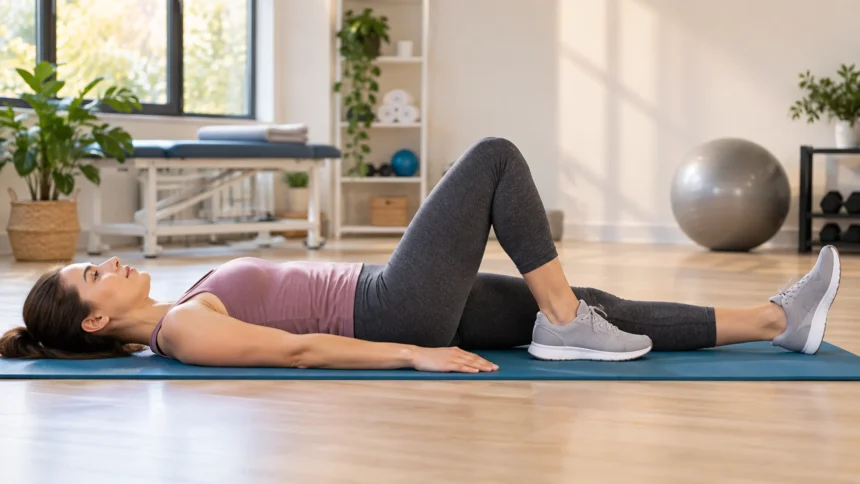
Heel slides are a common way to practice knee bending while the leg remains supported. Lie on your back on a comfortable surface, with the working leg extended as far as comfortable. Slowly slide your heel toward your body, allowing the knee to bend, then return toward the starting position without forcing either direction.
Keep the movement smooth and let your heel stay close to the supporting surface throughout the repetition. Avoid twisting the leg or lifting your pelvis to make the bend appear larger. A mild stretch may be acceptable in some rehabilitation plans, but sharp pain or a blocked sensation is a reason to stop rather than pull harder.
Start with a small amount of movement if your knee is stiff, and assess how it responds before increasing the range. A towel may provide assistance when a clinician has recommended that variation, but it should not be used to force the joint. The purpose is controlled practice, with any assistance serving the movement rather than overcoming pain.
Seated Knee Bends for an Accessible Mobility Exercise
Seated knee bends offer another way to practice flexion without lying on the floor. Sit on a stable chair with your thigh supported and your foot resting on the ground. Gently slide the foot backward beneath the chair until you reach a comfortable bend, then move it forward again in a slow, controlled motion.
Choose a chair height that lets you sit securely rather than perching at the edge to reach the floor. Keep your hips facing forward and avoid turning the foot simply to gain extra movement. If the chair base obstructs the exercise, change your position or select another suitable chair instead of bending around the obstacle.
This variation may be convenient for people who find floor transfers difficult or prefer short movement breaks during the day. Convenience does not mean the exercise is appropriate for every knee condition, especially after surgery. Keep any prescribed bending limits in mind, and avoid having someone push the foot farther backward unless that assistance is specifically supervised.
Standing Hamstring Curls for Active Knee Flexion
Standing hamstring curls challenge the muscles at the back of the thigh while you actively bend the knee. Hold a stable support, stand upright, and slowly lift one heel behind you through a comfortable range. Lower the foot with control, keeping the working knee close to the other knee rather than swinging the entire leg backward.
Keep your trunk steady and breathe normally as you move, avoiding a large arch through the lower back. You do not need to bring your heel all the way to your buttock for the repetition to count. Focus on bending at the knee while limiting unnecessary hip movement, and stop before fatigue makes the motion uncontrolled.
Begin without added resistance so you can assess balance, technique, and symptom response separately. An ankle weight increases the challenge and should be introduced only when the movement is already manageable and appropriate for your condition. If standing on the supporting leg hurts or feels unstable, ask about a seated or lying alternative rather than continuing unsupported.
Sit-to-Stand Exercises for Everyday Function
Sit-to-stand exercises connect knee bending with a familiar activity while also training the hips and thighs. Place a stable chair against a wall, sit with your feet comfortably positioned, and lean your trunk slightly forward. Stand using controlled leg effort, then bend your hips and knees to return to the seat without dropping into it.
A higher seat generally makes the task less demanding than a low chair, so choose a height you can manage confidently. Use the armrests if you need support rather than insisting on an unsupported version immediately. Keep both feet grounded and allow your knees to move in a comfortable direction consistent with your feet.
This is a functional strengthening exercise rather than an isolated hamstring curl or a passive knee stretch. Its suitability depends partly on whether your knee tolerates weight-bearing and repeated transitions. If you cannot lower yourself smoothly, reduce the number of repetitions, use more support, or discuss an easier starting exercise with a physiotherapist.
Supported Mini Squats for Controlled Bending
A supported mini squat practices knee and hip bending while you remain standing with access to a steady support. Place your feet in a comfortable stance and gently lower your hips a short distance as though beginning to sit. Return to standing smoothly, using the support for balance and keeping the movement within a manageable range.
Start with a shallow bend instead of copying the depth used by someone with different strength or mobility. Keep your heels grounded and avoid sudden twisting, bouncing, or collapsing inward through the knees. The movement should feel controlled throughout, and a deeper squat is not automatically more useful for your current rehabilitation or exercise goal.
Mini squats add weight-bearing demand, so they may be unsuitable when your treatment plan restricts loading or bending. Being able to perform a heel slide does not necessarily mean you are ready for repeated squats. Progress according to the demands of each exercise, and seek guidance if the knee feels unstable or symptoms increase.
Choose a Suitable Frequency and Progress Gradually
Exercise frequency depends on whether you are practicing gentle movement, rebuilding strength, or following a rehabilitation protocol. A few comfortable mobility repetitions may be approached differently from a demanding resistance session. Begin conservatively, particularly with an unfamiliar movement, and use your response to decide whether the amount is appropriate rather than adopting someone else’s full routine.
NHS inform advises adding knee exercises gradually and notes that starting with two or three repetitions can be helpful. It also explains that exercise should not worsen existing knee pain overall or leave it worse the following morning. This provides a useful monitoring principle, although individual rehabilitation instructions may set different limits or targets.
Increase one element at a time, such as movement range, repetitions, or resistance, so you can understand the effect of the change. Keep a brief record of what you performed and how the knee felt afterward. If swelling, pain, or reduced function develops, step back from the progression and ask for advice when symptoms do not settle.
Common Form Mistakes and How to Avoid Them
One common mistake is chasing a larger bend by using momentum or strong external pressure. This can turn a controlled mobility exercise into an uncomfortable struggle and make it harder to notice warning symptoms. Choose a smaller range you can manage smoothly, then allow progress to follow improved tolerance rather than measuring success by depth alone.
Another mistake is compensating through the hips or back instead of practicing the intended knee movement. During a hamstring curl, for example, the whole thigh may swing backward as the lower back arches. Slow the repetition and reduce the range so you can distinguish actual knee bending from movement elsewhere, using a mirror if helpful.
People also confuse fatigue with permission to continue after their technique breaks down. Fewer controlled repetitions provide a clearer training stimulus than a longer set dominated by compensations and rushed movement. Plan the exercise around your current ability, keep breathing comfortably, and finish before you need to twist, jerk, or rely on unstable support.
When Knee Symptoms Need Medical Assessment
Seek urgent medical assessment if you cannot move the knee or bear weight, or if it becomes severely swollen or visibly changes shape. A hot, red knee accompanied by fever or feeling unwell also needs urgent attention. These symptoms should not be managed by trying to stretch the knee harder or completing another exercise session.
A knee that locks, repeatedly gives way, or develops painful clicking also warrants assessment, particularly after an injury. Painless clicking alone is common and does not necessarily indicate damage. Persistent symptoms that interfere with normal activities deserve clinical review because the appropriate exercise approach depends on identifying the problem rather than assuming all knee pain has the same cause.
After surgery, follow your surgeon’s and physiotherapist’s instructions about bending, weight-bearing, braces, and strengthening. Different operations protect different tissues, so a routine suitable after one procedure may be inappropriate after another. If progress stalls or an exercise repeatedly aggravates symptoms, discuss the issue instead of independently increasing force, resistance, or session frequency.
Conclusion
Knee flexion exercises can support comfortable movement, muscle function, and the daily activities that depend on bending the knee. Heel slides and seated bends emphasize mobility, while hamstring curls and functional movements introduce different strengthening demands. Choosing between them requires attention to your goal, current symptoms, and any restrictions associated with injury or treatment.
Good form begins with a stable position, a controlled pace, and a range that suits your present ability. Start with a manageable amount, monitor the response, and change only one part of the routine at a time. A consistent approach that your knee tolerates is more useful than occasional sessions built around forced bending or excessive effort.
Exercise is one part of knee care, and persistent or significant symptoms may require assessment before a program can be tailored effectively. Use professional guidance when recovering from surgery, managing an injury, or dealing with uncertain symptoms. The aim is steady improvement in useful function, with exercise choices that support your recovery rather than compete with it.
FAQs
What Are Knee Flexion Exercises?
Knee flexion exercises involve bending the knee. Examples include heel slides, seated knee bends, and hamstring curls, with different movements targeting joint mobility, muscle strength, or control during everyday activities.
Which Knee Flexion Exercise Is Best for Beginners?
Heel slides or seated bends may offer a simple starting point for gentle mobility. The best choice depends on symptoms, movement restrictions, and whether you are exercising generally or following rehabilitation advice.
Should Knee Flexion Exercises Hurt?
Do not push through sharp pain, locking, or instability. Some rehabilitation plans allow mild discomfort, but symptoms should settle appropriately and should not leave your knee worse overall afterward.
Can I Do Knee Flexion Exercises Every Day?
Gentle mobility work may be performed frequently when appropriate, while challenging strengthening requires suitable recovery. Follow your prescribed schedule if you have one, and adjust general exercise according to your knee’s response.
How Long Does It Take to Improve Knee Flexion?
There is no fixed timeline because progress depends on the cause of restriction, swelling, treatment, and exercise tolerance. Seek guidance if movement remains limited, worsens, or stops improving despite an appropriate program.