
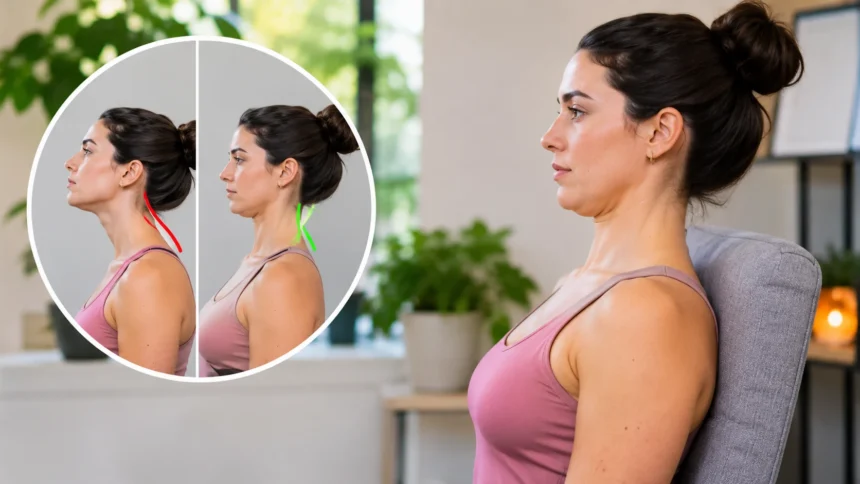
Neck stiffness and discomfort can make everyday activities difficult, especially when you spend long hours using a computer or looking at your phone. You may notice tightness around your neck, shoulders, or upper back after sitting in one position. Fortunately, gentle neck exercises may help improve movement control and comfort. The chin tucks exercise is a simple movement commonly used in neck rehabilitation and strengthening routines.
Chin tucks involve gently moving your head backward while keeping your gaze forward. This small movement encourages control of the muscles that support your head and cervical spine. Although the exercise looks easy, performing it incorrectly can create unnecessary discomfort.
Learning proper chin tuck form can help you practice the movement safely. This guide explains the benefits of chin tucks, the muscles involved, step-by-step instructions, beginner variations, common mistakes, and practical tips for incorporating the exercise into a balanced routine.
What Is the Chin Tucks Exercise?
The chin tucks exercise is a gentle neck movement that involves drawing your chin straight backward without bending your head downward. It is also commonly called cervical retraction. The exercise helps train control around the cervical spine and is frequently included in physiotherapy programs. Its small range of movement makes it suitable for many beginner routines.
During a chin tuck, the head moves backward relative to the upper body while the neck remains comfortably aligned. The movement may create the appearance of a temporary double chin. This is a normal result of the exercise rather than its purpose. The goal is to improve movement control, not change facial appearance.
Chin tucks can be performed while sitting, standing, or lying down. Different positions change the amount of support available for the head and neck. Some people find lying-down variations easier when beginning. The most suitable version depends on comfort, symptoms, and individual physical abilities.
What Muscles Do Chin Tucks Work?
Chin tucks involve muscles that control the position and movement of the cervical spine. Deep neck flexor muscles, including the longus colli and longus capitis, contribute to cervical stability and controlled movement. These muscles help support the head during everyday activities. Their coordinated function is important for comfortable neck movement.
Other muscles around the neck also participate in maintaining head position. The movement requires coordination between muscles at the front and back of the cervical spine. The amount of muscle activity depends on exercise technique and positioning. Chin tucks are therefore better understood as a neck-control exercise than an isolated muscle-building movement.
The shoulders and upper back also influence overall head and neck positioning. However, chin tucks do not directly strengthen every muscle involved in posture. A complete rehabilitation program may include additional exercises for the shoulder blades and upper back. Balanced training supports comfortable movement throughout the upper body.
Benefits of Chin Tucks for Neck Health
One potential benefit of chin tucks is improved control of neck movements. The exercise encourages gentle cervical retraction without requiring large or forceful motions. Some people find this useful when managing stiffness associated with prolonged sitting. However, results vary depending on the cause of discomfort and individual circumstances.
Chin tucks may also contribute to strengthening and endurance training for muscles that help support the cervical spine. These muscles play a role in maintaining head position during everyday tasks. Regular practice within an appropriate exercise program may improve muscular coordination. The exercise should remain controlled rather than physically demanding.
Another benefit is that chin tucks require little time and no specialized equipment. They can be incorporated into a broader routine involving movement breaks and gentle strengthening. However, chin tucks are not a guaranteed treatment for neck pain. Persistent symptoms may require professional assessment and individualized rehabilitation.
How to Do Chin Tucks With Proper Form
Begin by sitting comfortably in a chair with your feet resting on the floor. Keep your shoulders relaxed and look straight ahead. Allow your head to remain in a comfortable starting position. Avoid forcing your spine into an exaggerated upright posture before beginning the exercise.
Gently draw your chin straight backward, as though moving your head toward the wall behind you. Keep your eyes looking forward and avoid dropping your chin toward your chest. The movement should be small and controlled. Stop before reaching a position that causes pain or significant discomfort.
Hold the position briefly while breathing normally. Slowly return your head to the starting position without pushing it forward. Repeat only while the movement remains comfortable. If you experience dizziness, tingling, sharp pain, or worsening symptoms, stop the exercise and seek appropriate guidance.
Chin Tucks Exercise for Beginners
Beginners should focus on learning the movement rather than performing many repetitions. A small, comfortable chin tuck is enough to practice cervical control. The exercise should not require force or intense muscular effort. Starting gently helps you recognize whether the movement feels suitable.
Practice in front of a mirror if visual feedback helps you understand the technique. Keep your head level while moving it backward. Avoid moving your entire upper body to create the appearance of a chin tuck. The goal is controlled movement through the neck rather than leaning backward.
Begin with a few comfortable repetitions and take breaks as needed. If the exercise repeatedly creates discomfort, do not force additional attempts. A physiotherapist can help modify the movement or recommend alternatives. Developing consistent technique is more useful than completing a predetermined number of repetitions.
How Long Should You Hold a Chin Tuck?
The appropriate hold duration depends on your comfort, experience, and reason for performing chin tucks. Beginners may start with gentle holds lasting approximately three to five seconds. This provides time to practice control without creating unnecessary fatigue. There is no universal hold duration suitable for everyone.
Some rehabilitation programs gradually increase hold duration as neck muscle endurance improves. However, longer holds do not automatically produce better results. The movement should remain comfortable throughout the exercise. If breathing becomes restricted or neck muscles begin to strain, return to the starting position.
Short, controlled holds are often preferable to prolonged positions performed with excessive tension. Rest between repetitions when needed. A healthcare professional may recommend different durations for specific rehabilitation goals. Always prioritize technique and comfort over the amount of time spent holding the position.
How Many Chin Tucks Should You Do?
The number of chin tuck repetitions should reflect your physical abilities and symptoms. Some beginners may start with five comfortable repetitions during a session. Others may require fewer movements or a modified approach. There is no need to perform large numbers immediately.
As the exercise becomes familiar, a physiotherapist may recommend gradually increasing repetitions or hold duration. Progression should remain manageable and should not cause worsening symptoms. Repeatedly forcing uncomfortable movements can be counterproductive. The appropriate volume depends on the purpose of the exercise.
Chin tucks are often combined with other gentle neck and upper-back activities. They should not become the only exercise in a complete fitness or rehabilitation program. Regular movement variety is important. Seek individualized guidance if you are unsure how frequently or intensely to practice.
Chin Tucks While Sitting
Seated chin tucks are a convenient variation for people who spend time at desks. The position allows the exercise to be performed without lying on the floor. A supportive chair may help maintain comfort. However, the movement should not interrupt activities requiring your full attention.
Sit with your shoulders relaxed and your head comfortably positioned. Gently move your chin backward while keeping your gaze forward. Avoid leaning your torso against the chair to force the movement. Return slowly to the starting position after a brief, comfortable hold.
Seated chin tucks may be included during movement breaks from prolonged computer use. However, changing positions and walking briefly are also valuable. No single exercise can fully offset the effects of remaining in one position for extended periods. Variety helps maintain comfortable movement throughout the day.
Chin Tucks While Lying Down
Lying-down chin tucks provide another option for practicing gentle neck control. The supporting surface can reduce the need to hold the head upright. Some people find this position easier when learning the movement. However, comfort varies depending on individual neck conditions.
Lie on your back on a supportive surface with your head resting naturally. Gently draw your chin inward without pressing your head forcefully into the floor. Keep your breathing relaxed. The movement should feel small and controlled.
Return to the starting position slowly after a brief hold. Avoid lifting your head unless a qualified professional has recommended an appropriate progression. If lying flat causes discomfort, use a suitable modification or choose another position. The exercise should never require pushing through neck pain.
Standing Chin Tucks Against a Wall
Standing chin tucks can help you practice head movement while maintaining an upright position. A wall may provide useful feedback about alignment. However, it should not be used to force the head backward. The movement must remain gentle.
Stand comfortably near a wall with your body in a relaxed position. Keep your gaze forward and slowly draw your chin backward. You may notice your head moving closer to the wall. Avoid pressing your skull forcefully against the surface.
Hold briefly and return to a comfortable position. Keep your shoulders relaxed throughout the movement. If the wall position causes discomfort, practice without it. A small movement completed with control is more useful than forcing your head into contact with the wall.
Chin Tucks for Forward Head Posture
Forward head posture describes a position in which the head sits farther forward relative to the torso. It is commonly discussed in relation to desk work and prolonged device use. However, head position varies naturally between individuals. Forward head posture does not automatically cause neck pain.
Chin tucks may help improve awareness and control of cervical movement. They are sometimes included in exercise programs for people experiencing discomfort associated with sustained positions. However, the exercise does not guarantee permanent posture correction. Research does not support treating one head position as universally ideal.
A broader approach may involve regular movement breaks, comfortable workstation arrangements, and strengthening exercises. Changing positions throughout the day can be more practical than maintaining rigid alignment. If neck pain persists, individualized assessment is appropriate. The goal is comfortable movement rather than achieving a perfect-looking posture.
Can Chin Tucks Help With Neck Pain?
Chin tucks are sometimes included in treatment programs for certain types of mechanical neck pain. They may help improve movement control and muscle function when appropriately prescribed. However, not every neck condition responds positively to cervical retraction. The underlying cause of pain matters.
Some people experience temporary relief after gentle chin tucks, while others find the movement uncomfortable. Pain involving nerves, joints, or recent injuries may require different management. Continuing an exercise that repeatedly worsens symptoms is not recommended. Professional assessment can help identify suitable movements.
Research on neck exercises generally supports individualized programs rather than relying on one exercise alone. Strengthening, mobility, and activity adjustments may all contribute to rehabilitation. Chin tucks can be one useful component when appropriate. They should not replace medical evaluation for persistent or unexplained neck pain.
Chin Tucks for Tech Neck and Desk Workers
The term tech neck commonly describes neck discomfort associated with prolonged use of phones, computers, and other devices. Sustained positions may contribute to temporary stiffness or muscular fatigue. However, device use does not automatically cause a structural neck problem. Symptoms depend on multiple factors.
Chin tucks can provide a gentle movement option during work breaks when they feel comfortable. Slowly retracting the head may help reduce the sensation of remaining in one position. However, regular walking and shoulder movements are also useful. A varied routine is preferable to repeatedly performing only one exercise.
Adjusting your workspace may improve comfort during long periods of computer use. Position screens and input devices where they can be used without unnecessary strain. Change positions regularly rather than forcing yourself to sit perfectly upright. Practical adjustments can complement gentle neck exercises.
Chin Tucks and Deep Neck Flexor Strength
Deep neck flexor muscles help control movement around the cervical spine. These muscles are often considered during rehabilitation for certain neck conditions. Their function involves coordinating subtle movements and contributing to spinal support. Appropriate exercises may help improve muscular control.
Chin tucks can involve these muscles, but simple cervical retraction is not identical to every deep neck flexor training exercise. Some rehabilitation programs use a gentle head-nodding movement called craniocervical flexion. This may be performed with professional supervision or feedback. The exact exercise depends on treatment goals.
Attempting stronger movements without adequate preparation may create unnecessary neck strain. Begin with gentle control and progress only when appropriate. A physiotherapist can assess muscle function and recommend suitable variations. Effective strengthening requires appropriate technique rather than excessive force.
Chin Tucks vs. Neck Stretches
Chin tucks and neck stretches serve different purposes. Chin tucks generally involve controlled cervical movement and muscular activation. Stretching exercises focus more on exploring comfortable movement ranges or addressing specific muscle restrictions. Both may have a place in an individualized neck-care routine.
A gentle neck stretch might involve slowly turning the head or tilting it within a comfortable range. Chin tucks emphasize moving the head backward without significant downward bending. These differences affect which muscles and joints are challenged. Neither approach is universally superior.
Some people benefit from a combination of strengthening and mobility work. Others may need specific modifications because particular movements aggravate symptoms. Avoid forcing either exercise into painful positions. A qualified clinician can help determine which techniques are appropriate for your needs.
Chin Tucks vs. Neck Retraction
Chin tucks and cervical retraction are often used interchangeably in everyday fitness discussions. Both generally describe moving the head backward relative to the upper body. However, terminology can vary between rehabilitation programs. Some clinicians use chin tuck to describe a smaller nodding motion.
Cervical retraction typically involves translating the head backward while keeping the gaze relatively level. Craniocervical flexion involves a gentle nodding movement at the upper cervical joints. These actions are related but not identical. Understanding the difference can help when following professional exercise instructions.
If a healthcare professional recommends a particular movement, ask for a demonstration. Small differences in technique may matter during rehabilitation. Avoid assuming every online exercise with a similar name is interchangeable. Clear instructions support safer practice and more consistent results.
Common Chin Tuck Exercise Mistakes
One common mistake is lowering the chin excessively toward the chest. This changes the movement from cervical retraction into a different neck position. The goal is usually to move the head backward while keeping the gaze forward. A small movement is sufficient.
Another mistake is pushing the head backward with unnecessary force. Chin tucks should not involve strong pressure against a wall or rigid surface. Excessive effort can increase muscular tension or discomfort. Gentle control is more appropriate than attempting to maximize the movement range.
Holding the breath or tightening the shoulders can also affect exercise comfort. Keep your breathing natural and allow the shoulders to remain relaxed. Stop when the movement becomes painful or difficult to control. Proper technique matters more than the number of repetitions completed.
When Should You Avoid Chin Tucks?
Chin tucks may not be appropriate for people with certain neck injuries, significant cervical instability, or symptoms aggravated by retraction. Recent trauma requires particular caution. Individuals recovering from cervical surgery should follow their healthcare team’s instructions. Do not begin unfamiliar neck exercises when medical restrictions apply.
Stop the movement if it causes dizziness, new tingling, weakness, or increasing pain. These symptoms may indicate that the exercise is unsuitable or requires further assessment. Avoid attempting to correct them by applying more force. A medical professional can evaluate the underlying cause.
Seek urgent medical attention for neck pain accompanied by severe headache, fever, significant neurological symptoms, or symptoms following a serious injury. Such problems should not be treated as ordinary muscle stiffness. Neck exercises are not substitutes for appropriate medical care. Safety must remain the main priority.
How to Include Chin Tucks in a Daily Routine
Chin tucks can be included in a gentle movement routine when they feel comfortable. Some people practice them during short breaks from desk work or other seated activities. The exercise requires little equipment and can be completed in a small space. However, regular practice is not necessary for everyone.
You can combine gentle chin tucks with shoulder rolls, comfortable neck movements, and brief walking breaks. These activities encourage movement variety during periods of prolonged sitting. Avoid creating a rigid schedule that causes discomfort or unnecessary repetition. Choose a routine that suits your daily activities.
If chin tucks have been prescribed as part of rehabilitation, follow the recommended instructions. A physiotherapist may adjust the exercise as your symptoms or movement control change. Consistency matters, but so does appropriate recovery. The goal is comfortable function rather than completing movements simply to meet a target.
Best Practices for Safe Chin Tuck Exercises
Begin every session with a comfortable starting position and relaxed breathing. Perform the movement slowly rather than pulling your head backward suddenly. Keep the range small and avoid unnecessary muscular tension. Proper control should remain the main focus.
Choose a variation that matches your current abilities. Sitting, standing, and lying-down options provide different levels of support. There is no requirement to progress through every version. A simpler exercise may be more appropriate when it allows comfortable movement.
Monitor how your neck responds during and after practice. Temporary awareness of working muscles may be normal, but sharp pain or worsening symptoms are not goals of exercise. Stop when necessary and seek advice for persistent problems. Safe progression supports better long-term exercise habits.
Other Exercises That Complement Chin Tucks
Chin tucks may be combined with gentle shoulder blade movements and upper-back strengthening exercises. These activities train muscles that contribute to comfortable upper-body movement. For example, controlled shoulder blade squeezes can introduce awareness of the muscles around the upper back. Movements should remain relaxed and pain-free.
Wall push-ups and suitable resistance band exercises provide additional strengthening options. They can challenge shoulder and upper-back muscles while allowing resistance to be adjusted. However, exercise selection should reflect personal abilities and symptoms. Avoid adding demanding movements simply because they are commonly included in fitness routines.
Walking and general physical activity also contribute to overall musculoskeletal health. Long periods of inactivity may increase feelings of stiffness for some people. A balanced routine provides variety rather than concentrating on one body area. Individualized guidance is valuable when neck discomfort limits normal activities.
Conclusion
The chin tucks exercise is a gentle movement commonly used to train neck control and support cervical muscle function. It involves moving the head backward while keeping the gaze relatively level. The exercise requires little equipment and can be performed in several positions. However, correct technique and a comfortable movement range are essential.
Chin tucks may support certain neck-strengthening and rehabilitation programs, but they are not a universal treatment for neck pain or posture concerns. Beginners should start with small movements and manageable repetitions. Avoid excessive force, breath-holding, and uncomfortable positions. Stop the exercise if symptoms worsen.
A balanced approach to neck health includes regular movement, suitable strengthening, comfortable daily habits, and appropriate medical care when necessary. Chin tucks can be one useful option within that approach. Their effectiveness depends on individual needs and proper application. Gentle, controlled practice is more valuable than forcing the neck into a particular position.
Frequently Asked Questions
What Are the Main Benefits of Chin Tucks?
Chin tucks may improve neck movement control and support muscles involved in cervical stability. They are sometimes included in rehabilitation programs for certain neck conditions and movement-related discomfort.
How Many Chin Tucks Should Beginners Do?
Beginners may start with a few gentle repetitions, such as five comfortable movements. The appropriate number depends on symptoms, technique, and individual guidance. Stop if the exercise causes discomfort.
Can Chin Tucks Fix Forward Head Posture?
Chin tucks may help improve awareness and control of head movement, but they do not guarantee permanent posture correction. Regular movement and appropriate strengthening may provide additional benefits.
Should Chin Tucks Cause Neck Pain?
No, chin tucks should not produce sharp or worsening neck pain. Stop if discomfort increases, and seek professional advice when symptoms persist or include tingling, weakness, or dizziness.
Can You Do Chin Tucks Every Day?
Some people can perform gentle chin tucks regularly when comfortable, particularly if prescribed by a physiotherapist. However, daily practice is not essential for everyone, and exercise frequency should reflect individual needs.