

What Are the Rhomboid Major and Minor Muscles?
The rhomboid major and rhomboid minor are two skeletal muscles located in the upper back between the spine and shoulder blades. These muscles help control shoulder blade movements and support stability during everyday activities. Although they are relatively small compared with other back muscles, they play an important role in coordinated shoulder movement and upper-body function.
Both rhomboid muscles belong to a group of muscles that connect the shoulder blade, also called the scapula, to the axial skeleton. They work together to draw the shoulder blades toward the spine and maintain their position against the rib cage. Their coordinated activity supports movements such as pulling, reaching, lifting, and maintaining controlled shoulder positioning.
Understanding rhomboid anatomy helps explain how the upper back contributes to shoulder movement and stability. These muscles work alongside the trapezius, serratus anterior, and other shoulder stabilizers to support normal movement patterns. Learning about their attachments, nerve supply, and functions can also help people better understand common discomfort experienced between the shoulder blades.
Where Are the Rhomboid Muscles Located?
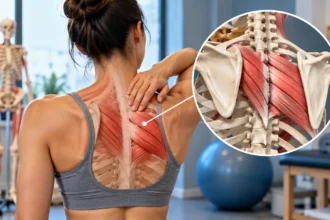
The rhomboid muscles are located in the upper back, deep to the trapezius muscle and close to the inner borders of the shoulder blades. They extend diagonally from the spinal column toward the scapulae. Their position allows them to influence shoulder blade movements while helping maintain contact between the scapula and chest wall.
The rhomboid minor sits above the rhomboid major and is the smaller of the two muscles. It connects the lower cervical and upper thoracic spine to the upper part of the scapula’s medial border. The rhomboid major lies directly below it and extends farther down the inner border of the shoulder blade.
Both muscles are positioned beneath more superficial layers of upper-back tissue, making them difficult to see directly. However, their general location corresponds to the area between the spine and shoulder blades. This region commonly experiences muscular discomfort after prolonged sitting, repetitive upper-body activities, or demanding physical work involving the shoulders and back.
Rhomboid Major: Origin, Insertion, and Structure
The rhomboid major is a broad, flat muscle that occupies the lower portion of the rhomboid muscle group. It originates from the spinous processes of the second through fifth thoracic vertebrae and associated connective tissue. These attachments provide a stable connection to the upper spine, allowing the muscle to influence scapular positioning during movement.
The muscle fibers travel diagonally downward and outward toward the medial border of the scapula. They attach along the inner border between approximately the level of the scapular spine and the inferior angle. This arrangement enables the rhomboid major to pull the shoulder blade toward the vertebral column while contributing to controlled scapular rotation.
Although the rhomboid major is larger than the rhomboid minor, the two muscles share several mechanical responsibilities. Their fibers work together during pulling movements and activities requiring shoulder blade stability. The rhomboid major contributes substantially to scapular retraction, particularly when the shoulder blades move backward against resistance during upper-body exercises or everyday tasks.
Rhomboid Minor: Origin, Insertion, and Structure
The rhomboid minor is a smaller, narrow muscle positioned immediately above the rhomboid major. It originates from the lower portion of the nuchal ligament and the spinous processes of the seventh cervical and first thoracic vertebrae. These attachment points connect the muscle to the region where the neck transitions into the upper back.
Its muscle fibers extend downward and outward toward the medial border of the scapula near the root of the scapular spine. This attachment is higher than the main insertion area of the rhomboid major. The shorter structure allows the rhomboid minor to contribute to shoulder blade positioning through a similar direction of muscular pull.
Despite its smaller size, the rhomboid minor plays a meaningful role in controlling scapular movement. It assists the rhomboid major during retraction and helps stabilize the shoulder blade during arm activities. Together, these muscles support coordinated movement rather than functioning as completely separate structures with unrelated responsibilities in the upper back.
Nerve Supply and Blood Supply of the Rhomboid Muscles
The rhomboid major and minor receive their primary nerve supply from the dorsal scapular nerve. This nerve commonly arises from the fifth cervical spinal nerve, sometimes with contributions from nearby cervical nerve roots. It travels toward the upper back and provides motor signals that allow the rhomboid muscles to contract during shoulder blade movement.
The dorsal scapular nerve also supplies the levator scapulae muscle, which contributes to shoulder blade elevation and positioning. Because these muscles share related functions, their coordinated activity helps control movements around the upper shoulder girdle. Problems affecting the dorsal scapular nerve may contribute to weakness or changes in scapular movement, although proper clinical evaluation is necessary.
Blood reaches the rhomboid muscles through vessels that commonly include the dorsal scapular artery and nearby arterial branches. The exact arterial arrangement varies between individuals, reflecting normal differences in upper-back anatomy. An adequate blood supply delivers oxygen and nutrients to muscle tissue while supporting normal muscular activity, maintenance, and recovery after physical exertion.
What Are the Main Functions of the Rhomboid Muscles?
Scapular retraction is one of the primary functions of the rhomboid major and minor muscles. This movement draws the shoulder blades toward the spine, as happens when bringing the shoulders backward during a rowing exercise. The rhomboids perform this action alongside other muscles, particularly the middle fibers of the trapezius.
The rhomboids also contribute to downward rotation of the scapula, a movement that changes the orientation of the shoulder blade. During downward rotation, the shoulder socket turns relatively downward as the inferior angle moves toward the spine. This action is part of coordinated shoulder movement and involves several muscles working together rather than the rhomboids acting independently.
Another important function is stabilizing the scapula against the thoracic wall during upper-body activity. The rhomboids help maintain controlled shoulder blade positioning while the arms perform different movements. Their stabilizing role is especially useful when pulling objects, supporting loads, or transitioning between arm positions that require coordinated movement around the shoulder girdle.
How Rhomboid Muscles Support Shoulder Blade Stability
Shoulder blade stability depends on several muscles working together to control the position of the scapula. The rhomboids help resist unwanted movement by maintaining tension between the spinal column and medial scapular border. This support allows the shoulder blades to respond appropriately when the arms move or external forces act on them.
During activities such as carrying objects or pulling against resistance, the rhomboids help maintain controlled scapular positioning. They work with the trapezius and other stabilizing muscles to distribute forces across the upper back. Balanced muscle coordination is important because excessively rigid shoulder blades can interfere with the natural movement needed for comfortable arm function.
Scapular stability does not mean keeping the shoulder blades permanently pulled backward. Healthy shoulder movement requires the scapulae to rotate, tilt, and glide naturally as the arms change position. The rhomboids contribute to this adaptable control by contracting or relaxing according to movement demands, rather than maintaining constant tension throughout every activity.
Rhomboid Major vs. Rhomboid Minor: Key Differences
The most noticeable difference between the rhomboid major and minor is their size and anatomical position. The rhomboid major is broader and located lower in the upper back, while the rhomboid minor is narrower and positioned above it. Their different attachment points allow them to influence similar shoulder blade movements from slightly different directions.
The rhomboid major originates from the upper thoracic vertebrae, whereas the rhomboid minor attaches near the lower cervical and upper thoracic spine. Their insertions also differ along the medial border of the scapula. Despite these structural differences, both muscles receive motor innervation from the dorsal scapular nerve and share important functional responsibilities.
Functionally, the two muscles work as a coordinated group rather than performing completely separate actions. Both assist scapular retraction, downward rotation, and stabilization against the thoracic wall. The distinction becomes most useful when studying detailed muscular anatomy, understanding clinical examination findings, or identifying how different structures contribute to shoulder girdle movement.
How the Rhomboid Muscles Work During Everyday Activities
The rhomboid muscles contribute to many ordinary movements involving the arms, shoulders, and upper back. Activities such as opening a heavy door, pulling an object closer, or carrying shopping bags require coordinated scapular control. During these tasks, the rhomboids assist other shoulder muscles in maintaining appropriate positioning as forces change.
Exercise movements also rely on rhomboid activity, particularly those involving controlled pulling against resistance. Seated rows, resistance band exercises, and certain upper-back strengthening movements recruit the rhomboids alongside the trapezius and other muscles. Their contribution depends on the movement direction, shoulder position, resistance level, and coordination of surrounding muscle groups.
Desk work and prolonged sitting can influence how the muscles around the shoulder blades feel and function. Remaining in one position for extended periods may contribute to stiffness or discomfort in the upper back. Regular movement breaks and comfortable workstation arrangements can help reduce prolonged static loading without requiring people to maintain one rigid posture.
Common Causes of Rhomboid Muscle Pain and Discomfort
Discomfort around the rhomboid region can develop after unfamiliar exercise, repetitive pulling activities, or physically demanding tasks. Muscles may become sore when exposed to workloads that exceed their usual activity levels. Minor muscular strains can also occur when tissue is overloaded, although pain between the shoulder blades does not automatically indicate a rhomboid injury.
Prolonged sitting and repetitive upper-body positions may contribute to muscle fatigue and discomfort in some individuals. Working at a computer without regular movement breaks can leave the upper back feeling stiff or uncomfortable. However, there is no single perfect posture, and discomfort often reflects several interacting factors rather than one specific sitting position.
Other structures can also produce pain near the rhomboid muscles, including joints, nerves, and surrounding tissues. Neck-related problems sometimes create discomfort that spreads toward the shoulder blades. Because symptoms can overlap, persistent or unexplained pain should not automatically be blamed on tight rhomboids without considering other possible causes and obtaining appropriate professional guidance.
Recognizing Rhomboid Muscle Strain and Related Symptoms
A possible rhomboid muscle strain may cause localized soreness between the shoulder blade and spinal column. Some people notice discomfort after demanding pulling movements or unfamiliar upper-body exercise. The affected area may feel tender, and certain movements can temporarily increase symptoms, although these findings are not specific enough to confirm a diagnosis.
Muscular discomfort can sometimes be associated with stiffness, reduced movement tolerance, or temporary sensitivity around the upper back. Symptoms may become more noticeable when reaching, lifting, or moving the shoulders against resistance. However, similar complaints can arise from other muscles or structures, making an assessment of the broader symptom pattern important.
Seek medical attention for persistent, worsening, or unexplained upper-back pain, particularly when it follows an injury. Progressive weakness, persistent numbness, or pain accompanied by fever also requires professional assessment. Sudden upper-back discomfort with chest pain, breathing difficulty, or faintness warrants urgent medical evaluation rather than assuming the problem is muscular.
Gentle Rhomboid Stretches and Mobility Tips
Gentle upper-back mobility exercises can help people maintain comfortable movement around the shoulders and thoracic spine. One simple option involves reaching both arms forward while allowing the shoulder blades to move naturally apart. The movement should create only a mild stretching sensation, without forcing the shoulders into positions that produce sharp pain.
A comfortable cross-body arm movement may also help improve general shoulder mobility. Bring one arm gently across the chest while keeping the shoulders relaxed and avoiding excessive pulling. Although this movement primarily affects several shoulder structures, it can be part of a broader routine supporting comfortable movement around the upper back.
Slow shoulder rolls and controlled arm movements provide additional opportunities to change positions during prolonged sitting. These exercises do not need to be aggressive or performed through discomfort to be useful. If stretching increases symptoms, causes tingling, or produces unusual pain, stop the movement and consider seeking guidance from a qualified healthcare professional.
Strengthening Exercises for Rhomboid Major and Minor
Seated rows are a common exercise for developing upper-back strength, including the muscles responsible for scapular retraction. With appropriate resistance, pull the handles toward the torso while allowing the shoulder blades to move naturally. Maintain a comfortable range of motion and avoid forcing the shoulders excessively backward at the end of each repetition.
Resistance band rows provide a convenient alternative for people exercising at home. Secure the band appropriately, maintain a stable position, and pull the elbows backward using smooth, controlled movement. Start with manageable resistance and focus on consistent technique, allowing the rhomboids and surrounding shoulder muscles to work together without unnecessary strain.
Light reverse fly movements and controlled scapular retraction exercises can also support upper-back conditioning. Strengthening programs should include other shoulder stabilizers, such as the trapezius and serratus anterior, rather than isolating the rhomboids exclusively. Gradual progression, adequate recovery, and comfortable exercise technique are more important than using heavy resistance or completing excessive repetitions.
Conclusion
The rhomboid major and rhomboid minor are important upper-back muscles that connect the spinal column to the shoulder blades. Their primary functions include scapular retraction, downward rotation, and stabilization during arm movements. Although they differ in size and attachment points, both muscles work together to support coordinated shoulder girdle function and everyday upper-body activities.
Understanding rhomboid anatomy can help explain why the shoulder blades move during pulling exercises and other physical tasks. The muscles also interact with surrounding structures that contribute to shoulder stability and movement control. Discomfort in their general location may involve several possible causes, so persistent symptoms should be assessed rather than automatically attributed to muscular tightness.
Maintaining comfortable mobility, building balanced upper-back strength, and taking regular movement breaks can support normal shoulder function. Exercises such as controlled rows and gentle mobility movements provide practical options when performed appropriately. By understanding how the rhomboid muscles work, individuals can make more informed decisions about exercise, everyday movement, and overall upper-back health.
Frequently Asked Questions
What is the difference between the rhomboid major and rhomboid minor?
The rhomboid major is larger and located below the rhomboid minor. Both connect the spine to the shoulder blade and contribute to scapular retraction, downward rotation, and stabilization during movement.
What is the main function of the rhomboid muscles?
The primary function of the rhomboids is drawing the shoulder blades toward the spine. They also assist downward scapular rotation and help stabilize the shoulder blades during various arm and upper-body movements.
What nerve supplies the rhomboid major and minor?
Both rhomboid muscles receive their primary motor nerve supply from the dorsal scapular nerve, commonly arising from the fifth cervical spinal nerve. This nerve also supplies the levator scapulae muscle.
What causes pain between the rhomboid muscles?
Pain in the rhomboid region may result from muscular overload, unfamiliar exercise, or prolonged static positions. However, nearby joints, nerves, and neck-related conditions can produce similar discomfort and may require assessment.
What exercises help strengthen the rhomboid muscles?
Seated rows, resistance band rows, and light reverse fly exercises can help strengthen the rhomboids and surrounding upper-back muscles. Controlled movement, manageable resistance, and gradual progression support comfortable and effective strengthening.