

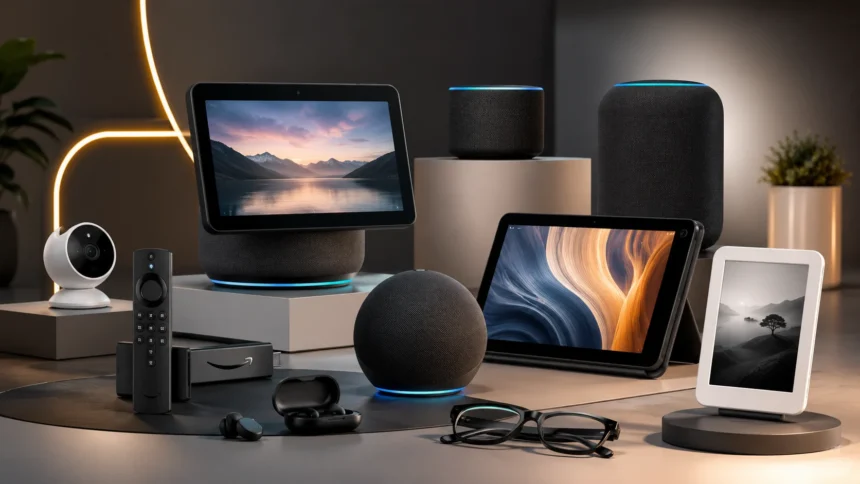
Amazon Technology and Device Updates
Amazon’s technology ecosystem has expanded far beyond online shopping. The company now develops smart speakers, displays, streaming devices, e-readers, security cameras, artificial intelligence services, custom processors, satellite connectivity, and smart-home technologies. These products increasingly work together rather than operating as completely separate devices. Amazon’s latest direction places artificial intelligence at the center of many experiences, particularly through Alexa+, smarter Fire TV discovery, personalized shopping tools, and connected-home features.
The biggest change is the movement from relatively simple voice commands toward more conversational AI. Amazon describes Alexa+ as its next-generation assistant powered by generative artificial intelligence, designed to understand natural conversations, maintain context, manage smart-home tasks, make recommendations, and complete certain actions for users. That shift affects not only Echo speakers but also Fire TV, Ring, music, web experiences, and other parts of the Amazon ecosystem.
Amazon has also continued updating physical devices. Recent announcements include newer Echo hardware designed around Alexa+, a faster Fire TV lineup, a redesigned Fire TV interface, evolving Ring security features, and a Kindle family that now includes traditional e-readers, Scribe devices, and Colorsoft models. At the same time, Amazon is pushing into newer areas such as satellite internet through Amazon Leo and larger investments in custom AI infrastructure.
For consumers, these developments can make choosing Amazon devices more complicated because hardware specifications are only part of the experience. Software updates, AI features, privacy controls, subscription services, compatibility, and ecosystem integration can matter just as much as processor speed or screen size. This guide explains the most important Amazon technology and device updates, what is changing across the company’s ecosystem, and what those changes may mean for people using Amazon products in everyday life.
Alexa+ Is Becoming the Center of Amazon’s Device Strategy
Alexa+ represents one of Amazon’s most significant technology changes because it attempts to transform Alexa from a command-based voice assistant into something more conversational. Traditional voice assistants usually worked best when users remembered relatively specific phrases. Alexa+ is designed to understand more natural requests, retain context across conversations, and respond more flexibly when users do not phrase instructions perfectly.
The assistant is also intended to perform more complex tasks rather than simply answering questions. Amazon says Alexa+ can help manage smart-home devices, make recommendations, assist with reservations, support shopping, control entertainment, and create routines through conversation. The goal is to make interactions feel less like navigating a voice-controlled menu and more like explaining what you want to another person.
Another important update is continuity across devices. Amazon has designed Alexa+ so a conversation can begin on an Echo device, continue through Fire TV or a phone, and potentially carry context into another supported endpoint. This makes the assistant less dependent on one piece of hardware and more closely connected to the broader Amazon ecosystem.
For existing Alexa users, this transition may be more important than any single hardware upgrade. A speaker with relatively familiar physical features can behave differently when the underlying assistant becomes more capable. Amazon’s strategy increasingly suggests that the intelligence connecting Echo, Fire TV, Ring, music, shopping, and smart-home services will become the primary differentiator rather than voice control alone.
Alexa+ Is Expanding Beyond Echo Speakers
Alexa originally became familiar through Echo speakers, but Amazon is increasingly treating the assistant as a service that can move across several types of screens and devices. Fire TV is an important example because users can ask conversational questions about entertainment instead of navigating streaming catalogs entirely through menus. Amazon says Alexa+ can make personalized recommendations and respond to more natural requests about shows, actors, scenes, and sports.
The assistant also connects with Ring products and smart-home devices. A user can potentially ask about what happened around the house, control compatible lights or locks, and create routines without manually building every automation through an app. This reflects a broader shift toward AI becoming the interface between the user and connected devices rather than requiring separate menus for every action.
The long-term direction appears to be a more unified Amazon assistant. Instead of thinking about Alexa only as something inside a speaker, users may increasingly encounter the same AI layer across entertainment, shopping, security, smart-home control, and general information. Whether that is valuable will depend on how accurate, private, and genuinely useful the assistant becomes in normal routines.
Amazon Introduced New Echo Hardware Built Around Alexa+
Amazon introduced a new generation of Echo hardware in September 2025, including the Echo Dot Max and a redesigned Echo Studio. These devices were presented as hardware built specifically with Alexa+ in mind, showing that Amazon is updating both the software intelligence and the physical products used to access it.
The Echo Dot Max represents an attempt to deliver stronger audio while remaining relatively compact, while the Echo Studio continues to target users who want more powerful sound. Amazon has increasingly positioned Echo devices as both smart-home interfaces and entertainment products, meaning speaker quality can be almost as important as voice-assistant performance for many households.
Echo Show devices add another dimension because the display allows Alexa to present visual information rather than responding entirely through audio. Amazon’s current Echo lineup includes products designed for calendars, video, entertainment, smart-home controls, and household organization. The upgraded Echo Show 15, for example, combines a large display with Fire TV, improved audio and camera hardware, smart-home integration, and Wi-Fi 6E compatibility.
Echo Hub Continues to Focus on Smart-Home Control
Echo Hub differs from traditional Echo speakers because it is designed primarily as a smart-home control panel. It uses an 8-inch touch display with a customizable dashboard that can organize compatible cameras, lights, locks, plugs, thermostats, blinds, alarms, and other connected devices.
This type of device reflects how smart homes are becoming more complex. A household may have products from several manufacturers, each with its own app and settings. A central control panel can reduce that fragmentation by providing one place to view cameras, change lighting, adjust temperatures, or monitor connected security systems.
Voice control still remains part of the experience because Echo Hub is Alexa-enabled. The combination of touch controls and conversational commands gives users two ways to interact with the home. Touch can be useful when users want to see several devices at once, while voice is convenient when their hands are busy or when they already know what they want to change.
Fire TV Received One of Its Biggest Interface Updates
Amazon introduced a redesigned Fire TV interface that began rolling out in February 2026 and is now available on current-generation Fire TV Stick devices and Amazon Ember smart TVs, with expansion to additional compatible televisions. The redesign focuses on getting users to content more quickly and making navigation feel less complicated.
Streaming has become increasingly fragmented because customers may subscribe to several services at the same time. Instead of remembering which platform contains a particular movie or series, Amazon wants Fire TV to act as the discovery layer sitting above those subscriptions. Alexa+ strengthens that approach because users can describe what they want conversationally rather than searching one application at a time.
Amazon has also been updating the Fire TV mobile experience alongside television software. The idea is to make discovering, controlling, and managing entertainment more consistent across phones and televisions. This matters because streaming platforms increasingly compete not only through exclusive content but also through how easily users can find something worth watching.
The redesigned interface also demonstrates a broader technology trend: software can extend the useful life of existing hardware. A Fire TV Stick may gain a substantially different experience without the owner replacing the physical device. For consumers, checking software support can therefore be just as important as comparing specifications when choosing streaming hardware.
New Fire TV Hardware Focuses on Faster Performance and Alexa+
Amazon’s recent Fire TV lineup includes updated televisions and the Fire TV Stick 4K Select. The 2025 flagship Omni QLED Series was announced with a display Amazon says is 60% brighter than the previous generation, nearly twice as many local dimming zones, and a processor described as 40% faster.
The company’s lineup also includes updated 4-Series and 2-Series televisions aimed at different price ranges. Rather than treating Fire TV simply as software licensed to other manufacturers, Amazon continues to develop its own televisions alongside Fire TV sticks and partnerships with companies such as Hisense and Panasonic.
Alexa+ is increasingly integrated into the entertainment experience. Users can make natural requests about what they want to watch instead of searching by exact title. Someone might describe a family-friendly movie, request something similar to a previous favorite, or ask about an actor. This type of discovery could become one of the most practical uses of generative AI because streaming libraries have grown too large for traditional browsing alone.
The biggest question for buyers is whether they need new hardware or simply the updated software experience. People using current-generation compatible devices may receive significant interface improvements without upgrading. Newer hardware becomes more attractive when customers also want better display performance, faster processing, or newer connectivity rather than software alone.
Kindle Has Expanded Beyond Traditional Black-and-White Reading
Kindle remains one of Amazon’s most recognizable device families, but the lineup has become broader than the traditional basic e-reader. Amazon currently highlights Kindle, Kindle Paperwhite, Kindle Color soft, and Kindle Scribe, alongside kid-focused versions. The devices continue emphasizing glare-free displays, long battery life, and a distraction-reduced reading experience.
Kindle Color soft represents one of the more significant changes because it adds color to the Kindle reading experience. Color can make comics, illustrated books, covers, highlighting, travel guides, and graphic content more visually useful while retaining the core e-reader approach. This moves Kindle closer to content categories where grayscale screens were previously limiting.
Kindle Scribe takes the lineup in another direction by combining reading with writing and note-taking. Large-screen e-paper devices appeal to people who want fewer distractions than a full tablet while still being able to annotate documents, create notes, or interact more actively with books and written material.
Amazon’s continuing Kindle updates show that dedicated e-readers still have a place even when phones and tablets can display the same digital books. The advantage comes from specialization: long battery life, comfortable reading screens, and fewer interruptions. Instead of trying to turn Kindle into another general-purpose tablet, Amazon has largely expanded the functions that directly support reading and writing.
Fire Tablets Remain Amazon’s Affordable Tablet Option
Amazon’s Fire tablets continue occupying a different position from Kindle devices. While Kindle focuses on reading, Fire tablets provide general-purpose entertainment, applications, video, games, browsing, and media consumption through a traditional color display. This makes them more comparable with budget Android-style tablets than dedicated e-readers.
The Fire HD 8 generation released in 2024 remains part of Amazon’s recent tablet direction, offering a hexa-core processor with 3 GB or 4 GB memory configurations, up to 13 hours of claimed battery life, and 32 GB or 64 GB storage options. Amazon has positioned it as a relatively affordable device for entertainment and everyday tasks.
Fire tablets are also closely connected with Amazon services such as Prime Video, Kindle books, Audible, Amazon Music, and Amazon Kids+. That ecosystem integration can be convenient for households already using those services, particularly families that want simple parental controls and child-focused content.
However, buyers should consider the software ecosystem before purchasing. A Fire tablet may provide strong value for Amazon-centered entertainment, but users heavily dependent on particular productivity or professional applications should confirm that the apps they need are available and work the way they expect.
Ring Is Adding Smarter AI-Driven Security Features
Ring remains a major part of Amazon’s smart-home and security strategy. The product family includes doorbells, indoor and outdoor cameras, floodlight cameras, alarm products, and connected monitoring features. Recent development has focused increasingly on improving video intelligence rather than simply increasing the number of cameras around a home.
At CES 2026, Amazon highlighted new Ring features alongside Alexa+, Fire TV improvements, and broader smart-home integrations. The direction emphasizes making security footage easier to understand and more useful rather than forcing users to manually inspect every recording.
Amazon had already upgraded certain Ring cameras with higher-resolution capabilities. In early 2025, Ring began rolling out 2K video support to Floodlight Cam Pro and Spotlight Cam Pro customers through software updates, demonstrating how existing hardware can sometimes gain meaningful improvements without replacement.
The integration between Ring and Alexa+ could become increasingly important. Instead of opening the Ring application and manually searching through events, users may increasingly be able to ask conversational questions about what happened around the house. That type of interaction can make security systems easier to use, although privacy settings, cloud storage, and data-sharing preferences remain important considerations.
Amazon Is Building More Technology Around the Connected Home
Amazon’s smart-home strategy increasingly depends on interoperability rather than expecting every device in the house to come from Amazon. Echo products, Alexa, Ring, eero, Fire TV, and third-party Matter-compatible devices can all play different roles within the same connected environment.
Matter is especially important because it is designed to make compatible smart-home products easier to use across different ecosystems. Amazon has been a contributor to the Matter standard and has previously added Matter-related capabilities such as Matter Casting to supported devices.
The practical benefit is that consumers can have more flexibility when choosing lights, locks, thermostats, switches, entertainment devices, and other connected products. A stronger smart-home standard reduces some of the frustration created when one device works only with one particular application or assistant.
Amazon’s challenge will be making that complexity feel invisible. Consumers generally do not want to think about protocols, hubs, and networking standards every time they turn on a light. Alexa+, Echo Hub, and interoperable devices suggest Amazon is trying to make natural language and centralized controls hide more of the technical work happening underneath.
Amazon Is Using AI for More Than Alexa
Alexa+ may be the most visible consumer application of Amazon’s AI investments, but the company is deploying generative AI across many other areas. Amazon has developed AI-powered shopping experiences, seller tools, cloud AI services, custom chips, and productivity features that operate separately from its household devices.
In March 2026, Amazon introduced a new AI-powered canvas experience for sellers in Seller Central. The system combines conversational AI with visual information, allowing sellers to explore business data, understand insights, compare scenarios, and take certain actions through a more interactive interface. It is built using Amazon Bedrock and the agentic architecture behind Seller Assistant.
Consumers may therefore encounter Amazon AI without realizing which underlying model or cloud service powers it. AI is increasingly becoming infrastructure embedded inside normal products rather than a separate feature users deliberately open. That may ultimately be one of the most important changes in Amazon’s technology strategy.
Amazon Continues Investing Heavily in AI Infrastructure
Generative AI requires enormous computing infrastructure, and Amazon has been investing heavily in data centers, networking, chips, and cloud services designed for AI workloads. CEO Andy Jassy said in 2026 that Amazon is making significant capital investments in AI infrastructure because the company sees artificial intelligence as a major long-term technology shift.
Amazon Web Services has also developed custom processors such as Trainium for AI workloads and Graviton for general cloud computing. Amazon’s broader technology organization now includes leadership focused on artificial general intelligence, custom chips, and quantum computing, indicating that the company’s ambitions extend well beyond consumer devices.
These infrastructure investments can eventually affect consumer products indirectly. Faster and more efficient AI models can improve Alexa, shopping recommendations, search, content discovery, smart-home intelligence, and other services. The hardware inside a data center may therefore influence what an Echo speaker or Fire TV can do even though customers never see those servers.
Amazon executives also remain cautious about how quickly AI will reach its theoretical potential. Peter DeSantis, who leads major areas of Amazon’s advanced computing work, said in June 2026 that substantial improvement is still required before AI becomes truly transformative and suggested future architectures may extend beyond today’s transformer-based models.
Amazon Nova Is Part of the Company’s Generative AI Push
Amazon Nova is the company’s family of foundation models designed for different generative AI tasks. These models form part of Amazon’s wider AI strategy alongside Bedrock, Alexa+, custom chips, and other technologies. Amazon’s innovation pages continue to position Nova as a major component of the company’s artificial intelligence portfolio.
Foundation models can support text generation, image understanding, multimedia tasks, application development, and agentic workflows depending on the specific model. For developers and businesses, these capabilities can be accessed through cloud services rather than requiring organizations to train their own large models from the beginning.
Amazon’s strategy differs from simply building one assistant. The company is creating several layers: infrastructure for training and running AI, models that developers can use, enterprise services such as Bedrock, and consumer applications such as Alexa+. Together, these layers allow Amazon to participate throughout the AI technology stack.
For everyday customers, the technical model name may matter less than the services built on top of it. The biggest impact is likely to appear when AI makes search easier, automates repetitive tasks, improves recommendations, or allows people to control technology using normal conversation.
Amazon Leo Is Expanding Amazon Into Satellite Connectivity
Amazon’s satellite connectivity project, previously known as Project Kuiper and now branded Amazon Leo, represents one of the company’s most ambitious hardware efforts. The system uses satellites in low Earth orbit to provide broadband connectivity, particularly in areas where traditional internet infrastructure is difficult or expensive to deploy.
Amazon began an enterprise preview in November 2025 using production hardware and software, with plans to expand the service more widely during 2026 as additional satellites increase network coverage and capacity. The company has described a long deployment roadmap involving many launches and a large satellite constellation.
The technology could eventually serve homes, businesses, mobile users, governments, telecommunications providers, and remote infrastructure. Satellite broadband can be particularly valuable in rural locations where fiber or cable networks are unavailable. Amazon has also been exploring direct-to-device concepts that could eventually extend certain connectivity to mobile devices beyond conventional tower coverage.
Amazon Leo shows how far the company’s technology strategy has expanded beyond retail and household devices. Amazon is now building infrastructure that spans consumer electronics, cloud computing, artificial intelligence, logistics, networking, and space-based communications.
Amazon Is Updating Devices Through Software for Longer
One of the most useful trends for existing Amazon-device owners is continued over-the-air updating. New features do not always require buying new hardware. Fire TV interface changes, Ring video improvements, and power-management features have all demonstrated how Amazon can extend or modify devices through software.
This can improve the value of devices over time. A television interface may become easier to navigate, a camera can gain improved capabilities, or an Echo device may support additional smart-home features without being physically replaced. The actual experience therefore depends partly on how long the device continues receiving software support.
Software updates can also improve security because connected devices depend on ongoing patches. Smart speakers, cameras, tablets, streaming devices, and routers can all develop vulnerabilities as software ages. Users should therefore keep automatic updating enabled when possible and avoid treating connected electronics as appliances that never need maintenance.
At the same time, older hardware will eventually reach practical limits. New AI experiences may require processors, memory, microphones, cameras, or networking capabilities unavailable in older models. Consumers should evaluate whether a missing feature genuinely improves their use case before replacing otherwise functional hardware.
Amazon Is Making Device Energy Efficiency More Important
Amazon has been increasing the use of Low Power Mode across compatible Echo and Fire TV products. The company’s sustainability reporting says more than 71% of Echo devices and Fire TVs featured Low Power Mode by the end of 2024, compared with 67% the previous year. Amazon also says it continues issuing over-the-air updates so some older devices can receive the feature.
Low Power Mode is intended to reduce electricity consumption when compatible devices are idle. The savings from one device may appear small, but millions of connected devices operating continuously can create significant cumulative energy demand. Efficiency therefore becomes increasingly important as smart homes contain more always-connected products.
Amazon has also redesigned packaging for product families including Echo, Kindle, and Fire TV with the aim of using more recycled fiber and less ink. Packaging does not determine the overall environmental impact of a device, but reducing unnecessary material can lower waste associated with large-scale electronics sales.
How Amazon Device Trade-In Fits Into the Upgrade Cycle
Technology companies frequently release new generations of products, but replacing devices creates electronic waste when older hardware is discarded unnecessarily. Amazon’s Trade-In program allows eligible devices and electronics to be exchanged for a digital gift card, sometimes alongside promotional discounts toward newer products.
Devices that remain useful may be refurbished rather than immediately recycled. Extending the life of electronics can reduce the need to manufacture another device solely for a second user. Refurbished products can also give buyers access to hardware at lower prices.
Products that are unsuitable for resale may be directed toward recycling channels. Effective electronics recycling can recover valuable metals and other materials while reducing the amount of hardware entering general waste streams. The environmental benefit depends on collection quality and how effectively materials are actually recovered.
From a consumer perspective, trade-in programs can make upgrading more affordable, but an upgrade is not automatically necessary simply because a new generation exists. Users should compare improvements in performance, software support, security, and functionality against what their current device already provides.
Privacy Will Become More Important as Amazon Devices Get Smarter
Smarter devices generally require more information to provide personalized experiences. Voice assistants may process conversations, cameras may identify events, recommendation systems can learn preferences, and smart-home platforms can understand household routines. As AI becomes more capable, privacy settings become increasingly important rather than less important.
Consumers should regularly review permissions inside Alexa, Ring, Fire TV, and other connected services. Microphone settings, camera access, voice history, household profiles, data-sharing preferences, linked skills, and third-party integrations can all influence how information moves through the ecosystem.
Strong account security is equally important because many Amazon devices are managed through one central account. A compromised Amazon account could potentially affect shopping, cloud-connected devices, security cameras, and smart-home controls. Unique passwords and multifactor authentication can significantly reduce this risk.
The most useful smart-home setup is one people understand and control. AI may automate more actions over time, but users should still know which devices are listening, recording, sharing, or storing information. Convenience works best when it is paired with transparent controls and deliberate privacy choices.
Should You Upgrade Your Current Amazon Devices?
An upgrade makes the most sense when new hardware solves a real limitation. A television that has become slow, an Echo that lacks the features you use most, or an older Kindle with poor battery health may justify replacement. Buying simply because a newer generation exists is less compelling when software updates keep the current device functioning well.
Alexa+ may be one reason some users consider newer Echo hardware, particularly when newer models are optimized for the next-generation assistant. However, Amazon has also been expanding Alexa+ across multiple existing endpoints. Compatibility should therefore be checked before assuming completely new hardware is required.
Fire TV users should similarly check whether their device receives the redesigned interface before purchasing another streaming stick. The 2026 Fire TV experience has rolled out broadly to current-generation compatible devices, meaning some customers may receive much of the updated experience through software alone.
For Kindle, Ring, or smart-home hardware, the decision should be based on specific improvements such as display quality, battery condition, camera resolution, connectivity, or features rather than generation number alone. Extending the useful life of functioning electronics is usually both cheaper and more resource-efficient.
What Amazon’s Technology Direction Means for Consumers
Amazon is moving toward an ecosystem in which AI becomes the layer connecting devices and services. Echo, Fire TV, Ring, smart-home products, shopping, music, and web experiences can increasingly share the same conversational assistant. This could reduce the need to learn separate interfaces for every product.
Hardware is also becoming more specialized. Echo Hub focuses on home control, Kindle on distraction-reduced reading, Fire TV on entertainment, Ring on security, and Amazon Leo on connectivity. Alexa+ and other cloud services can then provide intelligence across those specialized devices.
The advantage of this strategy is convenience. Someone already invested in Amazon products may be able to move between devices more naturally and use one account, assistant, and smart-home system across several parts of daily life. The disadvantage is that deeper integration can make switching ecosystems more difficult if users become dependent on connected services.
Consumers should therefore evaluate Amazon technology based not only on what a device can do today but also on compatibility, software support, privacy, subscriptions, and how well it fits the technologies they already own. A useful ecosystem should reduce friction rather than creating dependence on products that do not solve real problems.
What to Expect From Future Amazon Technology
Artificial intelligence will likely remain the biggest area of development. Alexa+ already shows Amazon’s intention to make AI conversational, personalized, and capable of completing more complex tasks. Future improvements may increasingly focus on agent-like actions rather than simply providing better answers.
Device hardware will probably continue evolving around these software capabilities. Faster processors, improved microphones, better cameras, stronger connectivity, and more efficient chips can make AI experiences quicker and more reliable. Amazon’s investments in custom silicon and cloud infrastructure give the company another way to improve those experiences behind the scenes.
Satellite connectivity is another major area to watch. Amazon Leo’s wider rollout can take Amazon into regions and markets that cannot rely on conventional broadband infrastructure. If direct-to-device technologies develop further, Amazon’s network ambitions could eventually extend beyond fixed satellite internet into broader mobile connectivity.
The broader pattern is that Amazon is becoming less dependent on any single device category. Speakers, e-readers, televisions, cameras, cloud infrastructure, AI models, and satellites all contribute to a technology ecosystem that increasingly blends physical hardware with cloud intelligence.
Final Thoughts
The latest Amazon technology and device updates show a company placing artificial intelligence at the center of its product strategy. Alexa+ is the clearest example, bringing more conversational interaction to Echo devices, Fire TV, smart homes, entertainment, and other services.
Amazon continues improving traditional device categories as well. Newer Echo hardware is designed around Alexa+, Fire TV has received both hardware and interface upgrades, Kindle now covers several reading and writing experiences, and Ring continues adding smarter security capabilities. These updates show that Amazon is still investing heavily in dedicated consumer hardware rather than moving entirely toward software.
At the same time, some of Amazon’s most important technology may be largely invisible to consumers. Custom processors, AI infrastructure, Amazon Nova, Bedrock, and Amazon Leo demonstrate how the company is building computing and connectivity systems that can support future products across many industries.
For consumers, the best approach is to focus on usefulness rather than upgrading automatically. Software updates can bring major improvements to compatible existing devices, while newer hardware is most valuable when it delivers capabilities you will genuinely use. Amazon’s ecosystem is becoming smarter and more connected, but the best device remains the one that solves a real everyday problem without adding unnecessary complexity.
Frequently Asked Questions
What is the biggest new Amazon technology update?
Alexa+ is one of Amazon’s most significant recent consumer technology changes. It uses generative AI to make Alexa more conversational, contextual, personalized, and capable of handling more complex tasks across supported devices and services.
What are the latest Amazon Echo devices?
Amazon’s newer Echo generation includes Echo Dot Max and a redesigned Echo Studio built around Alexa+. The company also continues offering smart displays and products such as Echo Show and Echo Hub for visual interaction and smart-home control.
What changed with Fire TV in 2026?
Amazon rolled out a redesigned Fire TV interface beginning in February 2026, with broader availability across current-generation compatible devices. The experience focuses on faster content discovery and stronger Alexa+ integration.
Is Amazon developing satellite internet?
Yes. Amazon Leo, formerly Project Kuiper, is Amazon’s low-Earth-orbit satellite network. Amazon began an enterprise preview in 2025 and has been expanding deployment and capacity during 2026.
Do I need new Amazon hardware to get new features?
Not always. Amazon delivers many improvements through over-the-air updates, including Fire TV interface changes, Ring enhancements, and certain energy-saving features. Hardware replacement is most useful when a feature requires capabilities an older device does not have.