

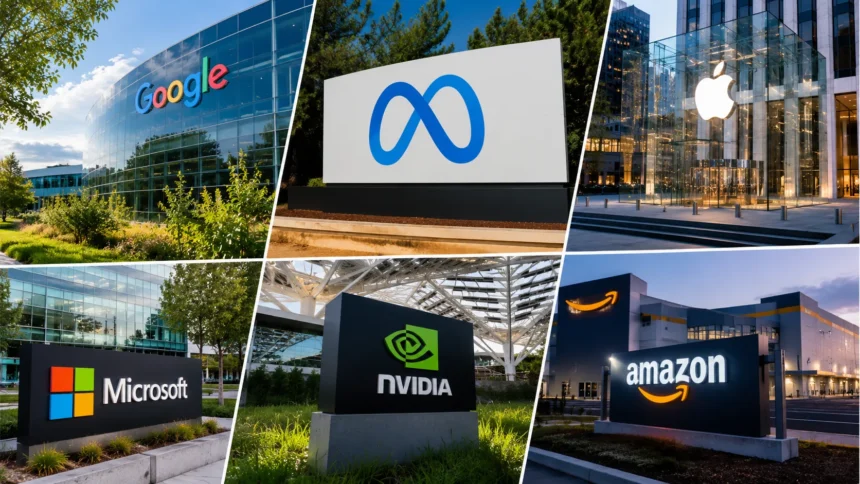
Biggest Technology Companies in the United States
The United States is home to many of the world’s most influential technology companies, shaping everything from artificial intelligence and cloud computing to smartphones, semiconductors, online shopping, digital advertising, and enterprise software. These businesses do far more than sell technology products. Their platforms have become part of the infrastructure used by consumers, companies, governments, developers, and researchers around the world. Understanding the largest U.S. technology companies therefore provides a useful picture of where the global technology industry is heading.
Defining the biggest technology companies in the United States is not as simple as ranking businesses by one number. Market capitalization is commonly used because it represents the stock market’s valuation of a publicly traded company, but revenue, profit, employees, users, intellectual property, and strategic influence also matter. Rankings can change quickly as stock prices move, so it is more useful to understand the group of companies consistently operating at enormous scale rather than treating one day’s order as permanent.
As of August 2026, NVIDIA, Apple, Alphabet, Microsoft, and Amazon occupy the highest positions among major U.S. technology companies by market capitalization, while Broadcom and Meta also rank among the country’s largest technology businesses. Their leadership reflects several powerful trends, including explosive demand for AI computing, continued expansion of cloud services, increasing digital advertising, and the enormous reach of consumer technology ecosystems.
This guide explores the major American technology companies driving those trends and explains what makes each one important. Rather than concentrating only on stock-market value, it looks at products, business models, technology strengths, AI investments, cloud infrastructure, semiconductors, and competitive advantages. Whether you are researching the technology industry, investing landscape, or leading U.S. corporations, these companies provide an excellent starting point.
1. NVIDIA: The AI Computing Powerhouse
NVIDIA has become one of the most important companies in modern technology because its computing platforms sit at the center of the artificial intelligence boom. Originally widely recognized for graphics processing units used in gaming, NVIDIA expanded GPU computing into data centers, scientific computing, machine learning, robotics, autonomous vehicles, and generative AI. That transformation has moved the company from a specialized chipmaker into a foundational supplier for advanced computing infrastructure.
The company’s GPUs are particularly valuable for AI because they can perform enormous numbers of mathematical operations in parallel. Training and running large AI models requires exactly this kind of computational performance. Technology companies, cloud providers, research institutions, startups, and governments therefore invest heavily in NVIDIA systems when building AI infrastructure. Software such as CUDA has strengthened this position by giving developers a mature programming ecosystem around NVIDIA hardware.
NVIDIA is also expanding beyond selling individual chips. Its business increasingly includes complete computing systems, networking products, AI software, data-center architectures, automotive technology, and platforms for robotics and physical AI. This broader strategy allows the company to provide much more of the technology stack needed to build large-scale artificial intelligence systems rather than competing only at the processor level.
The scale of this growth has been extraordinary. NVIDIA reported fiscal 2026 revenue of $215.9 billion, up 65% year over year, and followed that with quarterly revenue of $81.6 billion for the quarter ended April 26, 2026. Its market capitalization stood above $5 trillion in mid-August 2026, making it the largest U.S. technology company by market value at that point.
2. Apple: The Consumer Technology Giant
Apple remains one of the world’s most recognizable technology companies because it combines hardware, software, services, and retail into a tightly controlled ecosystem. The iPhone remains central to the business, but Apple’s product portfolio also includes Mac computers, iPad tablets, Apple Watch, AirPods, services, accessories, and entertainment platforms. Customers who own several Apple products benefit from the way those devices communicate and share information.
The company’s major competitive advantage is integration. Apple designs its own operating systems, develops increasingly important custom silicon, controls important elements of device hardware, and operates a large ecosystem of services. This enables Apple to optimize products around a consistent user experience instead of relying entirely on components and software developed by unrelated companies.
Services have become increasingly important to Apple’s business model. The company earns revenue through areas such as cloud services, subscriptions, digital content, payments, warranties, and its broader software ecosystem. This creates recurring revenue beyond the initial purchase of an iPhone or computer and strengthens customer retention because users can accumulate applications, subscriptions, files, photos, and other services within the Apple ecosystem.
Apple remains one of the largest companies in the world by market capitalization. Its fiscal 2025 fourth-quarter revenue reached $102.5 billion, while its market value stood around $4.5 trillion in mid-August 2026. That combination of enormous hardware sales, recurring services revenue, brand strength, and ecosystem loyalty keeps Apple at the center of the U.S. technology industry.
3. Alphabet: Search, Advertising, Cloud and AI
Alphabet is the parent company of Google and controls one of the most extensive technology ecosystems in the world. Google Search, YouTube, Android, Chrome, Gmail, Maps, Google Cloud, and many other products connect billions of users with information, entertainment, productivity tools, businesses, and digital services. This extraordinary reach makes Alphabet one of America’s most influential technology companies.
Advertising remains central to Alphabet’s economics because businesses pay to reach users across Google Search, YouTube, and other digital properties. Search advertising has historically provided the company with enormous cash flow, helping finance ambitious investments in cloud infrastructure, artificial intelligence, autonomous driving, consumer hardware, and long-term research projects.
Artificial intelligence has become increasingly important throughout Alphabet’s portfolio. Gemini models are being incorporated into search, productivity applications, cloud services, developer platforms, and consumer products. Google Cloud also competes directly with Amazon Web Services and Microsoft Azure for enterprise customers that need computing infrastructure, databases, AI services, data analytics, and large-scale cloud platforms.
Alphabet’s annual revenue exceeded $400 billion for the first time in 2025, demonstrating the extraordinary scale of its business. By mid-August 2026, its market capitalization was above $4 trillion, placing it among the very largest publicly traded technology companies in the United States.
4. Microsoft: Enterprise Software Meets the AI Era
Microsoft has been one of the defining companies of the technology industry for decades, but its business has evolved far beyond Windows PCs. Microsoft now operates major businesses in productivity software, cloud computing, cybersecurity, gaming, artificial intelligence, developer tools, databases, and enterprise applications. Products such as Microsoft 365, Azure, Teams, GitHub, LinkedIn, Dynamics, Xbox, and Copilot make the company relevant across both consumer and corporate technology.
Cloud computing transformed Microsoft’s position in the enterprise market. Azure allows companies to rent computing power, databases, storage, networking, analytics, AI services, and other infrastructure without operating everything inside their own data centers. The growth of cloud services has made Microsoft one of the strongest competitors to Amazon Web Services and an essential technology supplier for organizations undergoing digital transformation.
Microsoft has also positioned AI across much of its product portfolio. Copilot experiences appear throughout productivity tools, development environments, enterprise software, and Windows-related experiences. Rather than treating generative AI as one separate product, Microsoft is integrating it into software millions of workers already use, potentially making AI-assisted work a standard part of business productivity.
Microsoft Cloud revenue reached $51.5 billion in the quarter reported in January 2026, increasing 26% year over year. The company remained one of the world’s largest publicly traded businesses in August 2026, with a market capitalization of approximately $3.7 trillion. Its combination of enterprise relationships, recurring software subscriptions, cloud infrastructure, and AI investment gives it an unusually diversified technology business.
5. Amazon: E-Commerce, Cloud Computing and AI Infrastructure
Amazon is widely known for online shopping, but describing it purely as a retailer significantly understates its technology business. The company operates one of the world’s largest cloud computing platforms through Amazon Web Services, develops consumer devices such as Echo, Kindle, Fire TV, and Ring, invests heavily in artificial intelligence, and operates enormous logistics and fulfillment technology networks.
Amazon Web Services is particularly important because it provides computing infrastructure to startups, enterprises, governments, developers, and technology companies. AWS customers can access servers, storage, databases, analytics, networking, machine learning, generative AI, and many other services without building equivalent data-center infrastructure themselves. This makes Amazon one of the foundational providers behind modern internet services.
Amazon is also investing heavily in artificial intelligence infrastructure. Custom chips, data centers, AI platforms, foundation-model services, Alexa developments, and large-scale computing investments demonstrate that the company wants to compete across multiple layers of the AI industry. Its combination of consumer data, cloud infrastructure, e-commerce systems, logistics, and digital services gives Amazon opportunities to deploy AI across an unusually broad range of products.
Amazon remained among the five largest U.S. technology companies by market value in August 2026, with a market capitalization of roughly $2.9 trillion. Its scale comes from combining several enormous businesses rather than relying on one technology category, making it one of the most diversified companies in the American technology sector.
6. Broadcom: A Semiconductor and Infrastructure Software Leader
Broadcom is less familiar to many everyday consumers than Apple or Google, but it is one of the most important companies behind modern computing infrastructure. The company designs and supplies semiconductors used across networking, broadband, connectivity, data centers, storage, and other high-performance systems. Its technology is frequently embedded inside the infrastructure consumers use without ever seeing the Broadcom name.
Artificial intelligence has increased the importance of high-speed networking and specialized computing because enormous AI clusters need processors to communicate rapidly with memory, storage, and each other. Broadcom participates in several of these infrastructure markets, helping cloud and data-center operators build networks capable of supporting increasingly demanding AI workloads.
The company’s strategy has also expanded substantially into enterprise software. Broadcom’s acquisition of VMware created a much larger infrastructure-software business alongside its semiconductor operations. VMware technologies remain important for private clouds, virtualization, data-center management, and enterprise infrastructure, giving Broadcom an unusual combination of chip and software businesses.
Broadcom describes itself as a provider of semiconductor and infrastructure software solutions for complex enterprise needs, and in 2026 it continued expanding VMware Cloud Foundation with capabilities focused on production AI and private-cloud infrastructure. Its position demonstrates that some of America’s biggest technology companies operate primarily behind the scenes rather than through consumer-facing products.
7. Meta Platforms: Social Media, Advertising and AI
Meta Platforms operates some of the world’s largest social and communication platforms, including Facebook, Instagram, Messenger, WhatsApp, and Threads. These services give Meta an enormous global audience and make digital advertising the financial engine of the company. Businesses can target advertisements according to user interests, behavior, demographics, and other signals across Meta’s platforms.
Advertising funds large investments in technology infrastructure. Meta operates massive data centers and develops recommendation systems that determine which posts, videos, advertisements, and suggested content users see. Machine learning has long been important to these systems, and generative AI is becoming even more central to content creation, messaging, advertising, discovery, and user interaction.
Meta is also developing its own AI models and infrastructure rather than relying entirely on external providers. The Llama model family has helped position the company as an influential participant in open and developer-focused AI ecosystems. At the same time, Meta continues investing in augmented and virtual reality through Reality Labs, Quest headsets, smart glasses, and longer-term computing-platform ambitions.
By August 2026, Meta remained among the largest American technology companies, with a market capitalization above $1.5 trillion. Its scale comes primarily from social platforms and advertising today, but its enormous investment in AI infrastructure suggests the company expects intelligent assistants, recommendation systems, and next-generation computing interfaces to play a growing role in its future.
8. AMD: A Major Competitor in High-Performance Computing
Advanced Micro Devices, better known as AMD, develops processors and graphics technology for personal computers, gaming systems, servers, data centers, embedded devices, and artificial intelligence. For many years the company competed most visibly with Intel in CPUs and NVIDIA in graphics, but the rapid expansion of cloud computing and AI has created much larger opportunities.
AMD’s EPYC server processors have strengthened its position in data centers, where performance and energy efficiency can directly affect operating costs. Cloud providers and enterprise customers increasingly deploy AMD processors for demanding computing workloads, helping the company diversify beyond traditional consumer PCs.
Artificial intelligence has created another strategic growth market. AMD’s accelerator products compete for workloads involving machine learning and high-performance computing. NVIDIA remains dominant across much of AI infrastructure, but enormous global demand for computing capacity creates room for alternative hardware suppliers, especially when cloud providers and enterprises want more competition.
AMD’s importance extends beyond its current size because advanced processor competition influences pricing, performance, innovation, and supply throughout the technology sector. By mid-2026, AMD ranked among the world’s larger publicly traded technology companies, reflecting investor expectations that AI, cloud computing, and high-performance processors will remain major long-term markets.
9. Micron Technology: The Memory Behind AI and Data Centers
Micron Technology plays a less visible but essential role in computing because it develops memory and storage technologies. Modern processors cannot operate effectively without rapid access to data, making DRAM, NAND flash, and advanced memory products fundamental components inside computers, servers, smartphones, vehicles, and data centers.
Artificial intelligence has made high-performance memory particularly important. Large AI accelerators process enormous amounts of information and need high-bandwidth memory to keep data flowing rapidly enough to prevent expensive processors from waiting. As AI models grow, the relationship between processors and memory becomes increasingly important to overall system performance.
This demand has increased strategic interest in memory suppliers. AI infrastructure does not consist only of GPUs; it requires processors, networking equipment, memory, storage, electricity, cooling systems, data centers, and software working together. Micron therefore benefits from the wider infrastructure buildout even though consumers rarely interact directly with its brand.
The company’s position illustrates why the largest technology ecosystem includes more than famous consumer platforms. By August 2026, Micron ranked among the larger U.S.-headquartered technology companies by market capitalization, supported in part by strong investor interest in semiconductor infrastructure serving artificial intelligence and data centers.
10. Oracle: Enterprise Databases, Cloud and AI Infrastructure
Oracle has been a major enterprise technology company for decades, particularly because of its database software. Large businesses, governments, financial institutions, healthcare organizations, and other enterprises rely on databases to store and process mission-critical information. Oracle built a powerful position by becoming one of the most established suppliers of those systems.
The company has increasingly moved its products into cloud infrastructure through Oracle Cloud Infrastructure, commonly called OCI. Customers can run applications, databases, computing workloads, and increasingly AI systems in Oracle’s cloud instead of operating everything in their own facilities. This places Oracle in competition with AWS, Microsoft Azure, and Google Cloud while also allowing partnerships across cloud ecosystems.
Oracle’s database strategy is also adapting to artificial intelligence. The company promotes AI-focused database capabilities, autonomous management, data platforms, and multicloud deployment. Oracle AI Database technologies can now be used across multiple major cloud environments, allowing businesses to keep existing database investments while accessing newer AI and cloud capabilities.
This combination of long-standing enterprise relationships and growing AI infrastructure makes Oracle an important part of the U.S. technology landscape even though it receives less consumer attention than Apple, Amazon, or Meta. Its customers often operate critical systems where reliability, security, database performance, and long-term enterprise support matter more than consumer visibility.
Why NVIDIA Has Grown So Quickly
NVIDIA’s extraordinary rise demonstrates how dramatically artificial intelligence has changed the technology industry’s priorities. For years, the most valuable technology ecosystems centered heavily on smartphones, search engines, operating systems, social networks, and cloud software. Generative AI created enormous demand for the physical computing infrastructure needed to train and run increasingly sophisticated models.
AI models require enormous parallel computing power, and NVIDIA had spent years developing hardware and software for precisely that kind of workload. CUDA created a powerful development ecosystem around NVIDIA GPUs, while data-center products gave companies a path from individual accelerators to much larger computing clusters. When generative AI demand accelerated, NVIDIA already had mature technology ready for deployment.
Its advantage also extends into networking, systems, software libraries, enterprise AI tools, robotics, and simulation. This makes switching away from NVIDIA about more than replacing one chip. Customers may have significant software, infrastructure, developer knowledge, and operational processes built around the broader ecosystem.
The result has been enormous financial growth. Fiscal 2026 revenue reached $215.9 billion, and the company’s market value stood at roughly $5.5 trillion in August 2026. NVIDIA’s position shows how AI infrastructure has become valuable enough to challenge and surpass businesses built around some of the world’s largest consumer platforms.
Why Artificial Intelligence Is Reshaping America’s Largest Tech Companies
Artificial intelligence is no longer a specialist business for a small number of startups. Nearly every major U.S. technology company is investing heavily in AI models, chips, data centers, software, developer tools, assistants, automation, or advertising systems. The result is one of the largest investment cycles the technology industry has experienced.
NVIDIA benefits from selling core computing infrastructure, while Microsoft, Amazon, Google, and Oracle compete through cloud platforms that provide AI services. Meta invests in both AI models and recommendation systems, while Apple incorporates machine learning into consumer hardware and software. Broadcom, AMD, and Micron benefit from the semiconductor and infrastructure requirements created by growing AI workloads.
This competition also means companies are becoming increasingly connected. A cloud platform may use NVIDIA accelerators, Broadcom networking, Micron memory, and its own custom processors simultaneously. Technology leadership therefore depends not only on individual companies but also on extremely complex supply chains and partnerships.
The largest technology businesses can spend enormous amounts on data centers and research, giving them advantages in an AI market where computing infrastructure is expensive. This helps explain why companies already operating at massive scale remain central to the next generation of technology instead of being automatically replaced by smaller AI startups.
Cloud Computing Remains Another Major Battleground
Cloud computing fundamentally changed how companies purchase technology. Instead of buying large numbers of servers and maintaining them independently, businesses can rent computing, storage, databases, analytics, security, and AI services when needed. This shift has created enormous businesses inside Amazon, Microsoft, Google, and Oracle.
Amazon Web Services established an early leadership position and continues offering a vast cloud platform, while Microsoft’s enterprise software relationships helped Azure grow quickly. Google Cloud combines infrastructure with strong data and AI capabilities, and Oracle competes particularly strongly around databases and enterprise workloads.
AI is strengthening rather than replacing the cloud business. Training and serving large AI models requires enormous computing capacity that many organizations cannot build economically themselves. Cloud platforms can provide this infrastructure on demand while giving customers access to models, GPUs, databases, data pipelines, and AI-development tools within the same environment.
For the biggest American technology companies, cloud computing therefore serves both as an enormous existing business and a distribution channel for AI. Companies that control cloud infrastructure can sell the computing resources needed to build the next generation of software, creating recurring revenue as customers consume more processing and storage.
Semiconductors Have Become Strategically Critical
For many years, software platforms received most public attention while semiconductors remained largely invisible to everyday users. Artificial intelligence, cloud computing, autonomous systems, smartphones, and connected devices have demonstrated just how dependent the economy is on sophisticated chips.
NVIDIA, Broadcom, AMD, Micron, Intel, Qualcomm, and other American semiconductor companies occupy different parts of this ecosystem. Some design processors, others specialize in networking, memory, wireless communications, or infrastructure components. Together, their technologies support nearly every major digital service.
Semiconductor development is difficult because advanced chips require enormous research investments and highly specialized manufacturing. Only a relatively small group of companies can compete at the highest levels of design. Manufacturing itself also depends on global partners and complex equipment supply chains, creating significant geopolitical and economic importance.
The growth of NVIDIA, Broadcom, AMD, and Micron in recent technology rankings reflects this shift. The companies building the hardware beneath artificial intelligence are increasingly valued alongside the consumer and software platforms that dominated previous technology cycles.
What Makes a Technology Company “Big”?
Market capitalization is one of the simplest ways to measure corporate size because it represents the market value of a publicly traded company’s shares. It is calculated using the stock price and number of shares outstanding. Because stock prices change continuously, rankings based on market capitalization can move substantially even when the underlying businesses have not changed overnight.
Revenue provides another useful measure. Amazon generates enormous sales because its business includes retail, logistics, subscriptions, advertising, and cloud computing, while a semiconductor company may produce much lower revenue but achieve high margins and receive a very large market valuation based on future growth expectations.
Profitability also matters because two companies with similar revenue can have completely different economics. Software, digital advertising, semiconductor design, hardware manufacturing, and online retail have different cost structures. Investors therefore evaluate margins, cash flow, growth rates, competitive advantages, and future market opportunities alongside revenue.
Influence is harder to quantify but equally important. Android, Windows, AWS, iOS, NVIDIA GPUs, Google Search, Microsoft 365, and Meta’s social platforms affect other businesses and developers on an enormous scale. A company’s importance to the technology ecosystem cannot always be captured by a single financial ranking.
Where Are the Biggest U.S. Technology Companies Located?
California remains the most famous center of the U.S. technology industry. Silicon Valley and the wider San Francisco Bay Area have produced or attracted many leading technology companies, venture capital firms, research institutions, and startups. Apple, Google, Meta, NVIDIA, and many other influential businesses have major headquarters or operations in the region.
Seattle and its surrounding area form another major technology hub because of companies such as Microsoft and Amazon. Their growth helped create a large ecosystem of software engineers, cloud specialists, startups, suppliers, and technology talent throughout the Pacific Northwest.
Other regions are becoming increasingly important as well. Semiconductor companies operate in states with major chip-design or manufacturing communities, while cloud providers are building data centers across numerous parts of the country. Austin, New York, Boston, Northern Virginia, and several other regions have developed significant technology sectors.
The rise of cloud computing and remote work also means technology employment is more geographically distributed than it once was. Headquarters remain important, but America’s largest companies now operate offices, data centers, research facilities, logistics networks, and engineering teams across the country and internationally.
How These Companies Affect Everyday Life
The influence of America’s largest technology companies extends into daily routines. A person might wake up using an Apple phone, search Google for information, work using Microsoft 365, host business data on AWS, watch content recommended through Meta or YouTube, and interact with services powered by NVIDIA processors without consciously thinking about the companies involved.
Businesses are even more dependent on these technology ecosystems. Cloud infrastructure, advertising platforms, cybersecurity tools, productivity software, databases, payment systems, artificial intelligence, and communication services often come from a relatively small number of large suppliers.
This concentration creates convenience because integrated platforms can provide reliable global infrastructure and enormous developer ecosystems. At the same time, it creates concerns about competition, privacy, platform power, cybersecurity, and dependence on a small group of corporations.
Understanding the largest technology companies therefore matters beyond investing or business news. Their decisions can influence how people communicate, how companies operate, what information users discover, how AI develops, and which technologies become standards throughout the economy.
Which U.S. Tech Companies Could Grow the Most in the Future?
Artificial intelligence infrastructure remains one of the strongest growth opportunities, which benefits companies involved in GPUs, memory, networking, cloud computing, and data centers. NVIDIA has already experienced enormous growth, while AMD, Broadcom, Micron, Microsoft, Amazon, Google, Oracle, and other infrastructure providers are competing for additional AI spending.
Consumer AI represents another major opportunity. Companies are developing assistants, smarter search experiences, AI-powered productivity software, image and video creation tools, personalized recommendations, and automated workflows. The winners may be companies that integrate AI naturally into products people already use instead of treating it as a separate destination.
Robotics and autonomous systems could create another major technology cycle. AI models increasingly need to understand and interact with the physical world, opening opportunities around autonomous vehicles, warehouse robotics, humanoid robots, drones, manufacturing systems, and industrial automation.
Predicting which company will gain the most remains difficult because technology markets change quickly. The strongest businesses today nevertheless possess major advantages in computing infrastructure, cash flow, engineering talent, distribution, and existing customer relationships, giving them substantial resources to compete for emerging opportunities.
Final Thoughts
The biggest technology companies in the United States represent several different technology eras operating simultaneously. Apple dominates important areas of consumer devices, Microsoft and Oracle remain essential to enterprise computing, Google and Meta control enormous internet platforms, Amazon combines cloud computing with commerce, and semiconductor leaders such as NVIDIA and Broadcom provide infrastructure underneath the AI economy.
NVIDIA’s rise demonstrates how quickly industry leadership can change when a new technology creates extraordinary demand. Its GPUs and data-center platforms have become fundamental to modern AI development, pushing the company above many long-established consumer technology businesses in market value.
However, size alone does not guarantee permanent leadership. Technology companies must continuously adapt as computing platforms change. Microsoft successfully transitioned from traditional PC software toward cloud services, Amazon expanded from online retail into infrastructure, and Google is reshaping search around artificial intelligence. Future winners will similarly need to respond to technologies that may not yet be mature.
What is clear is that American technology companies remain extraordinarily influential across the global economy. Their products power communication, entertainment, commerce, software development, business operations, artificial intelligence, and cloud infrastructure. As AI, semiconductors, robotics, and data centers continue expanding, the composition and ranking of America’s largest technology companies may change again—but their impact on everyday life is likely to become even greater.
Frequently Asked Questions
What is the biggest technology company in the United States?
By market capitalization in mid-August 2026, NVIDIA was the largest U.S. technology company, with a market value of roughly $5.5 trillion. Market-cap rankings can change regularly because stock prices fluctuate.
What are the five biggest U.S. technology companies?
Current market-cap rankings place NVIDIA, Apple, Alphabet, Microsoft, and Amazon among the five largest U.S.-based technology companies. The exact order can change as their share prices move.
Why is NVIDIA worth so much?
NVIDIA supplies GPUs and computing platforms heavily used for artificial intelligence, data centers, scientific computing, gaming, robotics, and other demanding workloads. Rapid AI infrastructure spending has driven extraordinary growth in its data-center business.
Is Amazon considered a technology company?
Yes. Although Amazon operates one of the world’s largest e-commerce businesses, it also owns Amazon Web Services, develops AI infrastructure and consumer devices, and provides cloud computing used by organizations around the world.
Which U.S. technology companies are leading artificial intelligence?
NVIDIA, Microsoft, Alphabet, Amazon, Meta, AMD, Broadcom, and other major U.S. technology companies are heavily involved in AI through chips, cloud computing, foundation models, software, networking, data centers, or consumer AI products.