
What Are the Hip Adductor Muscles?
The hip adductors are a group of muscles located along the inner thigh that help move the leg toward the center of the body. They also contribute to balance, pelvic control, and lower-body stability during walking, running, squatting, and changing direction. Because they work during many everyday movements, keeping them strong and well coordinated can support comfortable movement.
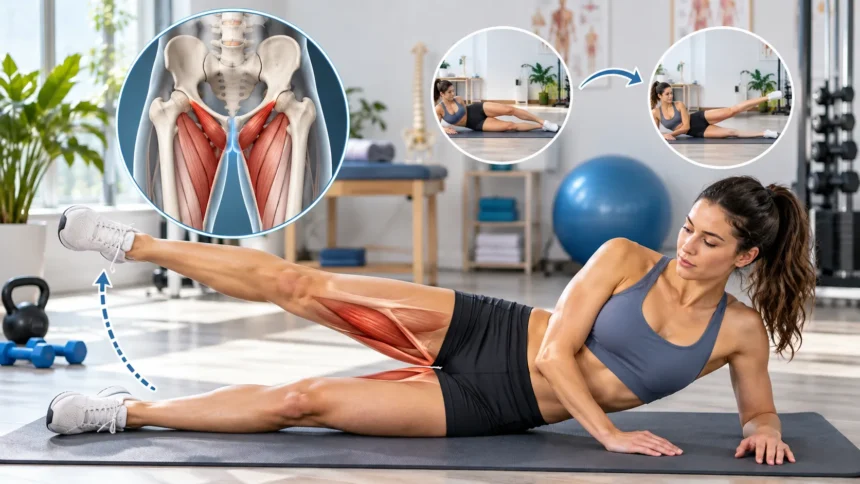
The main adductor muscles include the adductor longus, adductor brevis, adductor magnus, gracilis, and pectineus. These muscles attach between the pelvis and different areas of the thigh bone or lower leg. Although their primary role is hip adduction, several also assist with hip flexion, extension, or rotation depending on joint position.
Hip adductor exercises train these muscles through controlled resistance rather than simply stretching the inner thighs. Strengthening can be useful for athletes, active adults, and people rebuilding lower-body capacity after inactivity. The appropriate exercises depend on your current strength, mobility, training experience, and whether you have existing groin or hip symptoms.
Benefits of Hip Adductor Exercises
Strong hip adductors can contribute to better control of the legs and pelvis during everyday movement. They help stabilize the lower body when you walk, climb stairs, stand on one leg, or change direction. Improving their strength may make these tasks feel more controlled, particularly when training has previously focused mainly on the glutes and quadriceps.
Athletes also use the adductors heavily during sprinting, cutting, kicking, and rapid changes in direction. Sports such as football, soccer, basketball, hockey, and tennis place considerable demands on the inner-thigh muscles. Progressive strengthening can increase the muscles’ ability to tolerate these forces while complementing broader lower-body conditioning.
Adductor training can also create more balanced hip strength. Many exercise programs emphasize outward hip movement while giving less attention to muscles that pull the leg inward. Training both directions can improve overall hip capacity and provide more movement options without assuming that one particular muscle group needs to dominate.
How to Perform a Side-Lying Hip Adduction
Lie on your side with the leg you want to train positioned underneath. Bend the top knee and place that foot on the floor in front of the lower leg for support. Keep your torso comfortable and your lower leg straight, then gently tighten your inner thigh before lifting the lower leg several inches from the floor.
Raise the leg slowly without rolling your pelvis backward or twisting your body. Pause briefly at the top while keeping the movement controlled, then lower the leg back down. The range does not need to be large because the goal is to create tension through the inner thigh rather than lifting the foot as high as possible.
Begin with a manageable number of repetitions and stop before your technique becomes sloppy. If the exercise feels too easy, resistance can eventually be added with an ankle weight or light band. If you feel sharp groin pain rather than muscular effort, reduce the range or choose an easier variation.
Standing Hip Adduction With a Resistance Band
A standing banded hip adduction exercise trains the inner thigh while also challenging balance. Attach a resistance band securely to a low anchor and loop the other end around the ankle closest to the anchor. Stand tall while holding a stable surface if needed, then move the working leg across the front of your body.
Keep the movement slow and avoid swinging the leg for momentum. Your pelvis should remain relatively level while the inner-thigh muscles pull the leg inward against the band’s resistance. Return to the starting position gradually so the muscles also control the band as it pulls your leg outward.
Choose a resistance level that allows smooth repetitions without leaning dramatically to the side. As balance and strength improve, you can reduce hand support or increase resistance gradually. Standing variations are especially useful because they combine hip adductor strength with trunk and single-leg control in a functional position.
Copenhagen Plank for Advanced Adductor Strength
The Copenhagen plank is a more demanding exercise that places significant load on the hip adductors. Begin on your side next to a bench or sturdy elevated surface, placing the upper leg on top of it. Support your upper body on your forearm and lift your hips so your body forms a controlled line.
Beginners can make the exercise easier by supporting the upper knee rather than the ankle on the bench. This shortens the lever and reduces the demand placed on the adductors. Hold the position briefly while breathing normally, then lower yourself with control before repeating according to your current strength level.
The full Copenhagen plank can be challenging even for experienced exercisers, so progression matters. Do not begin with long holds or high volume if your inner thighs are not accustomed to this type of loading. Build tolerance gradually, especially if you participate in sports that already place significant stress on the groin muscles.
Sumo Squats for Hip Adductors
Sumo squats use a wider stance than standard squats and can involve the inner thighs more strongly during parts of the movement. Stand with your feet wider than shoulder width and turn your toes outward to a comfortable degree. Brace gently through your trunk and lower your hips while allowing your knees to track in line with your feet.
Descend only as far as you can maintain control and comfort. Push through your feet to return to standing while keeping your knees from collapsing inward. The glutes, quadriceps, and adductors all contribute, making the sumo squat a useful compound exercise rather than an isolated inner-thigh movement.
You can begin with bodyweight and gradually add a dumbbell or kettlebell when the movement becomes easy. Avoid forcing an extremely wide stance because wider is not automatically better. Your hip structure, mobility, and comfort should determine stance width instead of copying another person’s exact position.
Lateral Lunges for Inner-Thigh Strength
Lateral lunges train the hips through side-to-side movement while challenging the adductors in both lengthened and shortened positions. Begin standing upright, then take a controlled step to one side. Bend the stepping knee and push your hips backward while keeping the opposite leg relatively straight and your foot in contact with the floor.
You may feel the inner thigh of the straight leg lengthening while the working leg supports your weight. Push through the bent leg to return toward the center. Keep the motion smooth and avoid dropping quickly into the deepest position your flexibility allows, particularly when you are new to lateral movements.
Start with shallow lunges and gradually increase depth as strength and mobility improve. Bodyweight may be enough initially, while dumbbells can increase the challenge later. Lateral lunges are useful because they train movement in a direction that traditional squats and forward lunges often do not emphasize as strongly.
Adductor Squeeze Exercises for Beginners
An adductor squeeze is a simple beginner exercise that can be performed while lying down or sitting. Place a soft ball, rolled towel, or cushion between your knees and gently squeeze inward. Hold the contraction briefly while breathing normally, then release the pressure gradually rather than suddenly letting the knees move apart.
This exercise creates an isometric contraction, meaning the muscles produce force without large joint movement. Isometric exercises can be useful when you are learning how to activate the inner-thigh muscles or when dynamic movements feel too challenging. The squeeze should feel firm but controlled rather than like a maximum-effort contraction.
You can vary the duration and intensity as your control improves. Shorter gentle squeezes may be appropriate initially, while longer holds can increase endurance. If the exercise produces groin pain or discomfort around the pelvis, reduce the effort and consider whether a different exercise would be more suitable.
Common Hip Adductor Exercise Mistakes
One common mistake is using too much resistance before learning the movement properly. Heavy bands or weights can cause the pelvis to rotate, the trunk to lean, or other muscles to compensate. Starting lighter allows you to feel the adductors working while developing enough control to progress without turning every repetition into a whole-body movement.
Another mistake is training through sharp groin pain. Mild muscular effort and temporary fatigue are expected, but sudden pain should not be ignored. Groin discomfort can have several causes, and repeatedly forcing painful movements may increase irritation rather than building useful strength.
It is also important not to confuse unrelated musculoskeletal conditions with hip adductor problems. For example, Dupuytren’s contracture affects connective tissue in the hand rather than the inner-thigh muscles. Accurate anatomy matters because exercises should match the body region and condition you are actually trying to address.
How Often Should You Train the Hip Adductors?
Hip adductors can be trained as part of a broader lower-body strength program rather than requiring a separate daily workout. Many people can include one or two targeted adductor exercises several times per week, depending on intensity and recovery. The appropriate frequency also depends on whether your other exercises and sports already place substantial demand on these muscles.
Allow enough recovery between hard sessions, especially when using challenging exercises such as Copenhagen planks or heavy lateral lunges. Inner-thigh soreness after unfamiliar training can make walking or sports uncomfortable. Increasing training volume gradually gives muscles and tendons time to adapt without creating unnecessary fatigue.
Quality matters more than performing a large number of repetitions. Choose a level that allows controlled movement and stop before significant compensation appears. Over time, you can progress by increasing resistance, range, repetitions, or exercise difficulty rather than simply adding more sessions to the week.
Mobility and Stretching for the Hip Adductors
Adductor mobility can complement strength training when the inner thighs feel restricted during squats, lateral lunges, or other activities. Gentle wide-stance rocking, butterfly positions, or controlled side-to-side movements may help you explore a comfortable range. Stretching should create mild tension rather than sharp discomfort in the groin.
Mobility needs vary considerably between individuals. Some people naturally have more hip range than others because of differences in anatomy, training history, and activity. You do not need extreme flexibility for healthy hip function, and forcing wide positions beyond your natural range may provide little benefit.
Strengthening through gradually increasing ranges can also improve usable mobility. Lateral lunges and similar exercises teach the adductors to produce and control force while lengthened. Combining comfortable stretching with progressive strengthening may therefore provide more practical movement capacity than relying exclusively on passive flexibility exercises.
When to Modify or Avoid Adductor Exercises
Modify exercises if you are recovering from a recent groin strain, hip injury, or surgery and have not been cleared for unrestricted activity. Early rehabilitation may require lower loads and smaller ranges than general fitness routines. A physical therapist or other qualified professional can help determine which movements are appropriate for your stage of recovery.
Stop exercising if you experience sharp groin pain, sudden weakness, significant swelling, or pain that continues worsening after each session. Persistent symptoms around the hip or groin deserve assessment because several structures can produce discomfort in this region. Simply stretching or strengthening harder is not always the correct response.
Return to demanding exercises gradually once normal daily movement feels comfortable. Athletes may need to rebuild sprinting, cutting, and kicking tolerance in addition to general strength. Recovery should prepare the adductors for the actual forces required during your activities rather than focusing only on whether a basic exercise can be completed without pain.
Conclusion
Hip adductor exercises strengthen the muscles along the inner thigh that support hip movement, pelvic control, balance, and athletic performance. Side-lying adduction, banded movements, Copenhagen planks, sumo squats, and lateral lunges can all train these muscles in different ways. The best exercise depends on your current strength, mobility, and training goals.
Begin with movements you can control and increase difficulty gradually. Good form means keeping your pelvis and trunk stable, using an appropriate range, and avoiding momentum that removes tension from the intended muscles. Combining adductor strengthening with broader lower-body training can create a more balanced approach to hip fitness.
Mobility, recovery, and symptom response also matter. Mild muscular fatigue is normal, while sharp groin pain or persistent discomfort should not be pushed through. When practiced consistently and progressed appropriately, hip adductor exercises can improve inner-thigh strength and support more confident movement during everyday activities and sports.
FAQs
What is the best exercise for hip adductors?
There is no single best exercise for everyone. Side-lying adduction, resistance-band adduction, lateral lunges, sumo squats, and Copenhagen planks can all strengthen the adductors at different difficulty levels.
How often should I train my adductors?
Many people can train the adductors two or three times per week within a balanced lower-body program. Frequency should depend on exercise intensity, sports participation, soreness, and overall recovery.
Do squats work the hip adductors?
Yes. The adductors contribute during squats, particularly in deeper or wider-stance variations. However, targeted exercises such as banded adduction or Copenhagen planks can provide a more direct strength challenge.
Can weak adductors cause groin pain?
Weak or poorly conditioned adductors may contribute to some groin problems, but pain can have several causes. Persistent or significant groin pain should be assessed rather than automatically assumed to come from weakness.
Should I stretch my adductors every day?
Daily aggressive stretching is usually unnecessary. Gentle mobility can be performed regularly if it feels comfortable, while progressive strength training can also help improve usable range and control through the hips.