

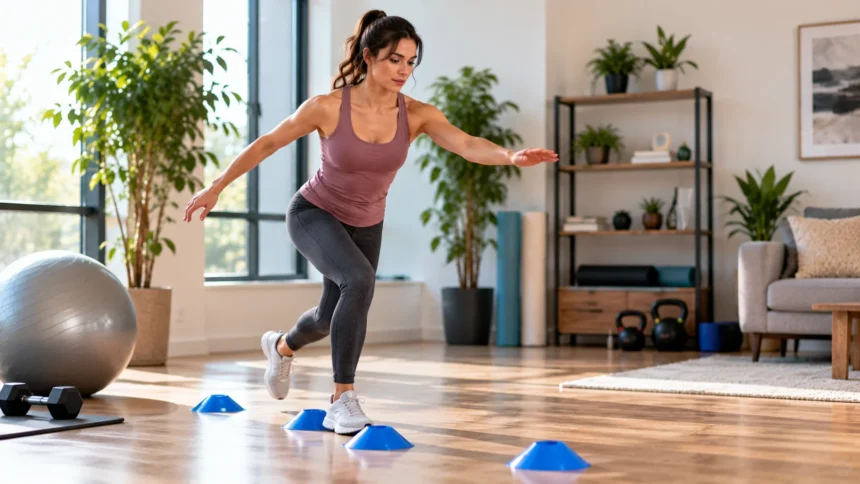
Coordination is the ability to control different parts of your body smoothly and efficiently during movement. It helps with everyday tasks such as walking, reaching, carrying objects, climbing stairs, and reacting quickly when your balance changes. Good coordination also plays an important role in sports, exercise, and activities that require timing between the eyes, hands, feet, and body.
Coordination can improve with practice because the brain, nerves, and muscles become better at working together. You do not need advanced athletic training to make progress. Simple balance drills, hand-eye activities, footwork patterns, strength exercises, and repeated movement practice can gradually improve control and confidence.
The best approach is to challenge coordination without making movements so difficult that form breaks down completely. Consistency, concentration, and gradual progression usually matter more than speed. This guide explains what coordination means, why it matters, which exercises can help, and how to practice safely in everyday life.
What Is Coordination?
Coordination refers to how effectively your brain and body organize movement. It involves timing muscle contractions, controlling direction, adjusting force, and responding to information from your eyes and other senses. When these systems work together efficiently, movements tend to feel smoother and more accurate.
Different types of coordination are involved in different tasks. Hand-eye coordination helps when catching a ball, typing, or reaching for an object, while foot-eye coordination matters during activities such as kicking or stepping over obstacles. Whole-body coordination is important when several joints and muscle groups need to move together.
Coordination is not exactly the same as strength, balance, or flexibility, although all of these abilities can influence it. Someone may be strong but still struggle with complex movement patterns. Improving coordination therefore requires actual practice with controlled movements rather than relying only on general fitness.
Why Good Coordination Matters
Good coordination makes everyday movement more efficient. Activities such as getting dressed, cooking, driving, carrying groceries, or moving around crowded spaces all require different body parts to work together. Better coordination can make these tasks feel more natural and reduce unnecessary effort.
Coordination is also important for exercise performance. Running, lifting weights, cycling, swimming, and playing sports all depend on timing and movement control. The better your body can organize these actions, the easier it becomes to learn new movement patterns and perform them consistently.
For older adults, coordination can support confidence during daily movement. Quick adjustments may help when stepping around obstacles or changing direction. Coordination work should usually be combined with strength and balance training because these abilities work together rather than functioning separately.
Improve Balance First
Balance and coordination are closely connected because many coordinated movements require you to remain stable while another body part moves. Simple balance drills can therefore provide a useful foundation. Standing with your feet closer together or practicing supported single-leg balance are common starting points.
Use a wall, counter, or sturdy chair for support when necessary. Begin with short holds and gradually reduce hand support as your confidence improves. The goal is not to wobble as much as possible, but to maintain control while making small corrections.
Once basic balance becomes easier, add gentle movement. You might turn your head, move your arms, or slowly tap one foot in different directions while standing on the opposite leg. These changes make the nervous system process more information and can create a stronger coordination challenge.
Practice Hand-Eye Coordination
Hand-eye coordination helps your visual system guide movements of the hands and arms. Throwing and catching a soft ball is one of the simplest ways to practice this ability. Start close to a wall or partner and focus on making accurate, controlled movements rather than throwing quickly.
You can increase difficulty by changing the size of the ball or the direction of the throw. Alternating hands is another useful progression because your non-dominant side may require more concentration. Keep the movement manageable enough that you can complete several successful repetitions.
Daily activities can also train hand-eye coordination. Drawing, gardening, certain crafts, racket sports, and carefully placing objects can all require visual information to guide hand movement. Variety is useful because different tasks challenge timing and accuracy in slightly different ways.
Work on Foot-Eye Coordination
Foot-eye coordination involves using visual information to control movements of the feet and legs. It is important in sports but also helps during ordinary tasks such as stepping over objects or navigating uneven ground. Simple cone or floor-marker drills can help develop this skill.
Place several markers on the floor and step between them using different patterns. You can move forward, sideways, diagonally, or alternate feet. Begin slowly enough that you can place each foot accurately before trying to increase speed.
Ball drills can also improve foot-eye coordination. Gently tapping or passing a ball between the feet requires timing and visual control. If these activities are new, use a larger ball and open space until movement becomes more comfortable.
Use Cross-Body Movements
Cross-body exercises require one side of the body to work with the opposite side, which can challenge coordination effectively. A simple example is touching your right hand to your left knee and then switching sides. Perform the movement slowly while maintaining steady posture.
Cross-crawl patterns can also be done while marching. Lift one knee and move the opposite arm forward, then switch sides. This resembles natural walking mechanics but becomes more challenging when you intentionally slow the movement and focus on precise timing.
These exercises can be included in warm-ups because they combine movement, balance, and concentration. They do not need to be complicated to be useful. Once the basic pattern becomes easy, you can increase speed or add slightly more complex sequences.
Practice Agility and Direction Changes
Agility drills challenge coordination because the body must change direction while maintaining balance and control. You can practice stepping forward, backward, and sideways between floor markers. Begin at a walking pace before adding faster movements.
Short shuffle patterns are another option. Move two or three steps to one side, pause with control, and then return. Keep your knees slightly bent and avoid crossing your feet unless the drill specifically requires it.
Speed should come after accuracy. Moving quickly with poor control does not necessarily improve coordination effectively. Gradually increasing pace while maintaining good foot placement creates a safer and more useful training progression.
Try Single-Leg Exercises
Single-leg exercises challenge balance, hip stability, and coordination at the same time. Standing on one leg is a simple starting point, but you can progress to controlled knee lifts, small reaches, or gentle leg movements. Use support if you cannot maintain a steady position.
Step-ups can also improve single-leg coordination. Place one foot on a low step, press through that leg, and bring the other foot up with control. Step back down slowly rather than dropping your weight.
As ability improves, you can add arm movement or change the direction of your reach. These variations force the body to coordinate several actions while maintaining stability. Keep the range comfortable and prioritize smooth movement throughout each repetition.
Strength Train for Better Movement Control
Strength and coordination are different qualities, but stronger muscles can make controlled movement easier. Exercises for the legs, hips, core, shoulders, and upper back can help your body maintain position while performing more complex tasks. Weakness may make coordinated movements harder because stability is limited.
Basic movements such as squats, bridges, rows, presses, and step-ups can build useful strength. Choose exercises you can perform with good technique and progress gradually. Coordination often improves naturally as you become more familiar with these movement patterns.
Resistance training also teaches the nervous system to organize force. When you lift a weight with control, multiple muscles must activate in the correct sequence. This is another reason strength training can complement balance, agility, and skill-based coordination work.
Slow Down New Movements
One of the easiest ways to learn coordination is to slow a movement down. Fast practice can hide mistakes because momentum carries the body through the pattern. Slower repetitions give you time to notice where your arms, feet, and torso are positioned.
Break complicated movements into smaller parts when necessary. Practice one section until it feels comfortable, then add the next. This method works well for dance steps, exercise technique, sports drills, and other unfamiliar movement patterns.
Speed can increase after accuracy improves. The nervous system becomes more efficient through repeated successful practice. Trying to perform a complex movement quickly before learning the basic pattern may simply reinforce poor technique.
Use Both Sides of Your Body
Many people rely heavily on their dominant side during daily activities. Practicing movements with the non-dominant hand or leg can create a useful coordination challenge. Simple tasks such as controlled ball throws, step patterns, or light reaching drills can help.
You do not need to make every activity equally difficult on both sides immediately. Start with slower movements and fewer repetitions on the less coordinated side. Over time, the goal is to improve control rather than force perfect symmetry.
Bilateral exercises are also valuable. Movements where both arms or legs work together can improve timing between the two sides of the body. Jumping patterns, marching, rowing movements, and controlled lifting exercises all involve coordinated bilateral action.
Include Coordination in Your Morning Routine
Practicing coordination regularly is easier when it becomes part of an existing routine. A short session in the morning can include marching, balance drills, cross-body reaches, and controlled footwork. Even five to ten minutes can provide useful movement practice when performed consistently.
Morning activity can also help you transition from inactivity into more purposeful movement. Begin with gentle mobility before adding balance or coordination drills. If you want to build a broader routine around this idea, learning how to structure morning exercise can help you combine coordination practice with other forms of movement.
Keep morning coordination work simple enough that it feels sustainable. You do not need challenging agility drills immediately after waking. Controlled movement, gradual progression, and repetition are more important than intensity for developing coordination.
Try Sports and Recreational Activities
Sports naturally challenge coordination because they involve timing, reaction, changing direction, and responding to unpredictable situations. Tennis, badminton, basketball, football, swimming, and table tennis all require different forms of movement control. Recreational participation can therefore be an enjoyable way to build coordination.
Dance is another useful option because it combines rhythm, balance, memory, and whole-body movement. Learning short sequences challenges the brain to organize several actions at once. You can start with beginner-friendly routines and progress as patterns become more familiar.
The best activity is one you enjoy enough to practice regularly. Coordination improves through repetition, so consistency matters. Recreational activities can make training feel less repetitive while still providing significant movement challenges.
Challenge Reaction Time
Reaction time is related to coordination because the body must respond quickly to changing information. Partner drills can be useful, such as catching an unexpectedly released ball or moving toward a called direction. Keep the environment safe and the movements controlled.
You can also use simple visual cues. Place several colored markers around you and move toward a randomly selected one. The unpredictability forces you to process information and organize movement quickly.
Reaction drills should remain appropriate for your fitness level. Fast changes of direction may not be suitable for everyone, especially when balance is limited. Begin with slower responses and increase difficulty only when you can maintain control.
Practice Coordination Consistently
Coordination improves through repeated exposure to specific movement challenges. Practicing once every few weeks is less effective than shorter sessions performed regularly. Ten minutes several times per week can be enough to make a noticeable difference in familiar movements.
Variety can help prevent progress from becoming too specific. Combine balance, hand-eye drills, cross-body patterns, footwork, and strength exercises rather than relying on only one activity. This gives the nervous system several different types of movement problems to solve.
Progress should remain gradual. Once a drill becomes easy, you can increase speed, change direction, reduce support, or add another movement. Changing only one variable at a time makes it easier to maintain good technique while creating a new challenge.
Common Coordination Training Mistakes
Trying to progress too quickly is a common mistake. Complex drills can look impressive, but they are not useful if you cannot control the basic pattern. Start with a level where you can succeed consistently before adding speed or difficulty.
Fatigue can also reduce coordination. As muscles become tired, timing and balance may deteriorate, which can make complex drills less effective and potentially less safe. Coordination exercises are often best performed before heavy fatigue develops.
Another mistake is ignoring the weaker side. Always practicing with the dominant hand or leg can reinforce existing differences. Include both sides gradually so the nervous system receives practice controlling a wider range of movements.
When Coordination Problems Need Medical Attention
Some coordination difficulties simply reflect lack of practice, fatigue, or unfamiliar movement. However, sudden or unexplained loss of coordination is different and may require medical attention. A significant change in walking, hand control, balance, or speech should not be treated as an ordinary fitness issue.
Seek urgent medical care for sudden coordination problems accompanied by facial drooping, severe headache, weakness, numbness, confusion, vision changes, or difficulty speaking. These symptoms can indicate a serious medical problem that requires immediate evaluation.
Persistent coordination problems that gradually interfere with daily activities should also be discussed with a healthcare professional. A clinician can evaluate whether vision, the nervous system, medications, balance systems, or another factor may be contributing. Exercise recommendations can then be tailored more appropriately.
Conclusion
Improving coordination requires your brain, nerves, and muscles to practice working together. Balance drills, hand-eye activities, footwork, cross-body movements, agility exercises, and strength training can all help develop smoother and more accurate movement. The best exercises are challenging enough to require focus without causing complete loss of control.
Start slowly and repeat movements consistently. Learn basic patterns before adding speed, resistance, unstable surfaces, or complex combinations. Short practice sessions several times per week can be more effective than occasional difficult workouts.
Coordination can improve at different ages and fitness levels, but sudden changes should not be ignored. If coordination problems appear unexpectedly or occur with neurological symptoms, seek medical evaluation. For ordinary skill development, gradual practice and varied movement provide a practical foundation for progress.
FAQs
What is the best exercise to improve coordination?
There is no single best exercise. Balance drills, ball tosses, cross-body marches, agility patterns, and single-leg movements all train different aspects of coordination and can work well together.
How long does it take to improve coordination?
Progress depends on the skill, training frequency, and starting level. Some movements may feel easier within weeks, while more complex coordination patterns can require longer, consistent practice.
Can adults improve coordination?
Yes. Adults can improve coordination through repeated movement practice, balance training, sports, strength work, and skill-based exercises. Progress usually comes from consistency and gradually increasing difficulty.
Does strength training improve coordination?
Strength training can support coordination by improving stability and teaching muscles to work together during controlled movements. However, specific coordination drills are still useful for timing, accuracy, and reaction skills.
Why has my coordination suddenly become worse?
Sudden loss of coordination can have causes that require medical attention, particularly when accompanied by weakness, numbness, speech problems, severe headache, or vision changes. Seek prompt evaluation for unexplained sudden changes.