
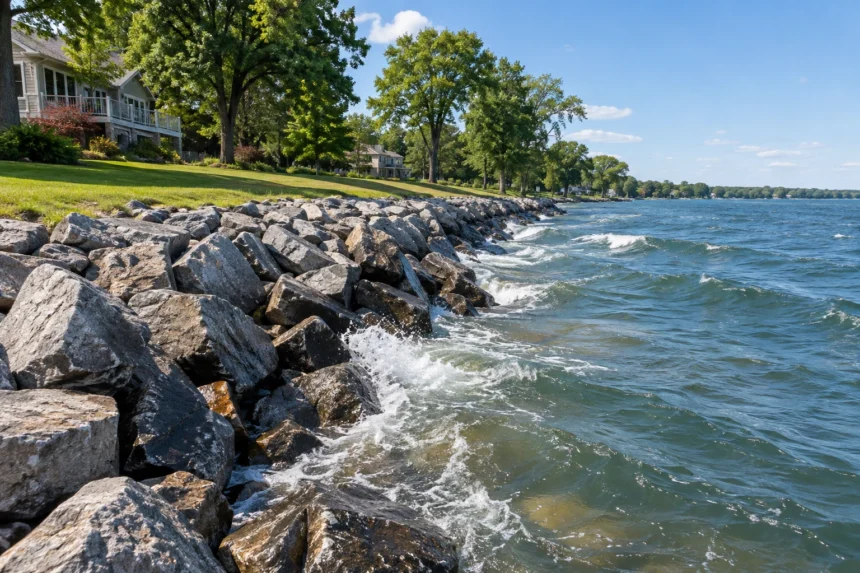
Riprap protects a shoreline differently from a vertical wood, vinyl, or concrete wall. Shore Protect Team describes riprap bulkheads as natural stone and large boulders that absorb wave energy and protect the shore from erosion while maintaining a natural appearance.
The company’s shoreline construction services include several structural approaches, so riprap should be selected because its rock-based form matches the erosion and wave conditions of the site, not merely because the owner prefers a natural look.
The bulkhead page lists riprap starting at $150 per linear foot for labor and materials. The FAQ identifies rock stabilization as essential for areas with aggressive waves and active erosion and states that it requires no maintenance.
Energy absorption is the central difference. Instead of presenting a flat vertical face to moving water, the stone mass breaks up and absorbs wave energy along the shoreline. That makes the system particularly relevant where water-side erosion is a leading concern.
Riprap does not answer every bulkhead problem. A property that needs a defined vertical edge or a particular structural relationship with adjacent waterfront features may lead to another system. The site review should begin with the function required.
The riprap bulkhead details can therefore be evaluated against wood, vinyl, concrete, and gabions by looking at wave exposure, erosion, drainage, maintenance, appearance, and shoreline geometry.
Wave energy is the main reason to consider riprap
The service page directly connects riprap with aggressive waves and active erosion. Large stone and boulders provide mass and irregular surfaces that absorb energy while protecting the shoreline.
This is a different mechanism from a vertical wall. The owner should understand which type of shoreline edge the property actually needs before comparing prices.
Natural appearance is part of the material’s appeal
Riprap is described as blending naturally into the landscape. On properties where a rock shoreline fits the visual character of the site, that can be an advantage alongside erosion control.
Appearance should still remain secondary to function. Stone size, placement, and overall scope have to match the exposure conditions of the property.
- Wave exposure – Riprap is associated with aggressive waves and active erosion.
- Energy absorption – Large stones and boulders are used to dissipate wave energy.
- Appearance – The system creates a natural shoreline look.
- Maintenance – The FAQ describes rock stabilization as requiring no maintenance.
- Starting price – From $150 per linear foot for labor and materials.
Riprap and drainage are different considerations
Rock voids allow water movement through the stone mass, but the service page specifically highlights natural drainage as a defining characteristic of gabions. Owners should not assume that every rock-based system performs the same structural role.
Riprap should be compared with gabions by function and site geometry. Gabions contain rock within a flexible basket system, while riprap uses free stone and boulders along the shoreline.
- Determine whether active erosion and wave energy are primary site problems.
- Confirm that a sloped rock shoreline fits the property’s required use and geometry.
- Compare riprap with gabions or vertical walls only after the desired shoreline form is clear.
- Measure the shoreline length and access required for stone placement.
- Review adjacent soil and water-level conditions as part of the full site assessment.
- Use the starting per-foot figure only after the material quantity and access are understood.
Where riprap fits in a broader bulkhead plan
Riprap is strongest as a choice when wave energy and active erosion dominate the problem and a natural rock shoreline is acceptable. It is not simply a cheaper substitute for concrete or vinyl because it creates a different physical shoreline.
A clear proposal should explain why rock stabilization fits the site, what shoreline length is included, and how access and placement will be handled. That makes the system easier to compare with other bulkhead options on function rather than appearance alone.
Stone placement is part of the construction scope
Riprap requires access for substantial quantities of natural stone or boulders to reach the shoreline. The service page lists site accessibility as a general bulkhead cost factor, so the route and working area should be reviewed before the starting per-foot reference is treated as a complete budget.
The finished rock edge should also be considered in relation to the property’s intended use. A sloped stone shoreline creates a different interface with the water than a vertical bulkhead. That can be appropriate for erosion control while being less suitable for an owner who specifically needs a clean vertical edge at that location.
These functional differences are why riprap should not be evaluated only by price. The project should first confirm that the shoreline form, wave conditions, erosion problem, and property use all fit a rock stabilization approach.
Riprap creates a shoreline profile, not a vertical property edge
Owners should visualize the finished geometry before selecting rock stabilization. Riprap occupies shoreline width and forms a sloped stone face, which is different from the defined vertical edge created by wood, vinyl, or concrete bulkheads. That difference can affect how the adjacent lawn, recreation area, or access to the water is used.
Access for stone can influence the estimate
Large boulders and natural stone have to be delivered and placed along the shoreline. Where terrain or equipment access is limited, the labor can differ from an open site. The service page’s general access guidance therefore applies to riprap as well as vertical walls.
Because riprap changes the physical shape of the shoreline, owners should also verify how the finished stone edge meets neighboring bulkheads, lawns, or access areas. Transition points belong in the project scope instead of being left as an undefined field condition.