
Knee swelling can make walking, bending, climbing stairs, and even resting uncomfortable. One common reason for noticeable swelling around the joint is knee effusion, sometimes described as “water on the knee.” It happens when excess fluid builds up inside or around the knee joint because of injury, inflammation, arthritis, infection, or another underlying problem.
Knee effusion treatment depends heavily on what caused the fluid buildup in the first place. Mild cases related to overuse may improve with rest and gradual rehabilitation, while sudden or severe swelling may require medical evaluation. Understanding the possible causes, treatment options, recovery process, and warning signs can help you respond appropriately and avoid making the problem worse.
What Is Knee Effusion?
Knee effusion occurs when more fluid than normal collects within or around the knee joint. The knee naturally contains a small amount of synovial fluid that reduces friction and helps the joint move smoothly. When irritation, inflammation, trauma, or disease affects the joint, the body may produce additional fluid, causing visible swelling and pressure.
People often notice that the affected knee appears larger or puffier than the other knee. The swelling may develop gradually over several days or appear quickly after an injury. Depending on the cause, knee effusion can also lead to stiffness, tenderness, warmth, reduced range of motion, or discomfort when placing weight on the leg.
Knee effusion itself is not usually considered a separate disease because it is commonly a sign of another condition. Identifying the reason behind the fluid buildup is therefore an important part of treatment. Managing only the swelling without addressing the underlying problem may provide temporary relief while allowing the original issue to continue.
Common Causes of Knee Effusion
Injuries are among the most common causes of sudden knee swelling. Ligament sprains, meniscus injuries, fractures, cartilage damage, and direct impacts can irritate structures within the joint and lead to fluid accumulation. Intense exercise or repetitive loading can also create inflammation, especially when the knee has not had enough time to recover.
Arthritis is another frequent cause of recurrent knee effusion. Osteoarthritis can gradually damage joint cartilage, leading to inflammation and excess synovial fluid, while inflammatory conditions such as rheumatoid arthritis can cause persistent swelling. Gout may also affect the knee when uric acid crystals accumulate inside the joint and trigger a strong inflammatory response.
Less commonly, knee effusion may result from infection or other medical conditions affecting the joint. An infected knee can become swollen, painful, hot, and difficult to move, sometimes alongside fever or feeling generally unwell. Because joint infections can become serious quickly, rapidly developing swelling with systemic symptoms requires prompt medical evaluation.
Symptoms That May Occur With Knee Effusion
Visible swelling is usually the most noticeable symptom of knee effusion. The contours around the kneecap may become less defined, and one knee may look significantly larger than the other. Some people describe a sensation of pressure, fullness, or tightness inside the joint, particularly when trying to bend the knee deeply.
Stiffness commonly develops because excess fluid limits normal movement within the joint. You may find it difficult to fully straighten or bend your knee, especially after sitting for long periods. Walking may also feel uncomfortable because pressure changes within the swollen joint each time body weight moves through the affected leg.
Pain varies considerably depending on the underlying cause. Some people experience mild aching while others develop sharp pain, throbbing, tenderness, or difficulty bearing weight. Warmth, redness, locking, instability, clicking, or bruising may provide additional clues and should be considered when deciding whether professional medical assessment is necessary.
How Knee Effusion Is Diagnosed
A healthcare professional will usually begin by asking when the swelling started and whether an injury occurred. They may also ask about pain, fever, previous knee problems, arthritis, recent exercise, or changes in activity levels. A physical examination can assess swelling, tenderness, stability, range of motion, and areas that reproduce discomfort.
Imaging may be recommended when the cause is uncertain or when significant structural injury is suspected. X-rays can help identify fractures, arthritis, or changes in joint structure, while ultrasound may show fluid accumulation and soft-tissue problems. MRI scanning can provide more detailed information about ligaments, cartilage, menisci, tendons, and other internal knee structures.
In some cases, a clinician may remove a small amount of joint fluid through a procedure called aspiration or arthrocentesis. The fluid can be examined when infection, gout, bleeding, or another inflammatory condition is suspected. Testing helps ensure that treatment addresses the underlying cause rather than simply trying to reduce visible swelling.
Initial Knee Effusion Treatment at Home
For mild swelling following overuse or a minor injury, reducing stress on the knee can be an appropriate first step. Avoid activities that clearly increase pain or swelling, particularly running, jumping, deep squatting, or prolonged standing. Complete inactivity is not always necessary, but movement should remain comfortable and should not repeatedly aggravate symptoms.
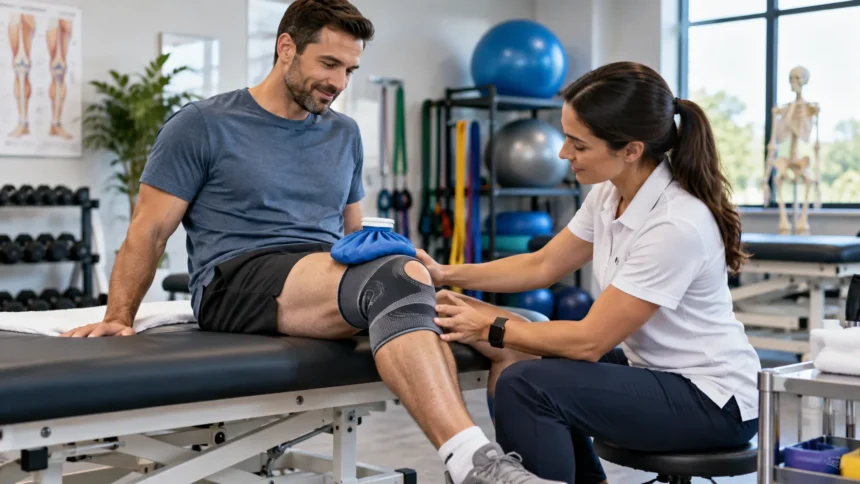
Cold therapy can sometimes help reduce discomfort during the early stages of swelling. An ice pack wrapped in cloth may be applied for approximately 15 to 20 minutes at a time, allowing the skin to warm fully between applications. Elevating the leg when resting can also help manage swelling, particularly when fluid tends to increase after spending time on your feet.
Compression may provide additional support when used appropriately, but it should not feel painfully tight or cause numbness, tingling, discoloration, or increased swelling below the wrap. Over-the-counter pain medication may be suitable for some people, although individual medical conditions and other medications matter. When unsure, it is safer to ask a qualified healthcare professional or pharmacist.
Medical Treatment for Knee Effusion
Medical treatment depends on why excess fluid has accumulated. If osteoarthritis is contributing to swelling, management may involve activity modification, physical therapy, strengthening, weight management when appropriate, and medication recommended by a clinician. Treatment for inflammatory arthritis may require disease-specific medication rather than relying only on temporary symptom relief.
A clinician may perform knee aspiration when significant fluid buildup causes pressure or when the fluid needs laboratory analysis. Removing fluid can sometimes reduce discomfort and improve movement, but the effect may be temporary if the underlying cause continues. Aspiration should be performed by a trained healthcare professional using appropriate sterile technique.
Other treatments depend on the diagnosis and may include prescribed anti-inflammatory medication, injections, antibiotics for infection, or treatment directed at gout or another medical condition. Structural injuries such as severe ligament damage or certain meniscus tears may require specialist assessment. Surgery is not necessary for most cases, but it may be considered when significant mechanical damage is present.
Exercises and Rehabilitation for Knee Effusion
Exercise can play an important role in recovery once severe pain and acute swelling begin to settle. Gentle range-of-motion movements can help reduce stiffness and maintain mobility without heavily loading the joint. The right starting point depends on the cause of the effusion, so rehabilitation should progress according to symptoms and professional guidance when available.
Strengthening the quadriceps, hamstrings, glutes, and calf muscles can improve support around the knee. Exercises such as gentle quad contractions, straight-leg raises, controlled heel slides, and later-stage sit-to-stand movements may be introduced gradually. The aim is to restore strength without producing a significant increase in swelling during or after exercise.
Core and hip strength can also influence lower-body control during walking, lifting, and sport. More dynamic movements, including rotational training such as oblique twists, belong later in rehabilitation rather than during an acutely swollen knee. They should only be added when normal movement is comfortable and the knee can tolerate exercise without renewed swelling.
How Long Does Knee Effusion Recovery Take?
Recovery time depends primarily on what caused the swelling and how severe the underlying condition is. Mild irritation from increased activity may improve within several days to a few weeks with appropriate load management. More significant injuries involving ligaments, cartilage, menisci, or bone can require a much longer rehabilitation period.
Arthritis-related knee effusion may behave differently because swelling can return periodically rather than disappear permanently. Managing activity, maintaining strength, and following a long-term treatment plan may help control symptoms. Improvement should therefore be measured not only by how quickly swelling disappears but also by whether movement, strength, and function are returning.
Trying to accelerate recovery by returning immediately to demanding exercise can sometimes trigger another flare. A gradual progression is usually more sustainable, especially when the knee has been swollen for several days. Increasing walking, strengthening, and sports activity in stages allows you to see how the joint responds before adding greater intensity.
What to Avoid While Your Knee Is Swollen
Activities that clearly worsen swelling should usually be reduced temporarily. Deep squats, heavy leg presses, running, jumping, repeated stair climbing, and high-impact sports may place additional stress on an irritated knee. Continuing painful activities simply because movement is still technically possible can prolong symptoms and make it harder to judge whether recovery is progressing.
Avoid aggressively stretching or repeatedly forcing the knee into maximum flexion when fluid is limiting movement. The feeling of tightness may come from swelling rather than from muscles that need stronger stretching. Gentle motion is generally more appropriate until the pressure inside the joint begins to decrease and normal range of motion gradually returns.
It is also important not to repeatedly drain or massage a significantly swollen knee without knowing why it is swollen. Home remedies cannot reliably distinguish between injury, arthritis, gout, infection, or other causes. When swelling is unexplained, severe, repeatedly returning, or associated with significant pain, professional evaluation becomes more important than continued self-treatment.
How to Prevent Knee Effusion From Returning
Building lower-body strength can improve the knee’s ability to handle everyday and sporting loads. Strong quadriceps, hamstrings, hips, and calves help control movement and distribute forces more effectively. A progressive strengthening program is usually more useful than suddenly performing large amounts of exercise after a long period of inactivity.
Training volume should also increase gradually. Rapid changes in running distance, gym intensity, jumping volume, or recreational sport can overwhelm tissues that are not prepared for the new workload. Allowing recovery days and monitoring how your knee feels during the 24 hours after exercise can help identify when activity levels are increasing too quickly.
Movement technique, appropriate footwear, recovery habits, and management of existing joint conditions may also influence recurrence. People with arthritis or previous knee injuries may need a more individualized prevention plan. The goal is not necessarily to avoid activity but to build enough capacity so the knee can tolerate the activities that matter to you.
When Should You See a Doctor?
Medical evaluation is advisable when knee swelling appears without an obvious reason or does not improve with simple measures. Persistent swelling that repeatedly returns may indicate arthritis, internal joint damage, or another condition requiring assessment. Significant difficulty walking, inability to fully move the knee, or symptoms following a serious injury also deserve professional attention.
Urgent medical care is particularly important when a swollen knee becomes very hot, red, or intensely painful. Fever, chills, feeling unusually unwell, or rapidly worsening swelling may raise concern about infection. A joint infection requires timely diagnosis and treatment because delaying care may lead to serious joint damage or wider health complications.
Seek medical attention promptly after major trauma if you cannot bear weight, the knee appears deformed, swelling develops extremely quickly, or you heard a pop followed by instability. These symptoms can occur with significant ligament, cartilage, or bone injuries. Early assessment can clarify the diagnosis and help establish an appropriate treatment and rehabilitation plan.
Returning to Normal Activity After Knee Effusion
Returning to normal activity should be based on function rather than simply waiting a fixed number of days. Ideally, everyday walking should feel comfortable and swelling should be clearly improving before demanding exercise is resumed. The knee should also move reasonably well and tolerate basic strengthening without becoming noticeably more swollen afterward.
Low-impact activities can provide a useful transition before returning to running or competitive sports. Depending on the cause of the effusion, options might include gentle cycling, controlled strength exercises, or progressively longer walks. Increase only one or two training variables at a time so you can identify what the knee can tolerate.
For athletes, returning directly from rest to full-speed training can create unnecessary setbacks. Sport-specific movements such as running, cutting, jumping, and rapid direction changes should usually be rebuilt gradually. A physiotherapist or qualified rehabilitation professional can be especially helpful after significant injuries because safe return-to-sport decisions depend on strength, stability, mobility, and movement quality.
Conclusion
Knee effusion occurs when excess fluid accumulates within or around the knee joint, usually because of injury, inflammation, arthritis, infection, or another underlying problem. Treatment should therefore focus on both controlling symptoms and identifying the cause. Mild swelling may respond to activity modification, cold therapy, elevation, compression, and gradual rehabilitation.
Recovery varies considerably from one person to another. Minor irritation may settle relatively quickly, while structural injuries or chronic joint conditions can require several weeks or months of management. Gradually restoring mobility and strength is generally more effective than either complete inactivity or returning to demanding activities before the knee is ready.
Pay attention to how the knee changes over time rather than focusing only on the amount of swelling visible on one particular day. Persistent, unexplained, rapidly worsening, hot, or very painful swelling should be assessed professionally. Appropriate diagnosis combined with sensible rehabilitation can help restore movement while reducing the chance of repeated knee irritation.
FAQs
Can knee effusion go away on its own?
Mild knee effusion caused by temporary overuse or minor irritation may improve with rest and gradual activity modification. However, persistent or unexplained swelling should be assessed to identify the underlying cause.
How long does knee effusion usually last?
Mild cases may improve within days or a few weeks, while injuries and chronic conditions can take considerably longer. Recovery depends on the cause, severity, treatment, and how the knee responds to activity.
Is walking good for knee effusion?
Gentle walking may be appropriate when it does not significantly increase pain or swelling. If walking causes limping, worsening discomfort, or additional swelling afterward, reduce the load and consider professional assessment.
Should I exercise with fluid on my knee?
Gentle mobility and carefully selected strengthening exercises may be helpful once acute symptoms settle. Avoid high-impact or painful exercises while the knee remains significantly swollen, and progress according to your symptoms.
When is knee effusion an emergency?
Seek urgent medical care when swelling is accompanied by intense pain, redness, significant warmth, fever, chills, severe injury, deformity, or inability to bear weight. These symptoms can indicate infection or serious joint damage.