

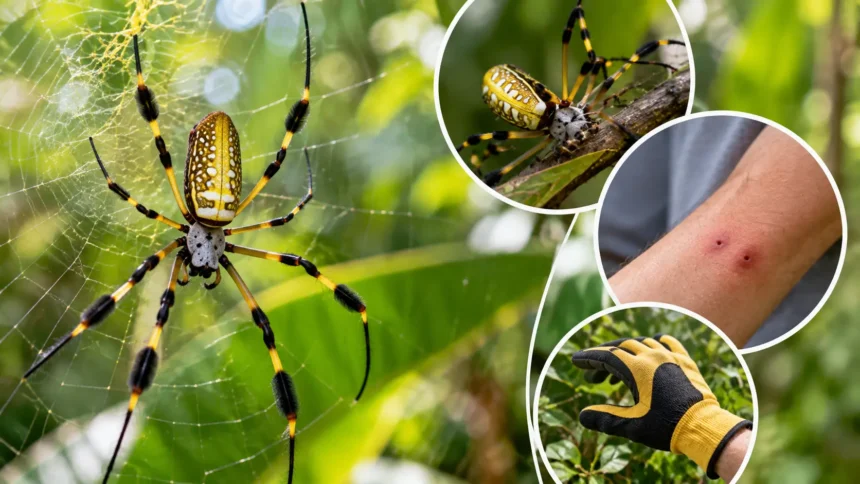
Banana Spider: Identification, Bite & Safety Facts
The name “banana spider” can be confusing because it is used for several very different spiders depending on the country and region. In parts of the southeastern United States, especially Florida, people often use banana spider to describe the golden silk orb-weaver, Trichonephila clavipes. This large, colorful spider builds impressive golden-colored webs and is generally considered low risk to people. In parts of Central and South America, however, “banana spider” may also refer to wandering spiders in the genus Phoneutria, which are medically important and can cause serious envenomation. Because these spiders differ dramatically in behavior and venom effects, identifying the species matters. Location, body shape, markings, web-building behavior, and habitat all provide useful clues.
Most encounters with the large web-building banana spiders commonly seen in gardens, forests, and around homes do not result in dangerous bites. Golden silk orb-weavers typically remain in their webs and are more likely to retreat than bite unless they are trapped, pinched, or handled. Their bites usually cause localized pain and mild redness rather than severe systemic illness. Brazilian wandering spiders behave differently, do not rely on large orb webs to capture prey, and have venom capable of producing serious neurological and cardiovascular symptoms. This guide explains what banana spiders look like, which spiders commonly receive the name, where they live, how dangerous their bites may be, what to do after a suspected bite, and how to stay safe around large spiders without unnecessarily killing beneficial species.
What Is a Banana Spider?
“Banana spider” is a common name rather than the scientific name of one particular species. Common names frequently develop locally, which means the same name may refer to unrelated animals in different places. In Florida and other parts of the southeastern United States, banana spider commonly refers to the golden silk orb-weaver, Trichonephila clavipes. This species is famous for its large body, long legs, and enormous golden-tinged webs. It belongs to a group of spiders specialized for catching flying insects in circular webs. Understanding this regional meaning is important because online searches for banana spiders often mix information about several species together.
Golden silk orb-weavers are among the largest conspicuous web-building spiders encountered in parts of the Americas. Adult females are considerably larger than males and can have bodies several centimeters long before the legs are included. Their bodies may show yellow, orange, brown, silver, or darker markings, while the legs often have contrasting bands and noticeable tufts of hair. A large female sitting in the center or upper portion of a broad web can look intimidating. Despite their appearance, these spiders are not generally considered medically dangerous to humans. They mainly use venom to immobilize insect prey.
The word banana spider is also associated with Phoneutria, a genus commonly called Brazilian wandering spiders or armed spiders. These spiders occur naturally in parts of Central and South America and are sometimes encountered around banana plantations and human structures. Unlike golden silk orb-weavers, they are active hunters and do not depend on a large permanent capture web. Several Phoneutria species possess medically significant venom. This difference is why an article that simply says “banana spiders are harmless” can be misleading. The geographic location and actual species must always be considered.
Other large spiders may occasionally be called banana spiders informally as well. Yellow garden spiders and various orb-weavers can receive similar local names because of their size, yellow coloration, or tendency to build large webs outdoors. Common names are especially unreliable when photographs circulate online without location information. Scientific identification relies on anatomical features, distribution, and behavior rather than color alone. Even trained observers may need close photographs or specimens to confirm certain species. For ordinary homeowners, distinguishing a web-building orb-weaver from an actively wandering spider is often a useful first step.
Banana spiders should therefore be discussed as a group of spiders sharing a nickname rather than one universal species. When someone reports finding a “banana spider,” useful questions include where it was found, whether it was sitting in a large web, how large its body was, and what markings were visible. These clues help narrow the possibilities. A large spider suspended in a golden orb web in the southeastern United States is very different from an unidentified wandering spider encountered in tropical South America. Accurate identification prevents both unnecessary fear and inappropriate reassurance.
How to Identify a Golden Silk Banana Spider
The golden silk orb-weaver is relatively distinctive when an adult female is present. Females have elongated bodies and exceptionally long legs that make them appear much larger than their body length alone would suggest. The body may contain yellow, orange, tan, silver, or darker areas, while the legs commonly show alternating bands. Hairy tufts can also be visible on portions of several legs. From a distance, the overall appearance is elegant and elongated rather than compact and stocky. The female usually remains associated with a large web during daylight.
Size is one of the first features people notice. Adult females can have bodies roughly 24 to 40 millimeters long, with the legs extending considerably farther. Males are dramatically smaller, slender, and much easier to overlook. A person may therefore see what appears to be a single giant spider while several tiny males are also present around its web. This difference between male and female size is normal for the species. Large size does not automatically indicate dangerous venom. Many harmless or low-risk orb-weavers are visually impressive precisely because of their long legs and large abdomens.
The web provides one of the strongest identification clues. Golden silk orb-weavers construct broad orb-shaped webs that may reach roughly one to two meters across in suitable locations. Their silk can have a noticeable golden or yellowish appearance when sunlight hits it. Webs are commonly stretched between trees, shrubs, forest edges, trails, or other structures where flying insects pass. The spider generally waits within the web instead of actively chasing prey across the ground. Finding an enormous organized web strongly supports an orb-weaver identification rather than a wandering spider.
People sometimes confuse golden silk orb-weavers with yellow garden spiders in the genus Argiope. Both can be large, colorful, and found in substantial webs. Some Argiope species commonly create a thick zigzag or zipper-like band of silk through the center of the web, although web patterns can vary. Golden silk orb-weavers are more strongly associated with long cylindrical bodies, extremely long legs, and golden-colored silk. Photographs showing the full spider and web are more useful for identification than a close-up of only one body part. Geographic distribution also helps narrow the possibilities.
Color should never be the only feature used for identification because individual spiders can vary and lighting changes how markings appear. Juveniles may also look different from mature females. If a spider is located somewhere where medically significant species occur, avoid handling it merely to obtain a closer view. A clear photograph taken from a safe distance can often provide enough information for a local extension service, pest professional, or arachnid expert to make a preliminary identification. Physical safety is more important than getting the perfect photo. Most spiders can be observed without direct contact.
Golden Silk Orb-Weaver vs Brazilian Wandering Spider
Golden silk orb-weavers and Brazilian wandering spiders are fundamentally different despite sometimes sharing the banana spider nickname. Golden silk orb-weavers are web-building spiders that spend much of their time in large structured webs. Brazilian wandering spiders are active hunters that roam rather than relying on large orb webs. This behavioral distinction is often one of the easiest differences for a nonexpert to recognize. Finding a large spider stationary in the center of a huge circular web strongly suggests an orb-weaver. Finding a large free-roaming spider does not automatically mean Phoneutria, but it deserves a different identification approach.
Geography is another major distinction. Trichonephila clavipes occurs through parts of the southeastern United States, the Caribbean, Central America, and South America. Phoneutria species naturally occur in Central and South America, with Brazil particularly associated with reports of medically significant encounters. Wandering spiders have occasionally attracted attention because specimens can hide among agricultural materials such as bananas. However, frightening media stories can make such encounters appear far more common in distant countries than they actually are. Local wildlife experts are better sources for assessing realistic regional risk.
Body shape and markings differ, although relying on appearance alone can be difficult for inexperienced observers. Brazilian wandering spiders tend to look more robust and ground-hunting in build, with long strong legs and brownish patterns that can provide camouflage. Golden silk orb-weavers generally look more elongated and colorful, particularly mature females. Some Phoneutria species may display defensive postures in which they raise the front legs when threatened. That posture should be treated as a warning to move away rather than an opportunity for closer inspection. Many unrelated spiders can still be mistaken for them.
Their medical importance is the biggest practical difference. A golden silk orb-weaver bite is generally associated with temporary localized symptoms rather than severe systemic poisoning. Phoneutria venom contains neuroactive components capable of producing significant symptoms involving pain, sweating, heart rate, gastrointestinal function, and the nervous system. Serious cases require urgent medical treatment. Death is uncommon, particularly where prompt medical care is available, but severe envenomation is possible. Anyone bitten by a suspected wandering spider in an endemic region should seek urgent medical advice rather than assuming it is a harmless orb-weaver.
The safest approach is not to identify a potentially dangerous spider by nickname. If someone in Florida says they saw a banana spider hanging in a huge golden web, they are likely describing the familiar golden silk orb-weaver. If someone in Brazil encounters a large wandering spider without a web, the term banana spider could refer to something medically more significant. Common names lose important information when they cross geographic boundaries. Scientific names or expert identification provide much greater clarity. When uncertainty involves a possible medically important species, caution is appropriate until identification becomes clearer.
Where Do Banana Spiders Live?
Golden silk orb-weavers favor warm climates and are found across a broad part of the Americas. In the United States, they are particularly associated with Florida and other southeastern areas. Their range extends through the Caribbean and Central America into parts of South America. They usually occupy habitats where strong web-supporting structures and regular insect traffic are available. Forest edges, wooded paths, gardens, wetlands, and areas between shrubs can provide suitable locations. Their visibility often increases when mature females grow large later in the season.
These spiders commonly build webs in open spaces between vegetation. A web may stretch across a walking path, between trees, along fences, or near structures surrounded by insects. This sometimes leads hikers or homeowners to walk unexpectedly into the web before noticing the spider. The experience can be startling because the silk is strong and the spider is large. However, accidental contact with the web does not mean the spider will attack. The spider generally wants to escape disturbance rather than confront a much larger animal.
Gardens can provide excellent habitat because flowering plants attract the insects orb-weavers eat. Flies, moths, bees, beetles, and other flying insects can become trapped in their webs. From a gardening perspective, these spiders can function as natural predators and help reduce some insect populations. Their presence does not indicate that a property is dirty or neglected. Large webs simply mean the location provides good structural support and adequate prey. Removing every orb-weaver can eliminate a useful part of the local ecosystem.
Brazilian wandering spiders occupy different environments depending on species. They occur naturally in tropical regions of Central and South America and may live in forests, plantations, vegetation, and sometimes around human structures. During the day, some may hide in sheltered locations such as under vegetation, debris, or objects before becoming more active later. Their association with banana plantations contributed to the common banana spider nickname. Because they are active hunters, they do not create the huge prey-catching orb webs associated with golden silk spiders.
Finding a large spider indoors does not by itself establish species. Many harmless hunting spiders enter homes accidentally, particularly during weather changes or while following prey. Geography remains one of the strongest clues. People outside the natural range of Phoneutria should not assume every large brown spider is a Brazilian wandering spider. Conversely, people living or working in areas where medically important spiders occur should avoid handling unidentified specimens. Local pest-control professionals or wildlife specialists can provide region-specific identification and removal assistance.
Are Banana Spiders Venomous?
Nearly all spiders use venom as part of their hunting strategy, but the presence of venom does not automatically mean a spider poses a serious danger to humans. Venom helps spiders immobilize small prey such as insects, and most species either cannot effectively bite people or produce only minor symptoms when they do. Golden silk orb-weavers have venom, but their bites are generally considered low risk. They are not known for aggressively pursuing humans. Most bites occur when the spider is trapped against the skin, grabbed, or otherwise physically threatened.
A bite from a golden silk orb-weaver may cause localized pain, mild swelling, itching, or redness around the bite site. Symptoms are generally short-lived and much less serious than those associated with medically important spider species. Individual reactions can still vary, and any broken skin has some risk of secondary bacterial infection. People with a history of severe allergic reactions should pay attention to symptoms beyond the bite site. Nevertheless, simply seeing a large golden silk spider does not represent a medical emergency. Its dramatic appearance is much greater than its typical threat.
Brazilian wandering spiders are different because some Phoneutria species have potent venom that can affect the nervous system. A clinically significant bite may cause intense local pain followed by sweating, nausea, vomiting, agitation, increased heart rate, excessive salivation, or other systemic symptoms. Severe cases can involve breathing problems and other dangerous complications. Children may be particularly vulnerable to significant envenomation because of their smaller body size. Suspected bites require urgent medical evaluation in regions where these spiders occur. Specific antivenom may be used for certain severe cases where available.
It is important not to diagnose spider bites solely from the appearance of a skin lesion. Many sores blamed on spiders are actually bacterial infections, insect bites, allergic reactions, or other skin problems. Unless someone actually sees the spider bite and the spider is reliably identified, the cause can remain uncertain. Skin infections may worsen if a person assumes venom is responsible and delays appropriate treatment. Expanding redness, pus, fever, or worsening pain deserves medical attention regardless of whether a spider was involved. Treatment should focus on actual symptoms rather than assumptions.
The statement “banana spiders are venomous” is therefore technically true but medically incomplete. The better question is which banana spider is being discussed and whether its venom is significant to humans. The common golden silk orb-weaver is generally a low-risk spider, while some spiders called banana spiders in the genus Phoneutria can cause serious envenomation. Location and identification make the difference. This is a good example of why common animal names can create unnecessary confusion in health information.
Banana Spider Bite Symptoms
A bite from a golden silk orb-weaver is uncommon because the spider normally remains in its web and avoids unnecessary confrontation. When a bite does happen, immediate localized discomfort may occur. The person may notice mild redness, swelling, tenderness, or itching around the puncture site. Symptoms generally remain confined to the area and improve without major medical treatment. The intensity can differ according to the individual, bite location, and whether the skin becomes irritated afterward. Most healthy adults are unlikely to experience severe systemic effects from this species.
Basic first aid for a minor suspected spider bite involves washing the area gently with soap and water. A cool compress can reduce discomfort and swelling, but ice should not be placed directly against bare skin for prolonged periods. Keeping the area clean can reduce secondary infection risk. Scratching should be avoided because broken skin can introduce bacteria. Over-the-counter pain or itch medicines may be appropriate for some people when taken according to product directions and personal medical conditions.
Symptoms after a suspected Phoneutria bite can be much more intense. Severe pain may begin around the bite site and can be accompanied by sweating, nausea, vomiting, agitation, rapid heartbeat, excessive salivation, or other neurological symptoms. Serious envenomation can affect breathing and require emergency treatment. Anyone who believes they have been bitten by a Brazilian wandering spider should not wait to see whether symptoms become severe. Emergency medical services or a poison information service should be contacted promptly. The spider should never be captured by hand for identification.
Difficulty breathing, facial or throat swelling, fainting, severe weakness, confusion, or rapidly worsening symptoms require emergency attention regardless of the spider species. These symptoms can indicate a severe allergic reaction, significant envenomation, or another medical problem. Children, frail older adults, and people with serious medical conditions may need particularly cautious evaluation. A photo of the spider taken safely can sometimes help clinicians, but obtaining one is never worth another bite. Safety comes before species confirmation.
A bite site that becomes increasingly painful, hot, swollen, or filled with pus over subsequent days may have developed a bacterial infection rather than continued venom activity. Fever or spreading redness also deserves medical assessment. People sometimes repeatedly apply harsh chemicals or cut open suspected spider bites, which can make the wound considerably worse. Do not burn, squeeze, cut, or attempt to suction venom from a bite. Clean wound care and appropriate medical evaluation are safer strategies when symptoms are concerning.
How Dangerous Are Banana Spiders?
The golden silk orb-weaver is much less dangerous than its size suggests. Its enormous web and long legs can create a frightening first impression, particularly when someone walks unexpectedly into the silk. Yet the spider’s primary defensive strategy is avoidance rather than attacking people. It has no reason to waste venom on something too large to eat. Most encounters involve no bite whatsoever. From a safety perspective, leaving the spider undisturbed is usually all that is necessary.
These orb-weavers may actually provide ecological benefits around homes and gardens. Their large webs capture numerous flying insects, including flies and other species people may consider pests. Spiders themselves are also food for birds, wasps, and other wildlife, making them part of the local food web. Removing them simply because they appear intimidating is not always necessary. If the web is positioned away from doors, walkways, or frequently used areas, allowing it to remain is often reasonable. Observation from a distance can be safer than repeated disturbance.
A different risk assessment applies to Brazilian wandering spiders. These spiders have medically significant venom and should not be handled. They may defend themselves when trapped, stepped on, or disturbed in hiding places. People living or working in endemic areas can reduce risk by checking shoes, gloves, clothing, boxes, and agricultural materials before use. Professional removal may be preferable when a suspected dangerous species is inside a home. Direct identification attempts using hands or household objects create avoidable exposure.
Media descriptions sometimes call wandering spiders among the “deadliest” spiders in the world, which can create a distorted impression of everyday risk. Venom potency and actual risk to a person are not identical concepts. Risk depends on whether a bite occurs, how much venom is delivered, the species involved, the person’s health and size, and access to medical treatment. Severe outcomes can occur, but not every bite causes life-threatening poisoning. Accurate information should encourage appropriate caution without treating every spider encounter as an emergency.
The simplest safety rule is to avoid handling unidentified spiders. Even spiders whose bites are medically minor can bite defensively when squeezed. Use distance, barriers, or professional assistance when relocation is needed. Teach children not to grab spiders regardless of color or size. People working in tropical agricultural environments should use gloves and inspect materials carefully. Respecting wildlife usually prevents bites far more effectively than trying to determine how close someone can safely get.
What to Do If You Find a Banana Spider
If a golden silk orb-weaver is outside and its web is not interfering with people, the easiest response is usually to leave it alone. The spider is likely capturing insects and poses little risk when undisturbed. Keep children and pets from grabbing the spider or damaging the web. If the web crosses a frequently used walkway, relocation may be reasonable. Avoid reaching blindly into vegetation where the spider is resting. Giving it space prevents most unwanted encounters.
When relocation is necessary, people who are comfortable with spiders can sometimes encourage a harmless web-building species to move using a long object rather than direct contact. However, this should only be attempted when identification is reasonably confident. Destroying the web alone may cause the spider to rebuild nearby rather than leave permanently. Moving outdoor lighting can sometimes help because lights attract insects and therefore attract web-building spiders. Reducing prey around doorways may encourage web construction somewhere less inconvenient. Chemical pesticides are rarely necessary for a single outdoor orb-weaver.
If a large unidentified spider is found indoors, trapping it under a container and sliding stiff paper beneath may work for harmless species when the person can do so without close hand exposure. When the species could potentially be medically significant, professional pest control is the safer choice. Never attempt to capture a suspected Brazilian wandering spider barehanded. Maintain distance and keep children or pets away from the room. An expert can remove the spider and help determine what it is.
Bananas purchased from stores occasionally inspire fears about hidden spiders, especially after sensational reports circulate online. Inspecting produce is reasonable, but discovering webbing or a spider does not automatically mean a dangerous Phoneutria species is present. Many different spiders and insects can be associated with agricultural products. Avoid touching an unfamiliar live spider directly. If identification is important, contain the area without handling the animal and contact an appropriate local expert or pest professional.
Repeated large spider sightings around a property usually reflect suitable habitat and abundant insect prey rather than an infestation in the conventional sense. Trimming vegetation away from doors, repairing screens, sealing gaps, and reducing unnecessary outdoor lighting can decrease indoor encounters. Outdoor spiders generally do not need elimination across an entire yard. Broad pesticide use can kill beneficial insects and spiders along with unwanted species. Targeted prevention is usually more sensible than treating every spider as a pest.
How to Prevent Banana Spider Bites
Avoiding direct handling is the most effective prevention strategy. Even normally docile spiders may bite when compressed between skin and clothing or trapped in a hand. Admire large orb-weavers from a distance and teach children to do the same. Use gloves when moving dense vegetation, firewood, stored outdoor equipment, or other materials where spiders may hide. Shake out gardening gloves before putting them on. These habits protect against many spider species, not just those called banana spiders.
When hiking in areas with large orb-weavers, watch for webs stretched across paths. Webs are particularly easy to miss when sunlight and background vegetation reduce contrast. A walking stick can sometimes help detect webs ahead without placing your face or hands directly into them. Accidentally walking into a web is unpleasant but usually not dangerous. If a spider lands on clothing, avoid crushing it against the skin. Gently brushing clothing away from the body can give the spider an opportunity to escape.
People living in regions with wandering spiders should pay more attention to concealed spaces. Shoes, boots, gloves, clothing, bedding near floors, stacked materials, and boxes can provide hiding sites for many arthropods. Shake these items out before use, particularly when they have been stored in garages, sheds, or outdoor environments. Workers handling bananas or other agricultural goods should follow workplace protective procedures. Gloves and appropriate footwear reduce accidental contact. Reaching blindly into dark spaces should be avoided.
Home maintenance can also reduce indoor spider encounters. Repair window and door screens, seal obvious cracks, and reduce clutter in storage spaces. Moving firewood and debris away from exterior walls removes hiding places for spiders and their prey. Controlling insects indoors indirectly reduces food available to spiders. Outdoor lights can attract moths and other flying insects, which in turn attract orb-weavers. Adjusting lighting placement may reduce webs near entrances without requiring pesticides.
Finally, learn which medically important spiders actually occur in your area. Online photographs from another continent can create fear of species that may not live anywhere nearby. Local universities, extension programs, museums, health departments, and reputable pest professionals can provide more geographically relevant information. Accurate knowledge helps people respond appropriately instead of either panicking or ignoring a genuine risk. The safest attitude toward unfamiliar spiders is respectful caution rather than fear. Most encounters end without injury when direct handling is avoided.
When to Seek Medical Attention After a Spider Bite
Most suspected bites from harmless orb-weavers can be watched at home when symptoms remain minor and localized. Clean the area, apply a cool compress, and monitor changes. Mild discomfort should gradually improve rather than intensify. If the person feels otherwise well and symptoms remain limited, emergency treatment is usually unnecessary. However, the identity of a spider is often uncertain. Worsening symptoms should therefore be judged by their severity rather than by assumptions about the species.
Seek prompt medical care when pain becomes severe, redness or swelling spreads rapidly, or systemic symptoms develop. Fever, repeated vomiting, heavy sweating, marked agitation, dizziness, weakness, or an unusually rapid heartbeat can indicate a more significant problem. These symptoms are especially important after a possible encounter with Phoneutria in an endemic area. Breathing difficulty, collapse, severe confusion, or loss of consciousness requires emergency treatment. Delaying care to continue searching online for spider photographs is not appropriate in a serious reaction.
Children should be evaluated more cautiously after a suspected medically important spider bite. Because they have lower body mass, a given amount of venom may have a greater effect. Older adults and people with serious cardiovascular or respiratory conditions may also have less reserve if systemic symptoms occur. Individual risk can vary even between bites from the same species. Clinicians evaluate the entire patient rather than relying solely on the spider’s reputation. Bringing a safely taken photograph can sometimes help, but capturing the spider is unnecessary.
Skin symptoms that worsen over several days may require assessment even without systemic illness. Increasing warmth, pus, expanding redness, or significant tenderness can indicate secondary bacterial infection. A dark or ulcerated wound may have many possible causes and should not automatically be diagnosed as a spider bite. Medical professionals may need to consider bacterial infections and other skin disorders. Treating the wrong presumed cause can delay recovery. Persistent wounds deserve a proper examination.
Whenever a dangerous species is genuinely suspected, contact local emergency services or a poison center appropriate to the country. Do not apply a tourniquet, cut the bite, attempt to suck out venom, or use extreme heat. Keep the person calm and reduce unnecessary movement while arranging appropriate advice. The majority of spider encounters never progress to severe illness, but recognizing warning symptoms allows serious cases to receive timely care. Sensible precautions provide better protection than fear of every large spider.
Frequently Asked Questions
What does a banana spider look like?
The answer depends on the species being called a banana spider. In the southeastern United States, the name often refers to the golden silk orb-weaver, a large long-legged spider with yellow, orange, silver, brown, and dark markings that builds a large golden-tinged web.
Are banana spiders poisonous or venomous?
Banana spiders are venomous rather than poisonous because they deliver venom through a bite. Golden silk orb-weaver venom is generally not medically dangerous to humans, while some Brazilian wandering spiders also called banana spiders can produce serious envenomation.
What happens if a banana spider bites you?
A golden silk orb-weaver bite usually causes localized pain, redness, or mild swelling that improves with basic care. A suspected Brazilian wandering spider bite can cause severe pain and systemic symptoms and should receive urgent medical evaluation.
Are banana spiders aggressive?
Golden silk orb-weavers are generally not aggressive toward people and usually bite only when grabbed, trapped, or squeezed. Brazilian wandering spiders can display defensive behavior when threatened, so unidentified large spiders in regions where they occur should not be handled.
Should I kill a banana spider in my yard?
A golden silk orb-weaver usually does not need to be killed and can help capture flying insects around a garden. If a web creates a problem near a doorway or walkway, relocation or environmental changes are generally preferable to unnecessary pesticide use.