
Lateral step ups are a simple but effective lower-body exercise that strengthen the hips, glutes, thighs, and muscles responsible for balance and side-to-side control. Unlike regular step ups, which usually involve stepping forward onto a platform, lateral step ups begin from the side. This change in position places additional emphasis on hip stability and single-leg control.
The exercise can be performed with body weight, dumbbells, resistance, or different step heights depending on your experience level. It fits easily into strength workouts, mobility sessions, athletic training, and general fitness programs. Because each leg works independently, lateral step ups can also help reveal differences in strength or balance between your right and left sides.
Good technique is essential if you want to get the most from the movement without placing unnecessary stress on the knees or hips. Choosing an appropriate step height, controlling the lowering phase, and keeping the working knee aligned all matter. This guide explains lateral step up form, muscles worked, benefits, progressions, common mistakes, and practical training tips.
What Are Lateral Step Ups?
Lateral step ups are a unilateral lower-body exercise performed by standing beside a step, box, or stable platform rather than directly in front of it. One foot starts on the elevated surface while the other remains on the floor. You then push through the elevated leg to lift your body onto the platform.
The exercise primarily challenges one leg at a time, which makes it useful for developing balance, coordination, and lower-body strength. Because the movement occurs from the side, the hips must work harder to keep the pelvis level and control unwanted inward or outward movement. This makes lateral step ups different from traditional forward step ups.
They can be adjusted easily for beginners or advanced trainees. A lower step reduces the range of motion and makes the exercise easier, while a taller step or added resistance increases the challenge. The movement can therefore remain useful as your strength improves over time.
Muscles Worked During Lateral Step Ups
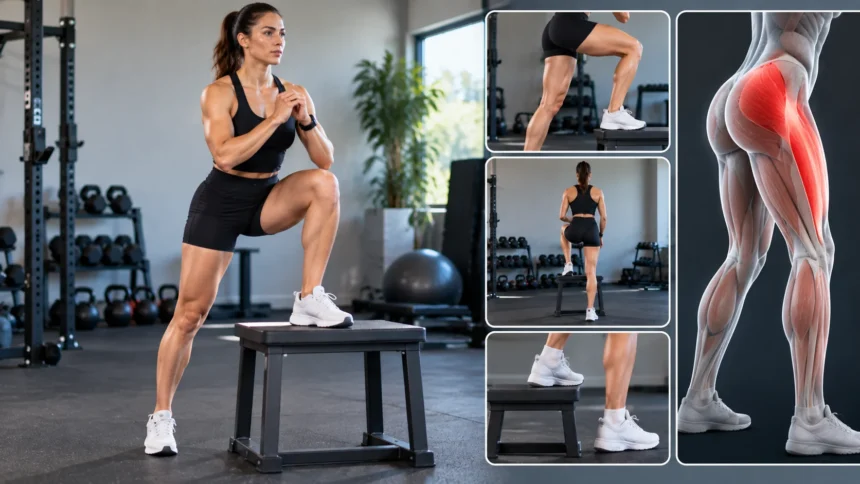
The gluteus medius is one of the key muscles involved in lateral step ups. This muscle sits on the outside of the hip and helps stabilize the pelvis when you stand on one leg. It also assists with moving the leg away from the body’s midline and controlling side-to-side movement.
The gluteus maximus, quadriceps, and hamstrings also contribute as you push your body upward. The quadriceps straighten the knee, while the glutes help extend and stabilize the hip. Depending on your step height and technique, you may feel different amounts of effort through the front of the thigh and the buttocks.
Your core and lower-leg muscles also work to maintain balance. The ankle must remain stable as your weight shifts onto the working leg, while the trunk helps prevent excessive leaning. This makes lateral step ups a useful compound exercise rather than a movement that isolates only one muscle group.
How to Do Lateral Step Ups With Proper Form
Stand beside a stable step or low box with one foot placed completely on top of it. Keep the other foot on the floor next to the platform and stand tall with your chest relaxed. Your planted foot should be positioned so the entire sole is supported rather than hanging partly off the edge.
Push through the elevated foot and straighten the working leg to lift your body upward. Bring the opposite foot toward the top without aggressively pushing off the floor leg. Keep your hips level and allow the working knee to track in the same general direction as your toes throughout the movement.
Lower yourself back toward the floor slowly and with control. Avoid simply dropping your body or letting the lower leg hit the ground heavily. Complete your desired repetitions on one side before switching, or alternate sides if that feels more natural and allows you to maintain good technique.
Choosing the Right Step Height
Step height has a major effect on exercise difficulty. Beginners should usually start with a relatively low platform that allows them to control the movement without twisting, pushing excessively off the lower foot, or losing knee alignment. A lower step is often enough to build strength when the movement is new.
As the platform becomes taller, the working hip and knee move through a greater range. This can increase muscular demand, particularly through the glutes and quadriceps. However, using a taller step is not automatically better if it causes the pelvis to tilt or forces you to use momentum.
Choose a height that allows the entire movement to remain smooth. You should be able to rise without jumping and lower without collapsing. Once you can perform several controlled repetitions easily, you can gradually increase the height or add resistance rather than changing everything at the same time.
Benefits of Lateral Step Ups
One major benefit of lateral step ups is improved single-leg strength. Many everyday activities, including walking, climbing stairs, and stepping over objects, require one leg to support much of your body weight. Training this ability can help improve confidence and control during daily movement.
The exercise also strengthens muscles responsible for hip stability. The gluteus medius helps prevent the pelvis from dropping excessively when you stand on one leg. Developing this area may be especially valuable for runners, athletes, and people who perform activities requiring frequent changes in direction.
Lateral step ups can also improve balance and coordination because you must control your body in a less familiar direction. This adds variety to lower-body training and challenges muscles differently from squats or forward lunges. A well-rounded routine often benefits from including both bilateral and unilateral movement patterns.
Lateral Step Ups for Glute Strength
Lateral step ups can place significant demand on the glutes when performed with good technique. Driving through the elevated leg and keeping the pelvis level encourages the hip muscles to work throughout the movement. A slightly taller but still manageable step may increase glute involvement by creating more hip flexion.
Try not to shift all your weight toward the lower leg before stepping up. Excessive pushing from the floor reduces the work performed by the elevated side. Think about using the upper leg as the main engine while the lower foot provides only light balance support.
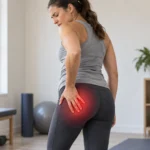
If you experience discomfort around the hip or buttock, do not automatically assume the muscles simply need more strengthening. Several conditions can cause pain in that area, and this guide to pain in the butt cheek explains some common possibilities. Persistent pain should be assessed before increasing exercise difficulty.
Lateral Step Ups for Knee Control
The knees play an important role in lateral step ups because the working knee bends and straightens repeatedly under load. Good control means keeping the knee aligned with the foot instead of allowing it to collapse sharply inward. This position helps distribute force more evenly through the lower body.
The exercise can help you practice controlling knee movement during single-leg tasks. This may be useful for sports involving running, jumping, cutting, or changes in direction. However, good technique should always come before adding heavy resistance or using a high step.
If your knee moves inward repeatedly, lower the platform or reduce the weight. You can also slow the exercise and focus on keeping the hip, knee, and foot working together. Sharp or increasing knee pain is a reason to stop and reassess rather than continuing simply because the exercise is supposed to be beneficial.
Common Lateral Step Up Mistakes
One common mistake is pushing too hard from the leg that begins on the floor. This turns the movement into more of a jump and reduces the strengthening effect on the working leg. Keep the lower foot light and concentrate on producing force through the elevated side.
Another mistake is allowing the knee to collapse inward during the upward or downward phase. This often happens when the step is too high, the load is too heavy, or hip control is limited. Reduce the challenge until you can keep your knee moving smoothly in line with the foot.
Dropping quickly from the platform is also common. The lowering phase is an important part of the exercise because the muscles must control your body weight against gravity. Taking two or three seconds to descend can increase difficulty without requiring heavier dumbbells or a taller step.
Lateral Step Up Variations
Body-weight lateral step ups are the best starting point for most beginners. Once the movement feels stable, you can hold dumbbells at your sides to increase resistance. This progression allows you to keep the same movement pattern while making the muscles work harder.
A slow eccentric variation involves taking extra time during the lowering phase. Step up normally, then take three or four seconds to return your lower foot toward the floor. This challenges control and can make a light weight feel significantly harder without requiring complicated equipment.
Advanced trainees can also experiment with higher steps or controlled knee-drive variations. After stepping up, bring the free knee toward your chest before lowering again. This increases the balance requirement, so it should only be added once the basic lateral step up can be performed confidently and without excessive trunk movement.
How Many Lateral Step Ups Should You Do?
Beginners can start with two or three sets of roughly eight to twelve repetitions per side. The exact number depends on your strength, step height, and whether you are using additional resistance. You should finish each set feeling challenged without losing knee alignment or relying on momentum.
For strength-focused training, fewer repetitions with heavier resistance may be appropriate once your technique is consistent. For endurance or general fitness, slightly higher repetitions can work well. The best range is one that allows you to maintain control rather than chasing a specific number regardless of form.
You can perform lateral step ups two or three times per week as part of a lower-body program. Allow recovery between harder sessions, particularly if you also run, jump, or perform heavy squats and lunges. Your total training load matters more than the frequency of this one exercise alone.
How to Add Lateral Step Ups to Your Workout
Lateral step ups work well after larger compound movements such as squats or deadlifts. They can provide focused single-leg training without requiring extremely heavy loads. You can also use them earlier in a session if unilateral strength or balance is one of your primary training goals.
A simple lower-body workout might include squats, lateral step ups, hip hinges, calf raises, and core work. This combination trains several major movement patterns without requiring many complicated exercises. Keeping the program straightforward also makes it easier to track progress over time.
Athletes may use lateral step ups alongside lunges, single-leg deadlifts, and lateral movement drills. The exercise develops strength but should not completely replace sport-specific practice. Combining strength training with running, jumping, or agility work creates a more complete approach to physical preparation.
Tips for Better Lateral Step Up Results
Use a controlled tempo from the beginning. Fast repetitions may allow momentum to take over, while slower movement makes it easier to feel which leg is doing the work. A brief pause at the top can also help you confirm that you have balanced fully on the working leg.
Keep your whole foot in contact with the step. If only your toes or heel are supported, stability becomes more difficult and force distribution may feel uncomfortable. Adjust your starting position until the foot feels secure before beginning each set.
Progress gradually instead of increasing step height, weight, and repetitions all at once. Change one variable and observe how your body responds. This makes it easier to improve strength while protecting technique and identifying any movement that causes unusual discomfort.
When Lateral Step Ups May Not Be Appropriate
Mild muscle fatigue through the hips and thighs is normal during lateral step ups, but sharp joint pain is not. Stop if you experience sudden knee, hip, ankle, or back pain. Lowering the step height or removing resistance may solve the problem if the exercise is simply too challenging.
People recovering from recent lower-body surgery, fracture, significant sprain, or acute injury should follow professional guidance before adding unilateral exercises. The movement requires balance and controlled loading through several joints. The appropriate starting point depends on the specific injury and recovery stage.
Persistent pain during walking, climbing stairs, or basic daily movement also deserves attention before progressing to harder variations. A physical therapist or qualified healthcare professional can assess strength, mobility, and joint function. Exercise should build capacity over time rather than repeatedly aggravating an unresolved problem.
Conclusion
Lateral step ups are a useful lower-body exercise for developing single-leg strength, hip stability, balance, and coordination. The glutes, quadriceps, hamstrings, core, and lower-leg muscles all contribute. Because the movement occurs from the side, it provides a different challenge from traditional forward step ups.
Proper form starts with choosing a stable platform and manageable step height. Keep the full foot supported, push primarily through the elevated leg, maintain knee alignment, and lower yourself slowly. Once the body-weight version becomes easy, resistance or more advanced variations can increase the challenge.
Include lateral step ups as part of a balanced lower-body program rather than relying on them as your only strength exercise. Progress gradually and pay attention to any sharp or persistent pain. Consistent, controlled training is more valuable than using a high step or heavy weights before your technique is ready.
FAQs
What muscles do lateral step ups work?
Lateral step ups primarily work the glutes, quadriceps, hamstrings, and hip stabilizers. The core and lower-leg muscles also contribute by helping maintain balance and alignment throughout the movement.
Are lateral step ups good for the glutes?
Yes. They challenge the gluteus medius and gluteus maximus, especially when you push through the elevated leg and keep your pelvis level rather than relying on momentum.
How high should the step be for lateral step ups?
Start with a low platform that allows smooth movement and good knee alignment. Increase the height gradually only when you can step up and lower down without jumping, twisting, or losing control.
Can lateral step ups hurt your knees?
They should not cause sharp knee pain when performed appropriately. Excessive step height, poor alignment, or heavy resistance may increase joint stress, so reduce the challenge if discomfort develops.
How many lateral step ups should beginners do?
Beginners can start with two or three sets of about eight to twelve repetitions per side. Use body weight first and increase resistance only after your balance and technique become consistent.