
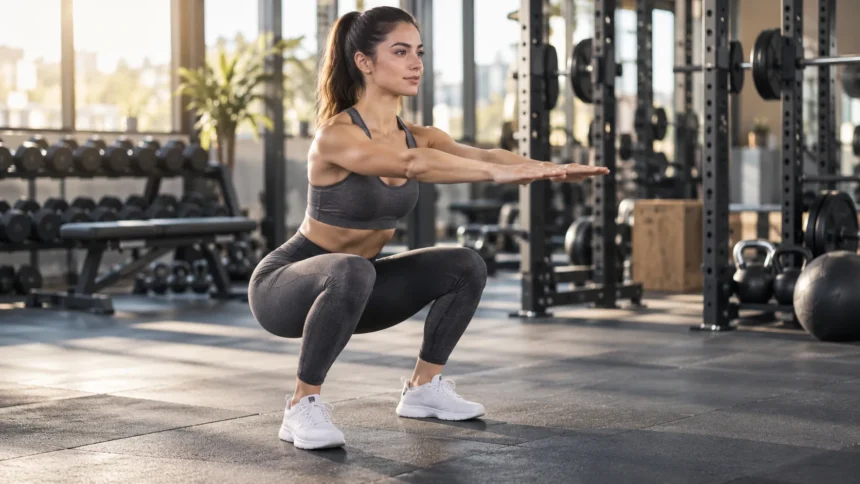
Squats are one of the most practical lower-body exercises because they train several major muscle groups at the same time. The movement strengthens the legs, hips, and core while also improving control during everyday actions such as sitting down, standing up, climbing stairs, and lifting objects. Squats can be performed with body weight or progressively loaded with dumbbells, kettlebells, or barbells.
Many people associate squats mainly with building bigger legs, but their benefits go beyond muscle growth. Squats can improve lower-body strength, joint control, balance, coordination, and overall movement capacity when they are performed with good technique. Different squat variations can also shift emphasis toward the quads, glutes, or other supporting muscles depending on stance and equipment.
The most important part is learning how to squat with control rather than forcing yourself into a specific depth or copying someone else’s stance. Hip structure, ankle mobility, training experience, and body proportions all influence how a squat looks. This guide explains what squats do, which muscles they work, how to perform them correctly, and how to avoid common mistakes.
What Do Squats Do for Your Body?
Squats primarily strengthen the lower body by challenging the muscles around the hips, knees, and ankles. Your quadriceps extend the knees as you stand, while the glutes help extend the hips and drive the body upward. Hamstrings, calves, and smaller stabilizing muscles contribute throughout the movement to control position and balance.
Squats also require your trunk to remain stable while your hips and knees move through a large range. This means the abdominal muscles, spinal stabilizers, and surrounding core muscles help prevent excessive movement through the torso. The amount of core demand increases when you add external resistance or use squat variations that place the load away from your center.
Beyond strength, squats can improve coordination between several joints and muscle groups. Because the movement resembles common daily tasks, stronger squatting mechanics may make sitting, standing, and lifting feel easier. The exercise can also help prepare the body for sports or activities that involve jumping, running, changing direction, or producing force through the legs.
What Muscles Do Squats Work?
The quadriceps are heavily involved in squats because they straighten the knees as you rise from the bottom position. The gluteus maximus also contributes strongly, especially when the hips move through a deeper and well-controlled range. Together, these muscles provide much of the force needed to return from the lowered position to standing.
The hamstrings and adductors support the movement by helping control the hips and stabilizing the legs. The calves assist around the ankle, while smaller hip muscles help keep the knees and pelvis controlled. Your exact muscle emphasis can vary depending on squat depth, stance width, foot angle, load position, and the type of squat you perform.
Your core and upper back also work during squats, particularly when using weights. These muscles help keep the torso stable and maintain a strong position while the lower body moves. Squats are therefore a compound exercise because several joints and muscle groups work together rather than one muscle performing the movement alone.
How to Do a Bodyweight Squat Correctly
Stand with your feet around shoulder-width apart and turn your toes slightly outward if that feels comfortable. Keep your chest relaxed, look forward, and create light tension through your abdomen. Begin the squat by bending the hips and knees together while keeping your feet firmly connected to the floor.
Lower yourself as far as you can while maintaining control and keeping your knees tracking in the same general direction as your toes. Your heels should remain down, and your torso should stay balanced rather than collapsing forward. You do not need to reach a specific depth if doing so causes your heels to lift or your posture to break down.
Push through your feet and straighten the knees and hips to return to standing. Avoid locking the knees aggressively or snapping the hips forward at the top. Move smoothly during both the lowering and rising phases so the muscles remain engaged and your joints stay under better control.
How Deep Should You Squat?
Squat depth should be based on your mobility, control, comfort, and training goals. Some people can squat comfortably below parallel, while others feel better stopping higher. There is no single depth that everyone must reach, especially when individual hip anatomy and ankle mobility can create large differences in how the movement looks.
A useful rule is to descend until you can no longer maintain a stable foot position and controlled torso. If your heels lift, knees collapse inward, or lower back changes position dramatically, you may be moving beyond your current comfortable range. Improving mobility and control over time can gradually increase depth without forcing it.
Deeper squats can increase the movement range through the hips and knees and may challenge the glutes and quads more extensively. However, deeper is not always better if technique deteriorates. A slightly shallower squat performed consistently with good control is usually more useful than forcing a depth that causes pain or compensation.
What Are the Main Benefits of Squats?
Squats can build strength in the quads, glutes, hamstrings, and supporting lower-body muscles. This can improve performance during activities that require leg strength, including climbing, jumping, lifting, and running. Strength gains also make everyday movements easier because your muscles can handle normal tasks with less relative effort.
The exercise can also support balance and joint control. Your ankles, knees, hips, and trunk need to coordinate while your body moves downward and upward. Practicing this movement with good form can improve your awareness of foot pressure, knee tracking, and hip positioning during many other exercises.
Squats are also highly adaptable. Beginners can start with bodyweight or supported squats, while experienced lifters can use barbells, dumbbells, kettlebells, resistance bands, or machines. This makes squats useful across many fitness levels because difficulty can increase gradually as strength and confidence improve.
Do Squats Build Your Glutes?
Yes, squats can strengthen and build the glutes, especially when they are performed through a comfortable range with progressive resistance. The gluteus maximus helps extend the hip as you rise from the bottom position. Deeper squatting generally increases hip movement, which can increase the amount of work performed by the glutes.
However, squats are not the only exercise needed for glute development. Hip thrusts, bridges, Romanian deadlifts, split squats, and step-ups can provide additional training angles. Combining several movement patterns may be more effective than relying on one exercise for all lower-body muscle growth.
Your technique and load progression also matter. If you always perform very light squats and never increase resistance or repetitions, muscle growth may eventually slow. Gradually increasing training difficulty while maintaining good form gives the glutes a stronger reason to adapt over time.
Common Squat Mistakes to Avoid
One common mistake is allowing the knees to collapse inward during the movement. Some natural inward movement may occur, but excessive collapse can indicate poor control or a load that is too heavy. Focus on keeping the knees generally aligned with the direction of your toes while maintaining even pressure through the feet.
Another mistake is lifting the heels or shifting excessively onto the toes. This can happen when ankle mobility is limited or when the body moves too far forward. Widening the stance slightly, adjusting foot angle, or using a small heel elevation can sometimes make the squat feel more stable and comfortable.
Upper-body tension can also create unnecessary problems. Avoid forcing the neck into an exaggerated position or looking sharply upward while squatting, especially under load. If you regularly experience neck stiffness, this guide to a crick in your neck can help you understand ways to manage tension and positioning more comfortably.
How to Keep Your Knees Safe During Squats
Your knees are designed to bend, and squatting can be a normal and useful movement when performed appropriately. The goal is not to prevent the knees from moving forward entirely. Instead, keep the feet stable and allow the knees to track naturally while controlling the descent and avoiding sudden, uncontrolled motion.
Choose a squat depth and load that match your current strength. Pain often appears when people increase weight, volume, or depth faster than their tissues can tolerate. Progressing gradually gives the muscles and joints time to adapt to greater demands without unnecessary overload.
If you already have knee pain, modify the exercise instead of pushing through sharp discomfort. Box squats, supported squats, or a reduced range may feel more manageable. Persistent swelling, instability, locking, or worsening pain should be evaluated before continuing heavy squat training.
Best Squat Variations for Beginners
The chair squat is a useful starting point because it provides a clear target for depth. Stand in front of a chair, lower yourself slowly until you lightly touch the seat, then stand again. This variation can help beginners practice hip and knee movement without worrying about balancing in a very deep position.
Goblet squats are another excellent progression. Hold a dumbbell or kettlebell close to your chest and squat while keeping the load centered. The front-loaded position often helps people maintain a more upright torso and makes it easier to feel balanced throughout the movement.
Box squats, wall-supported squats, and resistance-band squats can also be useful depending on your needs. Choose one variation that feels comfortable and learn it thoroughly before adding more complexity. Developing reliable technique with a basic squat provides a stronger foundation for heavier or more advanced versions later.
How Many Squats Should You Do?
The ideal number of squats depends on your goal, experience, and resistance level. Beginners using bodyweight might start with two or three sets of 8 to 15 repetitions. The final repetitions should feel challenging enough to require effort while still allowing good technique.
If your goal is strength, you may use heavier resistance and fewer repetitions. If your goal is muscular endurance or general fitness, moderate or higher repetition ranges can work well. There is no special number of squats that produces results for everyone, so training should be adjusted according to ability and progress.
Rest is important as well. Doing high-volume squats every day is not necessary for most people and can make recovery difficult. Two or three lower-body sessions per week may be enough for many beginners, especially when squats are combined with other leg exercises.
How to Make Squats More Challenging
Once bodyweight squats become easy, you can increase difficulty in several ways. Adding dumbbells, kettlebells, or a barbell increases the resistance your muscles must overcome. You can also add repetitions, slow the lowering phase, or pause briefly at the bottom to make lighter loads more demanding.
Single-leg variations such as split squats and Bulgarian split squats create another progression. These exercises challenge each leg more independently and increase demands on balance and hip stability. They can also help identify differences in strength or control between the left and right sides.
Progress should remain gradual. Adding too much load too quickly can make technique deteriorate and increase unnecessary strain. Change one variable at a time and make sure you can control the new challenge before progressing further.
When Should You Avoid or Modify Squats?
Squats may need modification when they cause sharp, increasing, or persistent pain. Mild muscle fatigue is normal, but joint pain, numbness, or sudden weakness is not something to ignore. Reducing depth, using less resistance, or choosing a supported variation may make the movement more comfortable.
Recent injuries or surgery may also require temporary modifications. Follow guidance from a qualified healthcare or rehabilitation professional if you are returning to exercise after a significant knee, hip, ankle, or back problem. Your safest progression may differ from someone who is beginning without an injury history.
You should also adjust squats when fatigue makes your technique noticeably unstable. Continuing heavy repetitions after control is lost rarely provides additional benefit. Ending the set slightly earlier can help maintain better movement quality and make long-term progress more consistent.
Conclusion
Squats are a versatile compound exercise that strengthen the quads, glutes, hamstrings, hips, and core. They can improve lower-body strength, coordination, balance, and confidence during everyday movements. Their benefits depend on consistent practice, appropriate resistance, and technique that matches your individual mobility and body structure.
To squat well, keep your feet stable, allow the knees and hips to bend together, and lower only as far as you can control. There is no need to force a specific stance or depth simply because someone else uses it. Comfortable, repeatable movement is more important than trying to create a visually perfect squat.
Start with bodyweight or supported variations and progress gradually as your strength improves. Add resistance only when you can maintain good control through the full movement. With consistent training and sensible progression, squats can become one of the most useful exercises in a balanced lower-body workout.
FAQs
What do squats mainly work?
Squats mainly work the quadriceps and glutes, while the hamstrings, calves, hips, core, and upper back contribute to stability. The exact emphasis depends on stance, depth, and load position.
Do squats make your glutes bigger?
They can help build the glutes when performed consistently with enough resistance and progression. Combining squats with hip thrusts, deadlifts, and split squats can provide more complete glute training.
Are squats bad for your knees?
Not necessarily. Squats can strengthen the muscles around the knees when performed appropriately. Pain usually requires adjusting depth, load, or technique rather than assuming the movement itself is always harmful.
How many squats should a beginner do?
Beginners can start with two or three sets of 8 to 15 controlled bodyweight squats. Increase repetitions or resistance gradually once the movement becomes comfortable and technique remains consistent.
Should your knees go over your toes during squats?
They can. Some forward knee movement is normal and depends on body proportions, squat depth, and ankle mobility. The priority is keeping the feet stable and maintaining controlled knee alignment throughout the movement.