
Why Back Strengthening Exercises Matter
Your back muscles play an important role in nearly every movement you make, from standing upright to lifting groceries or sitting at a desk. Strong back muscles help support your spine, shoulders, and pelvis while improving overall stability. Regular back strengthening exercises can also make everyday activities feel easier by building muscular endurance and improving the way your body handles physical stress.
A strong back is not only important for athletes or people who lift heavy weights. Weakness in the upper, middle, or lower back may contribute to poor posture, muscle fatigue, stiffness, and difficulty maintaining comfortable positions throughout the day. Strengthening these areas gradually can help create better muscular balance between the back, core, hips, and shoulders.
The key is choosing exercises that train different parts of the back without placing unnecessary pressure on the spine. Your routine should include controlled movements that strengthen the spinal stabilizers, latissimus dorsi, rhomboids, trapezius, erector spinae, and surrounding muscles. Proper technique matters more than lifting heavy weights or completing a large number of repetitions.
How to Prepare Before Back Strengthening Exercises
Before beginning a back workout, spend several minutes warming up your muscles and joints. Gentle walking, shoulder circles, arm swings, hip movements, and light spinal mobility exercises can increase blood flow and prepare your body for movement. A warm-up may also help you perform each strengthening exercise with better coordination and range of motion.
Pay attention to your starting position before completing any repetition. Keep your spine comfortably neutral rather than dramatically arching or rounding your back, and lightly engage your abdominal muscles for additional stability. Your movements should feel smooth and controlled, especially when you are learning an exercise or returning to physical activity after a long break.
Start with bodyweight movements before adding resistance bands, dumbbells, or heavier equipment. Learning proper form allows the correct muscles to perform the work rather than relying on momentum or compensation. Increase difficulty gradually as your strength improves instead of choosing challenging resistance simply because you can complete a few repetitions.
Bird Dog for Back and Core Stability
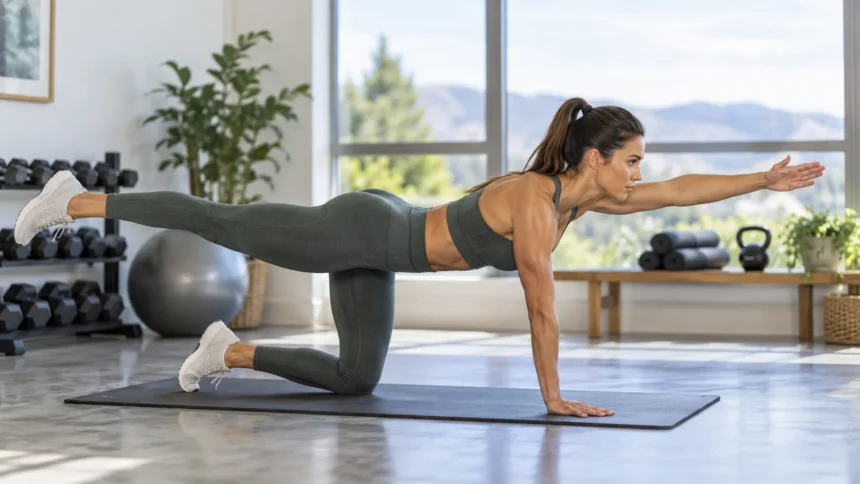
The bird dog is a simple bodyweight exercise that strengthens the lower back, abdominal muscles, glutes, and deep spinal stabilizers. Begin on your hands and knees with your wrists underneath your shoulders and knees positioned below your hips. Keep your head aligned naturally with your spine rather than looking too far forward or dropping your chin excessively.
Slowly extend your right arm forward while extending your left leg behind you until both are approximately parallel with the floor. Keep your hips level and avoid twisting your torso as you reach in opposite directions. Pause briefly, return to the starting position with control, and then repeat the movement using your left arm and right leg.
Focus on stability rather than trying to raise your arm or leg as high as possible. Your lower back should remain relatively neutral throughout the movement, with your abdominal muscles gently engaged. Beginners can start with six to eight repetitions per side before gradually progressing toward additional repetitions or longer holds as their balance and muscular control improve.
Glute Bridges for Lower Back Support
Glute bridges primarily strengthen the gluteal muscles, but they can also support better lower-back function by improving hip strength and pelvic stability. Lie on your back with your knees bent and feet flat on the floor approximately hip-width apart. Allow your arms to rest comfortably beside your body while keeping your head and shoulders relaxed.
Press through your feet and gently tighten your glutes as you lift your hips away from the floor. Continue until your shoulders, hips, and knees form a relatively straight line without aggressively arching your lower back. Hold the top position briefly, then lower your hips slowly instead of allowing them to drop quickly toward the floor.
If you mainly feel the exercise in your lower back, reduce the height of your bridge and focus more strongly on squeezing your glutes. Keeping your ribs controlled may also prevent excessive spinal extension. Once basic bridges become easy, you can progress with resistance bands, longer holds, or carefully performed single-leg variations.
Superman Exercise for Posterior Chain Strength
The Superman exercise targets muscles along the back of the body, including the spinal extensors, glutes, and muscles around the shoulders. Lie face down with your legs extended and arms reaching forward comfortably. Keep your neck neutral by looking toward the floor rather than dramatically lifting your head during the movement.
Gently engage your abdominal and glute muscles before lifting your arms and legs slightly away from the floor. You do not need to raise them very high to activate your back muscles effectively. Hold the lifted position briefly, then lower your arms and legs slowly while maintaining control rather than relaxing suddenly between repetitions.
Avoid turning the exercise into an exaggerated backbend because greater movement does not necessarily produce greater benefit. Small, controlled lifts usually provide enough resistance for beginners. If the traditional Superman feels uncomfortable, try lifting only your arms or only your legs until your strength and movement tolerance improve.
Bent-Over Rows for a Stronger Upper Back
Bent-over rows strengthen several major back muscles, including the latissimus dorsi, rhomboids, trapezius, and rear shoulder muscles. Stand with your feet around hip-width apart while holding light dumbbells or another manageable resistance. Bend slightly at your knees and hinge forward from your hips while maintaining a comfortably straight, stable spine.
Allow your arms to hang beneath your shoulders, then pull the weights toward the sides of your torso. Think about bringing your elbows backward while gently squeezing your shoulder blades together rather than shrugging your shoulders upward. Lower the resistance slowly until your arms are extended again, keeping the movement controlled during both portions of each repetition.
Avoid using momentum to swing the weights upward because doing so reduces muscular control and may place unnecessary stress on your lower back. Choose a resistance that allows you to maintain the same torso position throughout the set. As you become stronger, gradually increase the weight while preserving proper rowing technique.
Reverse Fly for Posture and Shoulder Stability
Reverse fly exercises help strengthen the upper-back muscles and rear deltoids that support shoulder positioning and posture. Hold a light dumbbell in each hand and hinge forward slightly from your hips with your knees softly bent. Keep your abdominal muscles engaged and allow your arms to hang below your shoulders with a small bend in your elbows.
Raise your arms outward until they are approximately in line with your torso, concentrating on moving through your shoulders rather than your hands. Gently draw your shoulder blades toward each other without forcing them together. Pause briefly before lowering the weights slowly back toward the starting position while maintaining the same controlled upper-body posture.
Reverse flies usually require much lighter resistance than rowing exercises because smaller muscles are involved. Using weights that are too heavy often causes people to swing their arms or shrug their shoulders. Prioritize smooth movement and muscular control, especially if your goal is improving upper-back endurance and counteracting long periods spent working at a desk.
Wall Angels for Upper Back Mobility and Control
Wall angels combine upper-back muscular control with gentle shoulder mobility. Stand with your back against a wall and position your feet slightly forward if necessary for comfort. Bring your arms toward the wall in a goalpost position while keeping your ribs controlled and avoiding an exaggerated arch through your lower back.
Slowly slide your arms upward along the wall as far as your comfortable shoulder mobility allows. You do not need to force your hands or elbows to remain completely against the wall if your current mobility makes that difficult. Reverse the movement slowly while focusing on controlled shoulder-blade motion and maintaining a relaxed neck.
Wall-based exercises can be especially convenient for beginners because they require little equipment and make body positioning easier to understand. You can also include movements such as wall push-ups when building a simple upper-body routine, since strengthening the chest, shoulders, arms, and stabilizing muscles can complement balanced back training.
Prone Y Raises for the Upper and Mid Back
Prone Y raises target muscles around the shoulder blades that contribute to healthy shoulder movement and upper-back stability. Lie face down with your arms extended diagonally overhead so your body resembles the letter Y. Keep your forehead supported comfortably and allow your shoulders to remain away from your ears before starting each repetition.
Gently lift your arms a short distance away from the floor while keeping your elbows straight but relaxed. Concentrate on using the muscles around your shoulder blades rather than aggressively lifting through your neck or lower back. Pause for a moment at the top before lowering your arms slowly to the floor with full control.
This exercise may feel surprisingly challenging even without weights because the muscles involved are relatively small. Begin with bodyweight resistance and moderate repetitions before considering very light dumbbells. Proper technique is more important than adding weight, particularly when using prone raises to improve posture, scapular control, and upper-back muscular endurance.
How to Build an Effective Back Strengthening Routine
A balanced back workout does not need to include every exercise during every session. Choose four to six movements that target different areas, such as bird dogs for stability, rows for pulling strength, bridges for hip support, and reverse flies for upper-back control. This approach provides variety without making your routine unnecessarily long or difficult to maintain.
For general strength, beginners can often start with one to three sets of approximately eight to fifteen controlled repetitions depending on the exercise. Allow enough rest between sets to maintain proper form rather than rushing through the workout. Training your back two or three nonconsecutive days each week can provide enough practice while allowing your muscles time to recover.
Progress gradually once exercises become noticeably easier. You might add several repetitions, increase resistance slightly, extend an isometric hold, or choose a more challenging variation. Avoid changing every variable simultaneously because small increases make it easier to recognize how your body responds and reduce the temptation to sacrifice technique for faster progress.
Common Mistakes During Back Strengthening Exercises
One common mistake is performing repetitions too quickly. Momentum may allow you to move more weight, but it often reduces the amount of controlled muscular work performed by your back. Slowing both the lifting and lowering phases helps you maintain better body positioning while making lighter resistance surprisingly effective for building strength.
Another mistake is ignoring the rest of your body while focusing exclusively on the back. Your abdominal muscles, hips, glutes, shoulders, and legs all contribute to efficient movement and spinal stability. A balanced strength program usually produces better results than completing only lower-back exercises or repeatedly training the same pulling movement.
Pain should also not be treated as proof that an exercise is working. Mild muscular effort and temporary fatigue are expected during strengthening, but sharp, worsening, radiating, or unusual pain deserves attention. Stop an exercise if symptoms become concerning, and consider guidance from a qualified healthcare or rehabilitation professional when pain persists or interferes with normal activities.
Conclusion
Back strengthening exercises can improve muscular support, posture, movement control, and confidence during everyday activities. Exercises such as bird dogs, glute bridges, rows, reverse flies, wall angels, and prone Y raises train different areas of the back and surrounding muscles. Combining several movements creates a more balanced approach than relying on one exercise alone.
Good technique should always come before heavier resistance or additional repetitions. Move slowly, maintain comfortable spinal alignment, and select exercises that match your current strength and mobility. Consistent training with gradual progression usually provides a more sustainable path toward stronger back muscles than trying to advance too quickly.
Most importantly, pay attention to how your body responds throughout each workout. Adjust the range of motion or resistance when necessary, and allow adequate recovery between training sessions. A simple routine performed consistently and correctly can provide meaningful strength benefits without requiring complicated equipment or lengthy workouts.
FAQs
What are the best back strengthening exercises for beginners?
Bird dogs, glute bridges, wall angels, bodyweight prone raises, and light rows are beginner-friendly options. Start slowly and focus on maintaining controlled movement and comfortable spinal alignment.
How often should I do back strengthening exercises?
Many people can perform back strengthening exercises two or three times per week on nonconsecutive days. Recovery needs vary, so adjust your training frequency according to your experience, workout intensity, and muscle soreness.
Can back strengthening exercises improve posture?
Strengthening the upper back, core, shoulders, and hips can support better postural control. However, posture also depends on mobility, daily movement habits, workstation setup, and how frequently you change positions.
Do I need weights to strengthen my back?
No. Bodyweight exercises such as bird dogs, bridges, Superman variations, and prone raises can strengthen important back and stabilizing muscles. Resistance bands or weights can be added gradually when bodyweight exercises become easier.
Should I exercise my back if it hurts?
It depends on the type and cause of the pain. Gentle movement may be appropriate in some situations, but sharp, severe, radiating, or worsening pain should be evaluated by a qualified healthcare professional before starting challenging exercises.