
The gluteus medius is an important hip muscle that helps stabilize the pelvis, control the position of the thigh, and support movements such as walking, running, climbing stairs, and standing on one leg. Strengthening it can improve lower-body control and make everyday movement feel more stable and coordinated.
A good gluteus medius workout does not require complicated equipment or heavy weights. Exercises such as side-lying leg raises, band walks, step-downs, and single-leg movements can train the muscle effectively when performed with proper form. The key is controlling the pelvis and avoiding compensation from the lower back or other hip muscles.
Training the gluteus medius can be useful for athletes, runners, beginners, and anyone building a balanced lower-body strength routine. However, more exercise is not always better, especially if you already have hip, knee, or back pain. Understanding the muscle’s function, correct technique, and sensible progression can help you train it more effectively.
What Is the Gluteus Medius?
The gluteus medius is one of the three main gluteal muscles, along with the gluteus maximus and gluteus minimus. It sits on the outer surface of the pelvis and attaches to the upper part of the femur. Its location allows it to influence both movement and stability at the hip joint.
One of its main functions is hip abduction, which means moving the leg away from the body’s midline. Different fibers of the muscle can also assist with internal or external rotation depending on hip position. This makes the gluteus medius important during movements that require control in several directions.
The muscle is especially active when you stand on one leg. It helps keep the pelvis from dropping excessively toward the unsupported side. Walking and running repeatedly involve brief periods of single-leg support, which explains why gluteus medius strength is important for efficient lower-body movement.
Why Train the Gluteus Medius?
Strengthening the gluteus medius can improve pelvic control during walking, running, and single-leg activities. When the muscle can manage these forces effectively, the hip and knee may remain in more controlled positions. This can make activities such as stairs, lunges, and sports movements feel more stable.
A stronger gluteus medius can also support overall lower-body training. Squats and deadlifts build important strength, but adding targeted lateral and single-leg exercises can challenge the hips in ways that traditional forward-and-back movements may not. Balanced training helps develop strength across multiple movement patterns.
However, gluteus medius exercises should not be viewed as a cure for every hip or knee problem. Pain can come from many different muscles, joints, tendons, and nerves. If symptoms are persistent, worsening, or significantly affecting movement, professional evaluation may be more appropriate than simply adding more exercises.
Side-Lying Leg Raises
Side-lying leg raises are one of the simplest gluteus medius exercises. Lie on one side with the lower leg slightly bent for support and the top leg straight. Keep your hips stacked so you are not rolling backward as you prepare to lift the top leg.
Raise the top leg upward in a controlled motion without turning the toes dramatically toward the ceiling. A slight forward position of the leg may help keep the movement focused around the side of the hip. Lift only as high as you can while maintaining a stable pelvis.
Lower the leg slowly instead of letting it drop. You should feel the outer hip working rather than strong tension in the lower back. If the exercise feels too easy, add a light resistance band or ankle weight gradually rather than immediately increasing the range.
Banded Lateral Walks
Banded lateral walks challenge the gluteus medius while you remain in a weight-bearing position. Place a resistance band around the thighs, knees, ankles, or feet depending on the difficulty you want. Stand with your knees slightly bent and your feet approximately hip-width apart.
Step sideways while keeping tension on the band and avoiding excessive swaying through the upper body. The knees should generally stay aligned with the feet rather than collapsing inward. Keep each step controlled and maintain a stable hip position from one side to the other.
The band position changes the difficulty and feel of the exercise. A band closer to the feet usually increases the challenge because it creates a longer lever. Beginners may prefer the band above the knees while learning to control the hips and avoid using momentum.
Clamshell Exercise
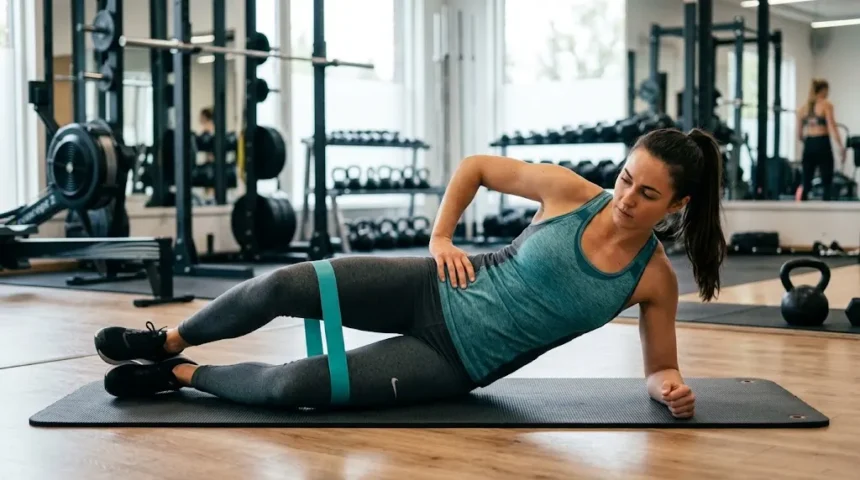
Clamshells are commonly used to target the muscles around the side of the hip. Lie on your side with your hips and knees bent, then keep your feet together while lifting the top knee. The pelvis should remain stacked rather than rolling backward as the knee opens.
Only move through a range that you can control. If you rotate the entire pelvis to lift the knee higher, the movement becomes less focused on the intended hip muscles. A smaller, slower repetition can often create more useful muscle engagement than a large movement performed with compensation.
A light resistance band above the knees can make clamshells more challenging. Increase resistance gradually because overly strong bands may encourage poor technique. The exercise works well as part of a warm-up, activation sequence, or lower-intensity accessory section within a broader hip-strengthening routine.
Step-Downs for Hip Stability
Step-downs train the gluteus medius in a functional single-leg position. Stand on a low step with one foot while the other leg hangs slightly off the edge. Slowly bend the standing knee and lower the opposite heel toward the floor without losing control of your pelvis.
Focus on keeping the knee aligned approximately over the foot as you lower. Avoid allowing the hip to drop dramatically or the knee to collapse inward. These movements can indicate that the exercise is currently too difficult or that additional control is needed.
Use a low step when learning the exercise. As strength and stability improve, you can gradually increase the step height or add light resistance. Step-downs can be especially useful because they combine hip strength, knee control, balance, and coordination in one movement.
Single-Leg Balance and Hip Control
Single-leg balance is a simple way to challenge the gluteus medius because the muscle helps keep the pelvis level while one foot is off the ground. Stand near a wall or stable object if needed. Lift one foot slightly and maintain an upright, controlled posture.
Try to keep your pelvis from shifting dramatically toward one side. The standing hip should feel active, but you should not need to grip the floor or hold your breath. Begin with short holds and gradually increase the duration as your balance improves.
To make the exercise harder, add a slight knee bend, reach the free leg in different directions, or hold a light weight. These progressions introduce more movement while the standing hip continues to stabilize. Quality and control matter more than making the balance challenge unnecessarily difficult.
How to Structure a Gluteus Medius Workout
A simple gluteus medius workout can include three or four exercises that challenge the muscle in different ways. For example, you might combine side-lying leg raises, banded lateral walks, step-downs, and single-leg balance. This provides both isolated and weight-bearing hip work without making the session overly complicated.
Beginners may perform two or three sets of each exercise using a manageable number of controlled repetitions. The final repetitions should feel challenging but should not cause the pelvis to twist or technique to collapse. There is no need to reach complete muscular failure for every exercise.
Two or three weekly sessions may be enough for many people, depending on the rest of their training. If you already perform squats, lunges, running, or sports, remember that the hips are working during those activities too. Recovery and total workload should be considered when deciding how much extra gluteus medius training to add.
Common Gluteus Medius Training Mistakes
One common mistake is using too much resistance too soon. Strong bands can make an exercise feel difficult, but they can also encourage the body to compensate through the lower back, torso, or other hip muscles. Start with resistance that allows you to keep the pelvis controlled throughout the entire movement.
Another mistake is performing every repetition quickly. Momentum can reduce muscular control and make it harder to notice whether the hip is moving correctly. Slower repetitions, especially during the lowering phase, can increase time under tension and provide better feedback about your technique.
People may also assume that feeling a strong burning sensation automatically means the exercise is working perfectly. Muscle fatigue can be useful, but form still matters. If discomfort becomes sharp, pinching, or joint-specific, stop the exercise and reassess your setup rather than pushing through the sensation.
Warm-Up and Mobility Before Training
A short warm-up can prepare the hips for strengthening exercises. Walking, easy cycling, bodyweight squats, gentle hip circles, and controlled leg movements can gradually increase muscle temperature and joint movement. The warm-up does not need to be long or exhausting.
Mobility can also be included if certain movements feel restricted. For example, comfortable hip and thigh stretches can be useful after prolonged sitting or before a lower-body session when they improve how you move. A gentle quad stretch can also complement hip-focused mobility by addressing the front of the thigh.
Avoid forcing extreme stretches before strength work. Mobility should make movement feel easier, not irritate the joints or leave the muscles feeling overstretched. A combination of light dynamic movement and specific activation exercises is usually enough to prepare for most gluteus medius workouts.
How to Progress Gluteus Medius Exercises
Progression can come from adding resistance, increasing repetitions, improving balance demands, or using more challenging positions. You do not need to change every variable at the same time. Small increases make it easier to maintain technique and understand which progression is creating additional difficulty.
For band exercises, you can gradually move to a stronger band or position the band farther from the hips. For step-downs and single-leg movements, increasing the step height or adding a light weight can create a greater challenge. Progress only when the current version feels controlled.
Another useful progression is increasing range of motion or slowing the movement. A three-second lowering phase can make an exercise much harder without additional weight. Progress should remain gradual enough that the gluteus medius continues doing the work instead of the body finding easier compensations.
When to Be Careful With Gluteus Medius Workouts
Muscular effort and mild fatigue around the side of the hip are normal during training, but sharp pain is not something to ignore. Pain in the hip joint, groin, knee, or lower back may indicate that the movement needs modification. Reduce the range or resistance if the exercise feels uncomfortable.
People recovering from hip surgery, significant injuries, or ongoing hip pain should seek appropriate guidance before beginning a new strengthening program. Exercise recommendations may need to change depending on the condition, healing stage, and individual movement limitations. A general workout plan cannot account for every medical situation.
Persistent weakness, difficulty walking, severe pain, numbness, or symptoms that continue worsening should be evaluated professionally. The gluteus medius is only one part of a complex lower-body system. Identifying the actual source of symptoms is more useful than repeatedly strengthening one muscle without understanding the underlying problem.
Conclusion
A well-designed gluteus medius workout can strengthen the outer hip, improve pelvic control, and support movements such as walking, running, stairs, and single-leg exercises. Effective options include side-lying leg raises, clamshells, band walks, step-downs, and controlled balance exercises.
Proper form should remain the priority throughout each movement. Keep the pelvis stable, avoid excessive momentum, choose manageable resistance, and progress gradually. A smaller range performed with good control is more valuable than forcing a difficult variation with poor technique.
For best results, combine gluteus medius training with a balanced lower-body program that also strengthens the gluteus maximus, quadriceps, hamstrings, calves, and core. If hip or knee symptoms remain persistent or severe, professional evaluation can help determine whether targeted strengthening is appropriate.
FAQs
What is the best exercise for the gluteus medius?
There is no single best exercise for everyone. Side-lying leg raises, banded lateral walks, clamshells, and step-downs can all train the gluteus medius effectively when performed with good control.
How often should I train the gluteus medius?
Many people can train the gluteus medius two or three times per week. Frequency depends on exercise intensity, overall lower-body training, recovery, and whether the muscle remains sore between sessions.
How do I know if my gluteus medius is working?
You may feel muscular effort around the outer hip during targeted exercises. More importantly, you should be able to maintain better pelvic and knee control without compensating through the lower back.
Can weak gluteus medius muscles cause knee pain?
Reduced hip strength or control can influence lower-body mechanics, but knee pain has many possible causes. Persistent knee pain should not automatically be blamed on the gluteus medius without proper assessment.
Are resistance bands good for gluteus medius workouts?
Yes. Resistance bands work well for exercises such as lateral walks, clamshells, and standing hip abduction. Choose resistance that challenges the muscles without causing poor technique or excessive body movement.